Speak with a licensed insurance agent

1-888-891-0229

Hospital Indemnity Insurance New York: DFS Rules, NY Carrier Entities and Costs

Reviewed by Russell Noga, Licensed Insurance Agent — Last updated November 7, 2026

Hospital indemnity insurance in New York is sold as limited benefits health insurance under the Department of Financial Services (DFS) regulation at 11 NYCRR Part 52, and it pays a fixed cash amount when you are admitted to a hospital, regardless of the bill. Most national carriers issue it in New York through a separate New York-licensed company, using forms filed only for this state.

New York plans

See Hospital Indemnity Plans Filed for New York

Enter a New York ZIP to compare cash benefits for a hospital stay.

Plan availability, eligibility, and benefits vary by state and policy.

That separate-company setup is the main thing that makes shopping here different. A brochure you find online may describe a version that is never sold in New York, while the New York form can carry different notices, benefit options and limits. For how plan designs work in general, see our guide to hospital indemnity insurance plans.

Below: the Part 52 rules, the company name on New York paperwork, local hospital costs and NY State of Health context. For quotes, compare hospital indemnity insurance from several companies at once.

New York in brief

Hospital indemnity insurance in New York is a DFS-regulated limited benefits policy that pays set cash amounts for a hospital stay. It must say it is not basic hospital, basic medical or major medical insurance, and it is not minimum essential coverage.

How DFS Classifies Hospital Indemnity Under Part 52

Part 52 of the New York insurance regulations sets minimum standards for the form, content and sale of health insurance, including standards of full and fair disclosure. It sorts policies into categories such as basic hospital, basic medical, major medical, disability income and accident coverage. Section 52.10 then defines limited benefits health insurance as any accident and health policy that falls outside those listed categories. A hospital indemnity policy that pays a flat amount per admission or per day lands in that limited-benefits group.

What the New York rules require
  • ✔
    Filed New York forms: carriers use state-specific policy and certificate forms, often marked with an NY suffix or prefix.
  • ✔
    A plain notice that the coverage is limited. Filed New York materials state the policy does not provide basic hospital, basic medical or major medical insurance as defined by DFS.
  • ✔
    An extra boxed notice on applications offered to people 65 or older, under section 52.16(k), pointing out that the coverage is limited benefits only.
  • ✔
    Caps on probationary periods under section 52.16(d), covered below.

No daily dollar floor in the definition:

Texas and some other states have a separate minimum-standards rule for hospital confinement indemnity. The section 52.10 definition sets no daily dollar minimum, so amounts come from each insurer’s DFS-approved filing.

What a Hospital Day Costs in New York

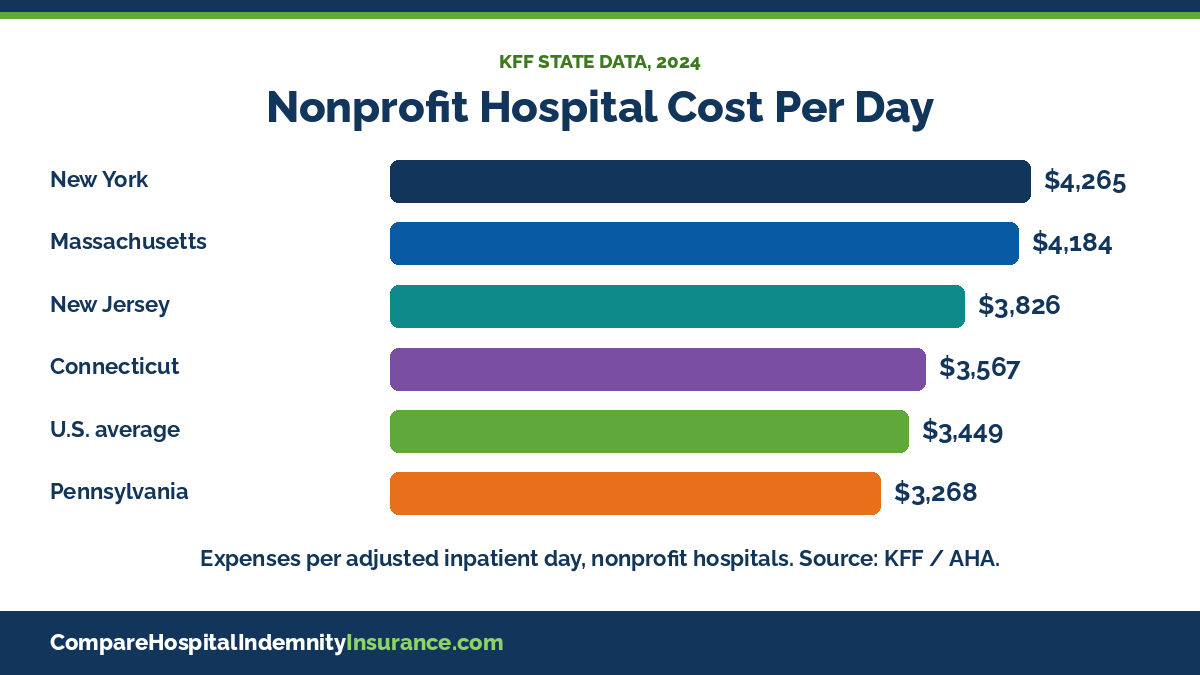
New York sits near the top of the country for hospital spending per patient day. KFF’s state data, drawn from the American Hospital Association’s 2024 annual survey, puts expenses at New York’s nonprofit hospitals at $4,265 per adjusted inpatient day, against a national nonprofit average of $3,449. These are hospital costs, not your bill, but they show why a fixed daily benefit covers a smaller slice of a stay here.

New York hospital cost markers (KFF, 2024 data)
$4,265
nonprofit hospital expense per adjusted inpatient day in New York
$3,894
same measure at state and local government hospitals in New York
$816
gap between New York and the U.S. nonprofit average per day

The practical point: a policy that pays $200 a day (example amount) is not trying to match those figures. It is meant to cover your share, such as a deductible or coinsurance, plus costs outside the hospital, like travel to a Manhattan medical center from upstate or lost hourly pay.

Russell Noga, licensed insurance agent

DFS lookup tip

The DFS Portal has an Insurance Company Search that looks up insurers by NAIC number or group. Enter the exact legal name from the certificate, such as a company of New York subsidiary, rather than the brand name. The parent brand and its New York company carry separate NAIC numbers and separate complaint records.

Russell Noga, Licensed Insurance Agent

Bar chart for hospital indemnity insurance New York buyers comparing nonprofit hospital expenses per inpatient day in New York, nearby states and the US

Which Companies Issue Hospital Indemnity in New York

We checked carrier disclosures, filed brochures and employer certificates for the company named on New York paperwork. Several carriers use a New York-only subsidiary; a few issue from their main company because it is already based here.

Carrier Company named for New York What the NY document shows
Aflac American Family Life Assurance Company of New York (Albany) Individual Hospital Advantage on NY policy forms NY49100 to NY49400; 12-month pre-existing look-back. Group HI launched in NY in July 2012.
Unum First Unum Life Insurance Company (Garden City) Group Hospital Indemnity on New York form GHIP16-1-NY, with the DFS limited-coverage notice.
Voya ReliaStar Life Insurance Company of New York Only this company is admitted in NY; New York policy form RNY-HI2-POL-18.
Guardian The Guardian Life Insurance Company of America (New York, NY) Product page carries the DFS notice that it is limited hospital insurance only.
MetLife Metropolitan Life Insurance Company (200 Park Ave., New York) Same company issues its group plan nationally; used by Long Island employers such as Catholic Health Services.
New York Life Group Benefit Solutions New York Life Insurance and Annuity Corporation (51 Madison Ave.) Columbia University 2026 certificate on form GBS-HI-CERT-1000.NY, with no pre-existing limitation.
Mutual of Omaha Companion Life Insurance Company (Melville), its New York-domiciled affiliate DFS exam lists accident and health authority; NY hospital indemnity availability not confirmed.
Cigna Supplemental (individual) None listed January 2025 availability chart shows no hospital indemnity products in New York.

Sources: carrier websites and disclosures, Aflac NY brochure NY49275, employer plan documents, DFS examination report (June 2024), Cigna Supplemental availability chart (01/2025). Products change; confirm with the carrier.

Two takeaways. First, the name on a New York certificate often differs from the brand on the flyer, and that legal name is what DFS tracks complaints under. Second, a license here does not mean every product is sold here. Profiles of these insurers sit on our hospital indemnity insurance companies page.

Waiting Periods and Pre-Existing Conditions in New York

Section 52.16(d) limits how long a probationary period can run on the policies it governs. A probationary period is a stretch after the start date when certain claims are not paid at all. Hospital plans filed in some other states can delay pregnancy benefits for many months; in New York, that kind of delay is capped at 30 days.

Specified conditions
Probationary period can be no longer than 30 days.
Pregnancy
No longer than 30 days for the inception of pregnancy, unless a statute says otherwise.
Accidents
No probationary period at all.

A probationary period is not the same as a pre-existing condition limitation, and New York allows the second. Section 52.16(c)(1) lets a policy exclude pre-existing conditions as defined in the regulation. Aflac’s New York individual brochure, for example, does not pay for a condition treated in the 12 months before coverage until 12 months after the start date, or six months for buyers 65 and older.

Watch for:

A short probationary period does not guarantee a pregnancy or a known condition is paid. Read both the probationary clause and the pre-existing clause on the New York certificate itself.

Hospital Indemnity Next to NY State of Health Coverage

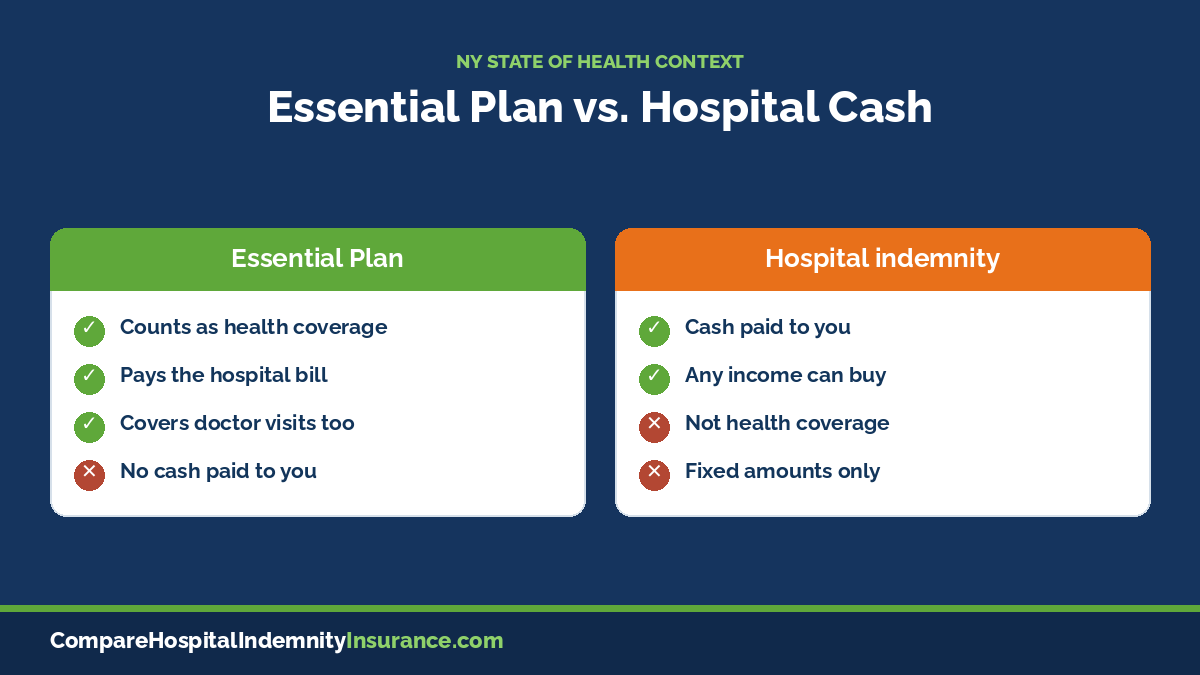
New York’s marketplace, NY State of Health, offers Medicaid, Child Health Plus, the Essential Plan and Qualified Health Plans. All of those are real health coverage. A hospital indemnity policy is not, and it cannot stand in for any of them.

  • Essential Plan changes in 2026: on July 1, 2026, New York ended its Section 1332 waiver and returned the Essential Plan to Basic Health Program rules, according to the state Department of Health.
  • Who moved: most of the roughly 450,000 enrollees with income between 200% and 250% of the federal poverty level lost Essential Plan eligibility and became eligible for Qualified Health Plans instead.
  • Who stayed: about 1.3 million people under 200% of the poverty level keep Essential Plan coverage.
  • Why it matters here: a move to a Qualified Health Plan usually brings a deductible, which is the gap a hospital cash plan is built to help with.

Key takeaway

Get major medical or Essential Plan coverage first through NY State of Health. A hospital indemnity policy only makes sense as a second layer on top.

Comparison of the New York Essential Plan and hospital indemnity insurance New York residents can add

Hospital Indemnity Quotes

Call a Licensed Agent Now

Licensed agents can pull the New York version of a plan, not the out-of-state brochure.

☎ 1-888-891-0229

No obligation to enroll

Buying Through a New York Employer vs. on Your Own

Hospital indemnity is often offered at New York workplaces as a voluntary benefit paid by payroll deduction. Group plans in the table above, from Unum, Voya, MetLife and New York Life, are issued to the employer, and you get a certificate. Individual plans, such as Aflac’s New York policy, are issued to you directly.

Group plan strengths
✔

Often guaranteed issue during the first enrollment window
✔

Some certificates, like the Columbia one, carry no pre-existing limitation
✔

Premium comes out of each paycheck
Group plan drawbacks
✕

Your employer picks the carrier and benefit levels
✕

Late enrollees may face health questions
✕

Coverage may end or need conversion when you leave the job

Group fixed indemnity plans are generally expected to pay per period, such as per day, under federal rules; our fixed indemnity insurance guide explains that standard and the tax treatment of pre-tax premiums.

Checking a New York Policy Before You Enroll

1
Match the company name. Find the legal insurer on the certificate or outline of coverage and confirm it is a New York company or licensed here.
2
Look for the NY form number. A New York form usually carries an NY marker. A brochure without one may describe an out-of-state version.
3
Find the DFS notice. The limited-coverage statement should be printed on the application or certificate.
4
Read the probationary and pre-existing clauses. Compare them with the 30-day caps in section 52.16(d).
5
Know where to complain. DFS takes consumer complaints about insurers licensed in New York.

Free comparison

Line Up New York Hospital Cash Plans Side by Side

Compare admission and daily amounts from New York-licensed insurers.

Plan availability, eligibility, and benefits vary by state and policy.

Hospital Indemnity in New York: Common Questions

➤ Is hospital indemnity insurance legal to sell in New York?

Yes. DFS treats it as limited benefits health insurance under 11 NYCRR Part 52, and insurers must file New York forms before selling it.

➤ Does hospital indemnity count as coverage on NY State of Health?

No. It is not minimum essential coverage and cannot replace Medicaid, the Essential Plan or a Qualified Health Plan. New York also has no state tax penalty for going without coverage.

➤ Why does my Aflac or Voya paperwork show a different company name in New York?

Many carriers issue New York policies through a separate New York company, such as American Family Life Assurance Company of New York or ReliaStar Life Insurance Company of New York. That entity is the one DFS regulates.

➤ Which carriers offer hospital indemnity through work in New York?

Employer documents and carrier disclosures show group plans from MetLife, Unum, Voya, Guardian, New York Life and Aflac’s New York company.

➤ Can a New York hospital indemnity policy make me wait a year for pregnancy?

Section 52.16(d) caps a probationary period for the inception of pregnancy at 30 days on the policies it governs. A pre-existing condition clause can still limit a pregnancy that began before coverage.

➤ What is the best hospital indemnity plan for fixed payments during a New York hospital stay?

Look for a daily confinement benefit with a long day limit, plus an admission benefit. Aflac’s New York individual policy, for example, lists up to 365 days per confinement.

➤ Where can I complain about a hospital indemnity claim in New York?

File with the insurer first, then with DFS, which handles complaints about insurers licensed in the state. Use the legal company name on your certificate.

Free Plan Comparison

Call a Licensed Agent Now

Compare cash benefits from New York-licensed insurers before you enroll.

☎ 1-888-891-0229

No obligation to enroll

Russell Noga, licensed insurance agent

About the Author: Russell Noga

Russell Noga is a licensed insurance agent and the founder of ZRN Health & Financial Services, LLC. He has helped people compare health and supplemental insurance for more than 16 years and reviews every page on Compare Hospital Indemnity Insurance before it is published. Learn more about us or read our Editorial Standards.

CompareHospitalIndemnityInsurance.com is operated by ZRN Health & Financial Services, LLC, a Texas limited liability company based in Austin, Texas. We are not connected with or endorsed by any government agency.