What Workplace Hospital Care Pays For
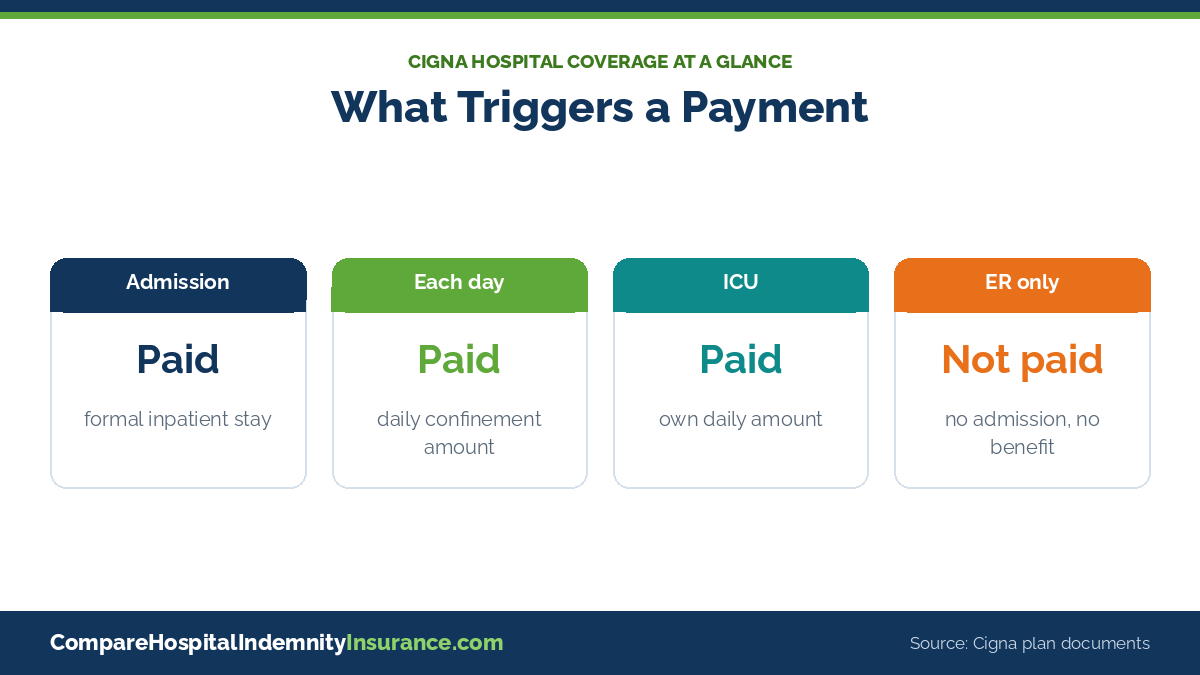
Cigna’s 2024 Hospital Care benefit guide template (form 984180 08/24) describes the core plan as a fixed cash benefit for a covered hospital stay, such as an inpatient procedure or childbirth. Employers then choose the amounts and any extra benefit lines.
| Benefit line |
What triggers it |
Frequency limit in Cigna documents |
| Hospital admission |
Formal inpatient admission for a covered illness or injury |
One day per admission; the 2024 template says one benefit every 365 days, while older employer plans use 90 days |
| Hospital stay |
Each day confined as an inpatient under a physician’s care |
Up to 30 days, one benefit every 90 days |
| ICU stay |
Each day in an intensive care unit |
Up to 30 days, one benefit every 90 days |
| Observation stay (optional) |
More than 24 hours of non-inpatient hospital or surgery center care |
Paid after a 24-hour elimination period, capped at 72 hours |
| Chronic condition admission (optional) |
Inpatient admission for a covered chronic condition treated by a specialist |
One benefit every 90 days |
| Newborn and wellness lines (optional) |
Nursery admission; a covered screening or immunization |
Set by the employer’s plan design |
Sources: Cigna Hospital Care benefit guide template 984180 08/24 (Cigna Health and Life Insurance Company); Cigna Hospital Care summary for group policy HC 960253, form GHIP-00-1000.00 (2018). Checked Nov. 2026.
Two rules that cut payouts:
When a day qualifies for both the hospital stay and ICU benefit, only the larger one is paid. Stays for the same or a related condition that fall close together count as a single stay, so a quick readmission does not restart the 30-day count.
Pregnancy and its complications count as a covered illness in the group form. Some employers go further: the University of Richmond’s Hospital Care page lists pregnancy as covered from day one, with no pre-existing condition clause.
What the Individual Cigna-Branded Policy Pays For
The individual Hospital Indemnity policy, as described on its Cigna product page in November 2026, pays the fixed confinement amount you select at application for a covered hospitalization. It comes in Choice Core, Choice Preferred and Choice Premier options, lists issue ages of 18 to 89, and is not sold in Massachusetts, New Jersey, New Mexico or New York.
- Base policy: a daily hospital confinement benefit at the amount you chose, paid regardless of what the hospital charges.
- Hospital Admission rider: a separate lump sum for an inpatient admission. It is optional and costs extra.
- Intensive Care rider: doubles the confinement benefit for days spent in an ICU.
- Ambulance rider: pays for ground, water or air transport with no admission required.
- Outpatient Diagnostic Exam and X-ray rider: pays for x-rays and major diagnostic exams at a hospital, urgent care center, ER or physician’s office.
Riders are not available in every state, and the policy may carry an annual payout limit.
Covered vs Not Covered: Group and Individual Side by Side
No single Cigna document lines the two products up. The table below does, using the group benefit guide and summaries for Hospital Care and the filed state disclosures for the individual LY-HIP-BA policy.
| Event or service |
Group Hospital Care |
Individual Hospital Indemnity |
| Inpatient admission |
Covered |
Covered with the Hospital Admission rider |
| Daily hospital confinement |
Covered, up to 30 days |
Covered at the amount selected |
| ICU days |
Covered, separate daily amount |
Covered with the Intensive Care rider |
| Observation stay |
Only if the employer added it |
No observation benefit listed |
| ER visit with no admission |
Not covered |
Not covered by the base policy |
| Outpatient x-rays and diagnostic exams |
Not in the summaries reviewed |
Covered with the diagnostic rider |
| Ambulance |
Not in the summaries reviewed |
Covered with the Ambulance rider |
| Routine pregnancy and childbirth |
Covered; some designs exclude pregnancy early in coverage |
Excluded, except complications and non-elective miscarriage |
| Cosmetic or elective surgery |
Excluded, with reconstructive exceptions |
Excluded, with reconstructive exceptions |
| Weight-loss surgery |
Not named as an exclusion |
Excluded |
| Rehab, hospice or custodial facility |
Not a hospital under the plan |
Not a hospital under the policy |
Our comparison. Sources: Cigna Hospital Care guide 984180 08/24 and employer summaries; Loyal American LY-HIP-BA state disclosures posted on cigna.com. Your certificate or policy controls. Checked Nov. 2026.
The biggest split
Childbirth is the event where the two products part ways most sharply. A workplace Hospital Care plan generally treats a delivery admission as a covered stay, while the individual policy excludes routine pregnancy and childbirth outright.
Coverage check
Cigna Hospital Care pays the core benefits only after a formal inpatient admission. The hospital assigns inpatient or observation status, and the itemized bill or discharge summary shows which one applied, so that record is worth requesting before a claim goes in.
Russell Noga, Licensed Insurance Agent
Pre-Existing Conditions, Waiting Periods and Look-Backs
Timing rules decide whether an otherwise covered stay pays, and the individual policy’s rule changes by state.
Timing rules in Cigna’s documents
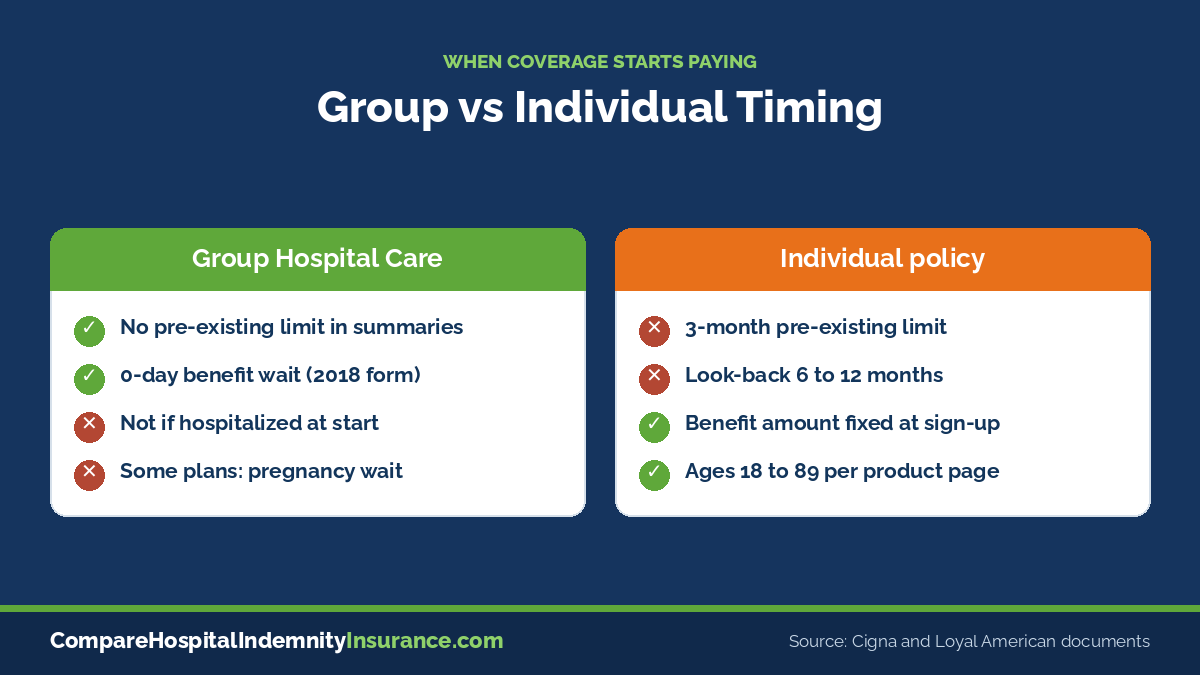
0 days
benefit waiting period in the 2018 group Hospital Care summary unless the plan states otherwise
3 months
pre-existing condition limitation on the individual policy after it takes effect
12 months
look-back for a pre-existing condition in Alabama’s individual policy disclosure
6 months
look-back in Arizona’s disclosure for the same policy
Under the individual policy, a condition diagnosed or treated during the look-back window will not trigger benefits during the first three months of coverage. Group summaries from employers such as Jay Peak Resort and the City of Hastings state there is no pre-existing condition limitation. One group catch remains: coverage does not start for someone hospitalized or disabled on the effective date, and late enrollees may need evidence of insurability.