Speak with a licensed insurance agent

1-888-891-0229

MetLife Hospital Indemnity Low vs High: Paycheck Cost, Payout Gap and a Rule for Choosing

Reviewed by Russell Noga, Licensed Insurance Agent — Last updated November 7, 2026

MetLife hospital indemnity low vs high comes down to one trade: the High option pays a larger fixed check when you are admitted, and on most posted menus a larger daily amount too, while costing roughly 1.4 to 2.2 times the Low deduction. Choose High only if your odds of a hospital stay next year beat the extra yearly premium divided by the extra payout per stay; otherwise Low is the better buy.

Add-on plans

Is Your MetLife High Option Still Not Enough?

Enter your ZIP to see individual hospital indemnity plans you can add on top.

Plan availability, eligibility, and benefits vary by state and policy.

Your employer, not MetLife nationally, sets both amounts, so the gap differs at every company. Below, three MetLife menus that employers posted publicly are turned into per-paycheck and yearly costs, along with the side benefits that move when you upgrade. For how the product works, see our MetLife hospital indemnity guide; for other insurers, our list of hospital indemnity insurance companies. You can also compare hospital indemnity insurance sold outside of work.

Both options are the same limited-benefit fixed indemnity policy. Neither one is health insurance, neither replaces your medical plan, and neither counts as minimum essential coverage.

Pick in a sentence

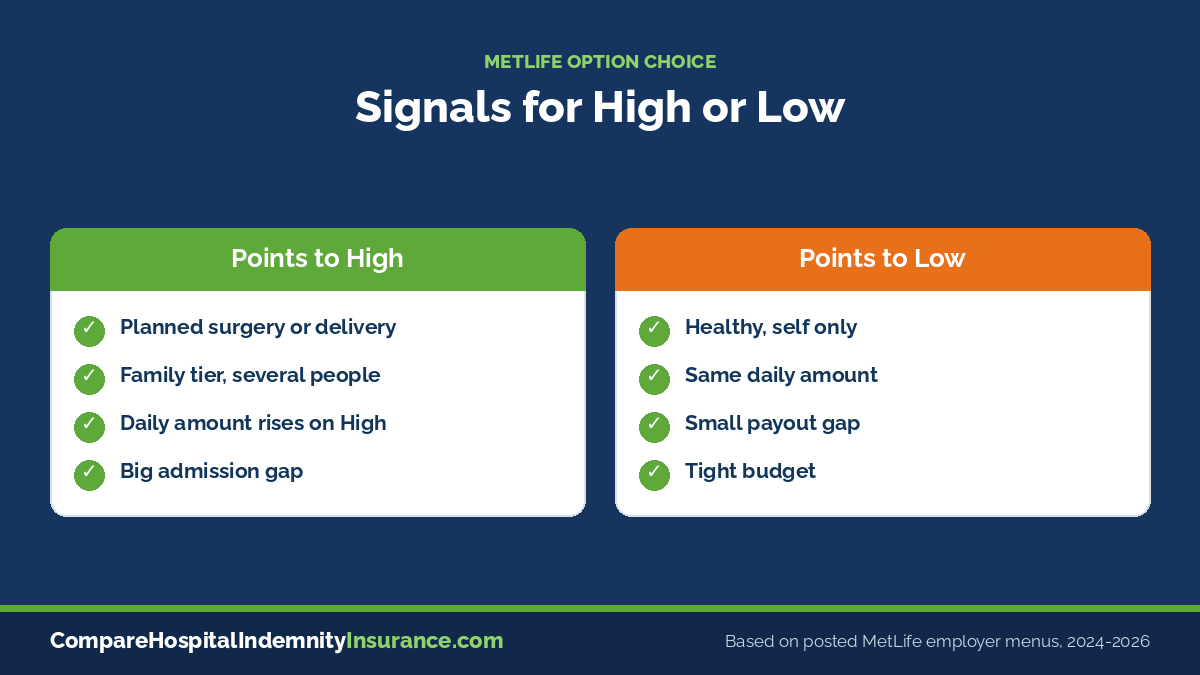
Take MetLife’s High option when a planned surgery, a likely delivery, a chronic condition or several covered family members make a hospital admission next year more likely than the upgrade’s break-even odds; take Low when you are healthy, covering only yourself, and the payout gap per stay is small.

How MetLife Labels and Builds the Two Options

On a MetLife workplace menu, Low and High are two benefit levels inside one group certificate. Claim rules, the hospital definition and the exclusions stay put; only the dollar figures your employer negotiated change.

Low option
The cheaper deduction. Usually the base admission and daily amounts, sometimes with smaller side benefits.
High option
Larger lump sums and, on many menus, a larger daily amount. Some employers call it the Highest Plan instead.
What never moves
Guaranteed acceptance while actively at work, the pre-existing condition wording, the age 65 reduction note and portability.

La Feria ISD in Texas calls its upper level the Highest Plan. The label says nothing about how far apart the levels sit, so read the numbers line by line.

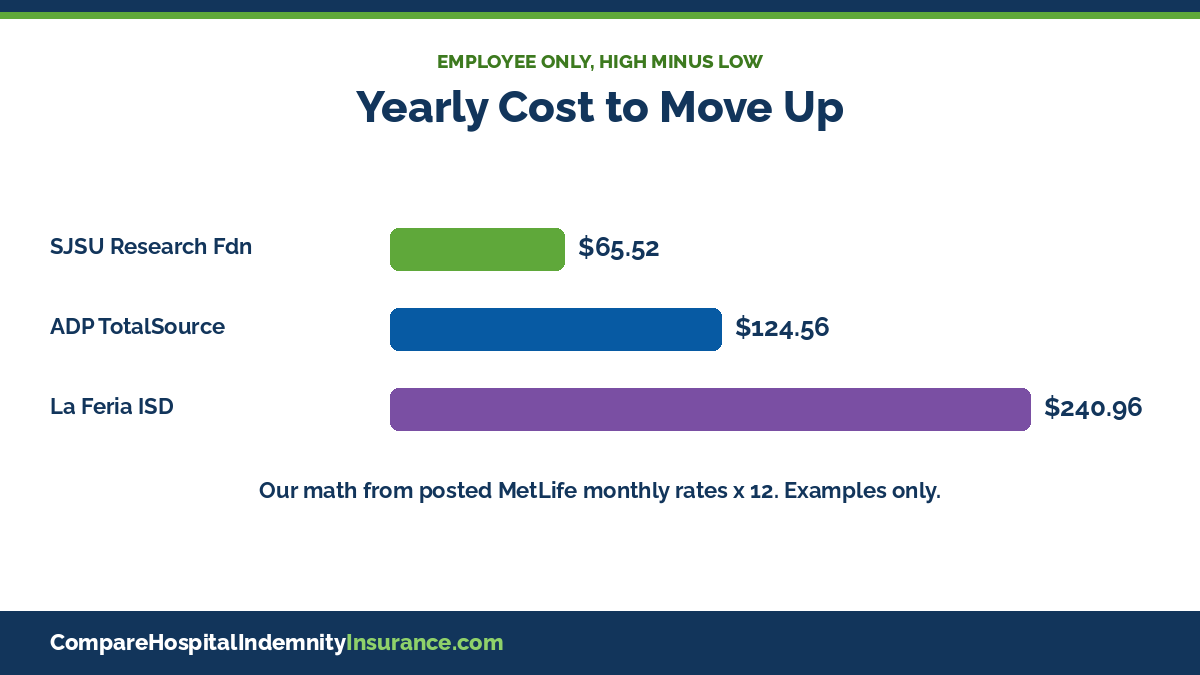
MetLife hospital indemnity low vs high yearly upgrade cost for employee-only coverage on three posted employer menus

Three Posted MetLife Menus With Low and High Side by Side

These menus come from MetLife plan summaries posted for workers, and none appears on our other MetLife pages. Each figure reads Low / High.

Line (Low / High) ADP TotalSource, PY 6/1/2024-5/31/2025 La Feria ISD, TX, eff. 1/1/2026 SJSU Research Foundation, eff. 1/1/2024
Admission $500 / $1,000, up to 5 a year $1,000 / $4,000, up to 4 a year $500 / $1,000, once a year
Daily confinement $100 / $200, up to 365 days No daily line in the summary $100 / $100, up to 31 days
ICU add-ons $500 / $1,000 admission; $100 / $200 a day Not listed Not listed
Inpatient rehab $100 / $200, 30 days a year $100 / $300, 15 days a year Not listed
Health screening $50 / $100 $50 / $50 $50 / $50
Employee only, monthly $10.49 / $20.87 $17.18 / $37.26 $14.33 / $19.79
Employee and family, monthly $25.25 / $50.71 $44.64 / $89.93 $36.52 / $50.26

Sources: MetLife Voluntary Hospital Indemnity plan summary and FAQ posted on Aon’s ADP TotalSource benefits site (plan year June 1, 2024 to May 31, 2025); MetLife hospital plan summary posted for La Feria ISD (coverage effective Jan. 1, 2026); MetLife hospital indemnity summary posted by the San Jose State University Research Foundation (effective Jan. 1, 2024). Examples only; the group certificate controls. Checked Nov. 2026.

Read across the rows

The SJSU Research Foundation High option raises only the admission check, leaving the $100 daily amount flat. That is why its upgrade costs just $5.46 a month for one person, while La Feria’s quadrupled admission costs $20.08 a month more.

Paycheck Math: The Premium Difference by Coverage Tier

The figure that matters is the gap between the Low and High deductions, because that is what the upgrade costs you. The table converts each menu’s monthly gap into a yearly cost and an approximate amount per biweekly paycheck.

Coverage tier ADP TotalSource gap La Feria ISD gap SJSU Research Foundation gap
Employee only $10.38 a month, $124.56 a year $20.08 a month, $240.96 a year $5.46 a month, $65.52 a year
Employee and spouse $16.14 a month, $193.68 a year $33.87 a month, $406.44 a year $11.01 a month, $132.12 a year
Employee and children $20.11 a month, $241.32 a year $31.50 a month, $378.00 a year $8.20 a month, $98.40 a year
Employee and family $25.46 a month, $305.52 a year $45.29 a month, $543.48 a year $13.74 a month, $164.88 a year
Employee only, per biweekly check about $4.79 about $9.27 about $2.52

Our math from the monthly rates in the three summaries: High minus Low, times 12. Biweekly figures assume 26 paychecks a year; your payroll schedule may differ.

  • Family tiers cost more to upgrade in dollars, but every covered person can trigger an admission check, so the payout side grows too.
  • The ratio is not fixed. High costs about twice Low at ADP TotalSource and La Feria, but only about 1.4 times Low at the SJSU Research Foundation.

Which MetLife Extras Change When You Upgrade

Side benefits are where MetLife menus differ most. Some scale with the level you pick and some pay the same either way, so part of the High column is not extra value at all.

Extras on the posted menus
  • ✔
    Health screening: rises from $50 to $100 per covered person at ADP TotalSource, but stays at $50 on both levels at La Feria ISD and the SJSU Research Foundation
  • ✔
    Newborn nursery care: $100 / $200 a day for up to 2 days at ADP TotalSource, while the University of Utah summary (effective July 1, 2024) pays $50 a day on both levels
  • ✔
    Inpatient rehabilitation: doubles at ADP TotalSource and the University of Utah, and triples at La Feria ISD, from $100 to $300
  • ✔
    Companion lodging: $100 / $200 for up to 30 days a year at ADP TotalSource, after a prior hospital stay and only in some states
  • ✔
    Surgery, ER and ambulance lines at La Feria ISD: $250, $150 and $50, identical on Low and Highest

Count only what changes:

Leave any extra that pays the same on both levels out of the upgrade math. At La Feria ISD, almost all added value sits in the admission check and rehab.

Russell Noga, licensed insurance agent

Paycheck math

The cost of the High option is the gap between the two deductions, not the High rate. On the ADP TotalSource 2024-25 menu, that gap for employee-only coverage is $10.38 a month, about $4.79 on a 26-paycheck schedule, and it buys $500 more per admission plus $100 more per covered day.

Russell Noga, Licensed Insurance Agent

MetLife hospital indemnity low vs high signals that point to the High option compared with signals that point to Low

Break-Even Odds: How Likely a Stay Has to Be

Divide the extra yearly premium by the extra check for one stay. The result is the yearly chance of an admission at which both levels cost the same on average; if your odds are higher, High comes out ahead.

Example: employee only, one 3-day stay with no ICU
17.8%
ADP TotalSource: $124.56 a year buys $700 more for this stay
8.0%
La Feria ISD: $240.96 a year buys $3,000 more per admission
13.1%
SJSU Research Foundation: $65.52 a year buys $500 more per admission
6.6% / 8.7%
Share of adults 18-44 and 45-64 with one or more hospital stays in 2019

The adult figures come from the National Center for Health Statistics hospital-stay table in Health, United States, and include childbirth admissions. The ADP TotalSource math assumes daily pay starts on day 2, as its summary states. All are labeled examples.

What the odds say:

For an average healthy adult covering only themselves, none of the three upgrades clears its break-even odds. A known reason for a stay, or a family tier where several people could be admitted, changes that answer quickly.

Switching Options at Open Enrollment

MetLife summaries tie enrollment to your employer’s enrollment period and require you to be actively at work, with coverage guaranteed and no health questions. None of the posted summaries states a separate rule for moving from Low to High later.

1
Check whether your choice rolls over. The ADP TotalSource FAQ says that if you make no changes during annual enrollment, your prior plan year choices carry forward.
2
Make the change during the window. Open enrollment or a new-hire period is the time to move up or down. Outside it, a change usually needs a qualifying life event under your employer’s rules.
3
Ask about the pre-existing clock. Several summaries note a possible pre-existing condition limit on sickness benefits. Ask HR whether an increase in benefits is treated as new coverage for that limit.
4
Confirm any late-entrant rules. If you skipped coverage before and want to join later, ask whether your group requires health questions or evidence for late applicants.

Hospital Indemnity Quotes

Call a Licensed Agent Now

Weighing MetLife’s upgrade? Licensed agents can price an individual plan to compare against it.

☎ 1-888-891-0229

No obligation to enroll

The Decision Rule, With Labeled Examples

Rule

Extra yearly premium divided by extra payout per stay equals the break-even odds. Pick High only when your realistic chance of an admission next year is above that number, and pick Low otherwise.

  • Example A, single and healthy, ADP TotalSource menu: break-even odds are about 18%, well above the typical adult rate, so Low is the better buy.
  • Example B, knee replacement scheduled for spring, La Feria ISD menu: a planned admission makes the odds close to certain, and $240.96 a year buys $3,000 more, so Highest wins, provided the pre-existing condition limit does not apply to the increase.
  • Example C, family of four, SJSU Research Foundation menu: $164.88 a year buys $500 more per admission for each covered person, so one admission in the next three years would cover it. High is reasonable if anyone in the household has frequent stays.
  • Example D, long stays expected, SJSU Research Foundation menu: the daily amount is flat across levels, so High adds only the one-time admission gap.

For the same choice at other carriers, see our guide to hospital indemnity low vs high plans. To see full MetLife schedules line by line, use our MetLife hospital indemnity payout chart.

Side-by-side quotes

Price an Individual Plan Before You Pay for the Upgrade

See admission and daily amounts from carriers licensed in your state.

Plan availability, eligibility, and benefits vary by state and policy.

MetLife Low vs High: Questions Employees Ask

➤ Is the MetLife High option always double the Low option?

No. ADP TotalSource doubles most lines, La Feria ISD quadruples the admission check, and the SJSU Research Foundation doubles the admission but keeps the daily amount flat.

➤ Which MetLife option is best for lower premiums with strong fixed payments during a hospital stay?

Low has the lower premium, but the daily confinement line is what keeps paying during a long stay. If your menu raises the daily amount on High, that matters more for long admissions than the admission check.

➤ Can I switch from Low to High in the middle of the year?

Usually only with a qualifying life event under your employer’s rules. Otherwise the change waits for the next open enrollment, and some menus roll your prior choice forward if you do nothing.

➤ Does picking High change what MetLife covers?

No. Both levels share the same certificate, so the definition of a stay, the exclusions and the pre-existing condition wording are the same. Only the dollar amounts and some side benefits change.

➤ Can I keep the High option if I leave my job?

MetLife summaries say coverage can continue if you keep paying premiums, subject to eligibility rules, and the level you held at work carries over.

Free Benefit Comparison

Call a Licensed Agent Now

See admission and daily amounts from several carriers before your enrollment window closes.

☎ 1-888-891-0229

No obligation to enroll

Russell Noga, licensed insurance agent

About the Author: Russell Noga

Russell Noga is a licensed insurance agent and the founder of ZRN Health & Financial Services, LLC. He has helped people compare health and supplemental insurance for more than 16 years and reviews every page on Compare Hospital Indemnity Insurance before it is published. Learn more about us or read our Editorial Standards.

CompareHospitalIndemnityInsurance.com is operated by ZRN Health & Financial Services, LLC, a Texas limited liability company based in Austin, Texas. We are not connected with or endorsed by any government agency.