Three Real Employer Menus, Low and High Side by Side
No carrier publishes one national Low and High schedule, because each employer group sets its own amounts. The figures below are copied from benefit summaries three employers posted for their staff, built with three different carriers.
| Benefit (Low / High) |
Dartmouth College, Cigna |
Houston ISD, Aflac Group |
Mesquite ISD, Aetna |
| Admission |
$1,000 / $2,000 |
$300 / $500 |
$500 / $2,000 |
| Daily hospital stay |
$100 / $200, up to 31 days |
$75 / $150, stays up to 365 days |
$100 / $300 |
| ICU daily |
$200 / $400, up to 31 days |
No separate ICU line shown |
$200 / $300 |
| Day or stay limits |
31 days for stay and ICU |
One admission per covered accident, sickness or pregnancy |
2 admissions a plan year, 30 days apart; 15 inpatient days a plan year combined |
| Observation |
$100 / $200 per 24 hours, 72 hours max |
Not shown |
Not shown |
| Employee-only premium |
$11.23 / $22.27 a month |
$2.36 / $4.48 per pay period |
$0.00 (employer paid) / $21.28 a month |
| Employee and family premium |
$25.98 / $51.80 a month |
$6.23 / $11.71 per pay period |
$10.15 / $65.90 a month |
Sources: Cigna Hospital Care benefit summary posted by Dartmouth College (Plan 1 = Low, Plan 2 = High; group policy HC110988; 2026 copyright, plan year not stated); Aflac Group hospital indemnity page posted by Houston ISD (plan year not stated); Aetna Hospital Indemnity summary posted for Mesquite ISD (2024 summary; Low is the employer-paid plan, High is the buy-up). Checked Nov. 2026. Examples only; your certificate controls.
What the table shows
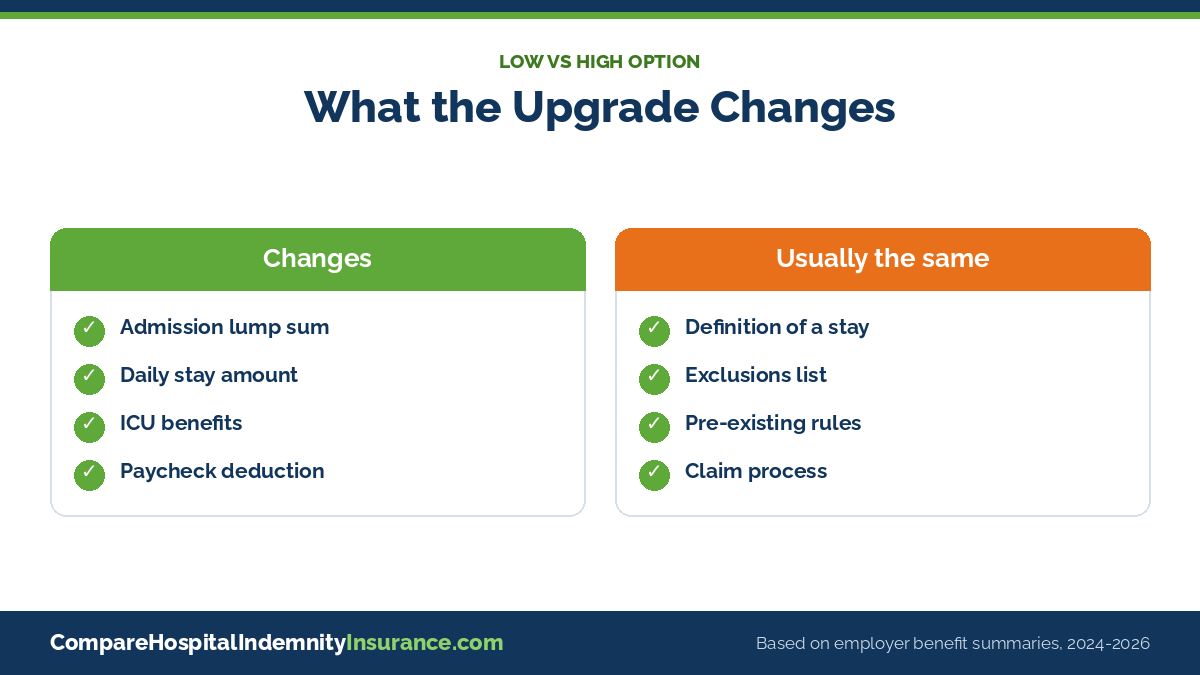
The size of the step from Low to High is not standard. Cigna’s menu doubles every line, Aflac’s raises admission by about two thirds, and Aetna’s quadruples the admission while raising the ICU rate by only half. Read the gap line by line instead of assuming High simply means twice the coverage.
If your employer pays for the Low option, as Mesquite ISD’s does, picking High means trading free coverage for a monthly bill, so weigh the added benefit against the full buy-up rate.
The Upgrade Math: Extra Premium Against the Extra Check
Whether the coverage is worth having at all is a separate question, covered in our look at hospital indemnity insurance cost. Choosing a level needs only the difference in premium and payout.
1
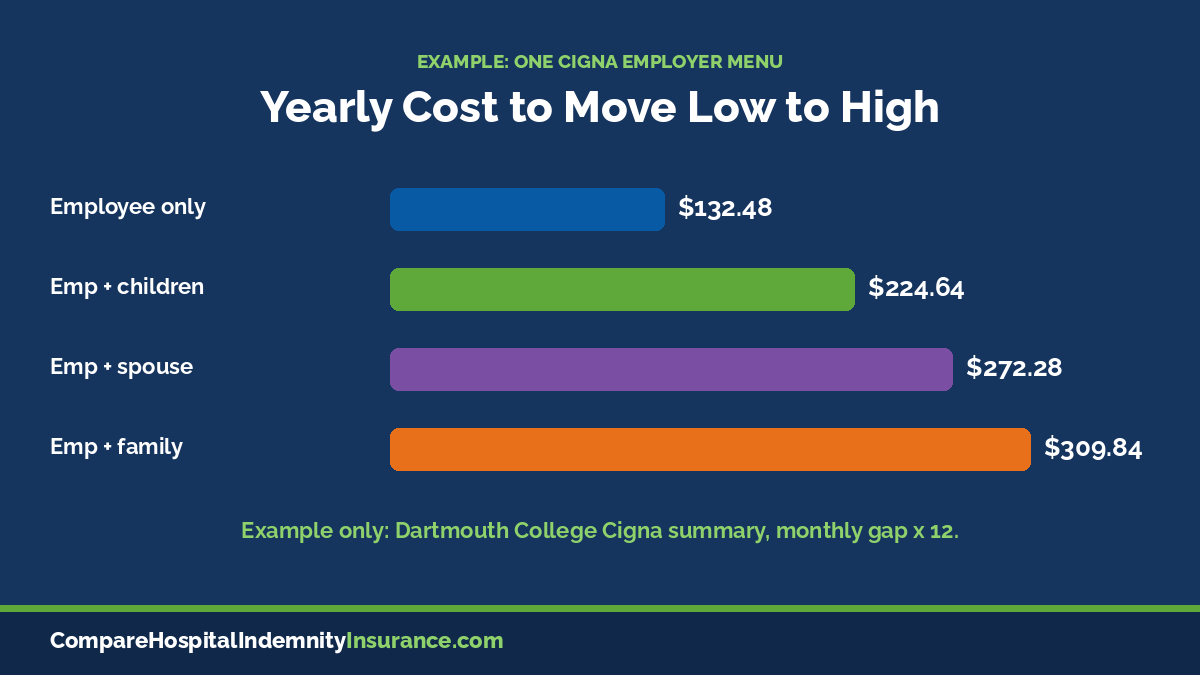
Subtract the premiums. Example using the Dartmouth Cigna rates for one employee: $22.27 minus $11.23 is $11.04 a month, or $132.48 a year to move from Low to High.
2
Subtract the payouts for a likely stay. Example two-day stay, assuming both days qualify for the daily benefit: Low pays $1,000 plus $200, or $1,200. High pays $2,000 plus $400, or $2,400. The upgrade adds $1,200.
3
Divide the extra check by the extra premium. $1,200 divided by $132.48 is about 9. One such stay would cover roughly nine years of the upgrade cost.
4
Ask how likely that stay is. If a stay within the next several years is a real possibility, the upgrade pays for itself. If no stay happens, the extra $132.48 a year is simply spent.
Run the same steps with your own menu. On Aetna’s Mesquite design the admission gap alone is $1,500, while on Aflac’s Houston ISD design both the payout gap and the premium gap are smaller.
Upgrade-decision note
The cost of moving from Low to High is the premium difference, not the High premium. On a menu where the Low option is employer paid, the full buy-up rate is the price of the upgrade, so compare that rate only with the added admission and daily amounts.
Russell Noga, Licensed Insurance Agent
Tie the Choice to Your Medical Plan’s Deductible
A fixed indemnity check is most useful when it lands against bills you would otherwise pay out of pocket. The size of your medical plan’s deductible and out-of-pocket maximum is the clearest signal of how much cash a stay could cost you.
IRS limits for HSA-qualified high-deductible plans, 2026
$1,700
minimum deductible, self-only coverage
$3,400
minimum deductible, family coverage
$8,500
maximum out-of-pocket, self-only
$17,000
maximum out-of-pocket, family
Those figures come from IRS Revenue Procedure 2025-19. On a high-deductible plan near those numbers, one inpatient stay can reach the full deductible, and a larger High admission amount closes more of that gap. With a deductible of a few hundred dollars, a Low option may already cover what you would owe.
HSA holders:
Federal tax law lists insurance that pays a fixed amount per day or other period of hospitalization as permitted coverage, so a hospital-only indemnity plan at either level does not by itself end HSA eligibility. Aetna’s summary for one employer states plainly that HSA holders can still enroll. Riders that pay for outpatient doctor visits or tests before the deductible deserve a question to HR before enrolling.