Speak with a licensed insurance agent

1-888-891-0229

How Much Does Hospital Indemnity Pay? Real Benefit Amounts and Example Checks

Reviewed by Russell Noga, Licensed Insurance Agent — Last updated November 14, 2026

Hospital indemnity usually pays a fixed admission benefit of $500 to $2,000 plus $100 to $200 for each covered day in the hospital, so an example five-day stay pays about $900 to $3,000 on the seven employer plans compared on this page. The money goes to you in cash, whatever the hospital charges.

Benefit check

See What Plans Near You Would Pay Per Stay

Compare admission and daily benefit amounts from several insurers.

Plan availability, eligibility, and benefits vary by state and policy.

Your exact check depends on the amounts in your plan’s schedule, the day your daily benefit starts, any intensive care days, and the plan’s limits and exclusions. Below, we line up posted plans from Aetna, Aflac, Cigna, Lincoln Financial, MetLife, Unum and Guardian, work out 3-day and 5-day payouts, and measure those checks against a typical deductible. For every benefit type, see our guide to hospital indemnity insurance coverage, or compare hospital indemnity insurance plans sold in your state.

Keep one point in mind throughout. These are supplemental, limited-benefit policies that pay fixed dollar amounts. They are not health insurance, they are not minimum essential coverage, and they do not replace a major medical plan.

Bottom line first

Hospital indemnity pays a flat amount when you are admitted, often $500 to $2,000, plus a set daily amount, often $100 to $200, so an example five-day stay pays roughly $900 to $3,000 depending on the plan level and the carrier’s day-count rule.

The Payout Formula: Admission Plus Days

Hospital indemnity does not look at your bill. The insurer multiplies its own fixed amounts by the events in your claim. For an ordinary inpatient stay, the math has three parts.

1
Admission benefit. One lump sum when you are formally admitted as an inpatient. Plans cap how often it pays, such as once per calendar year or up to four admissions a year.
2
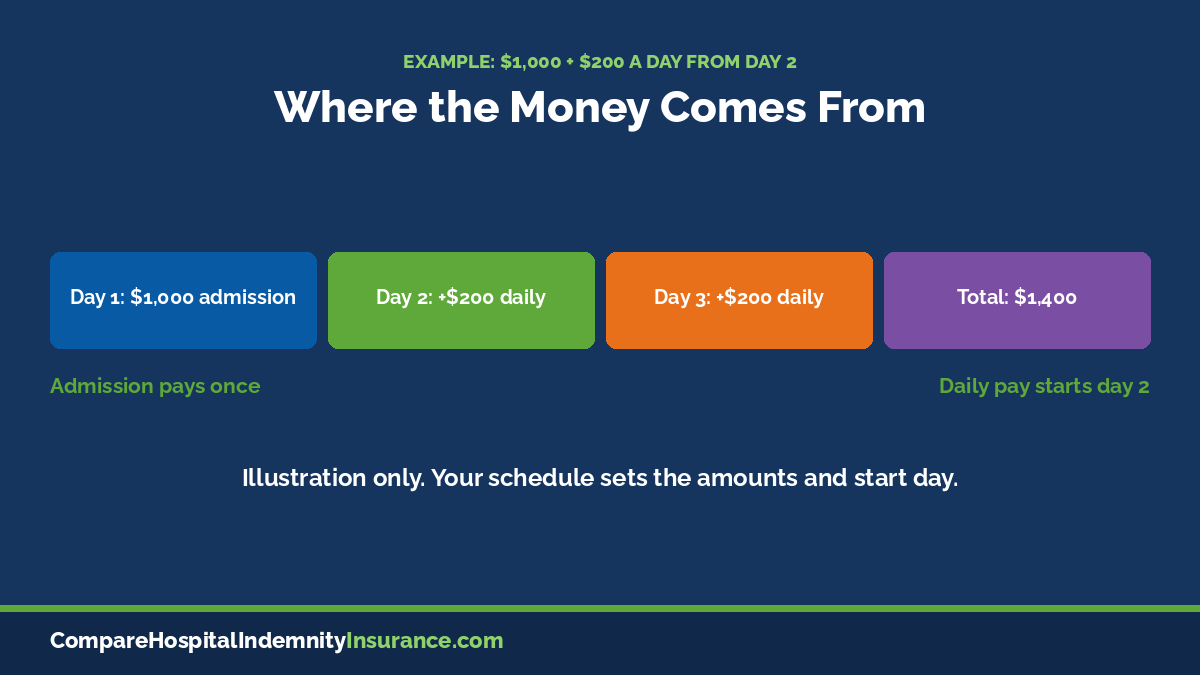
Daily confinement benefit. A set amount for each day you stay, up to a day limit. Some plans pay from the first day; others start the daily amount on day 2 because the admission benefit covers day 1.
3
Intensive care extra. A higher daily amount, or a second payment on top of the regular daily benefit, for days in an ICU. Day limits are usually shorter.
4
Optional add-ons. Observation, emergency room, outpatient surgery or rehab benefits pay only if your plan includes them.

For scale, the federal Healthcare Cost and Utilization Project (HCUP) put the average inpatient stay at 4.6 days and the average hospital cost at $11,700 per stay in its 2016 data. More recent American Hospital Association figures compiled for 2023 show nonprofit hospitals spending an average of $3,288 per adjusted inpatient day. A plan paying $1,000 to admit and $200 a day covers a slice of costs that size, which is why these plans work best as cash for deductibles, coinsurance, travel and lost pay.

How Much Each Carrier Pays: Seven Posted Plans

Searches for how much Cigna, Aetna, Aflac or Unum hospital indemnity pays all lead to the same answer: it depends on the menu your employer picked. So we took one posted plan per carrier, copied the scheduled amounts, and did the arithmetic for two example stays. Day counts follow each summary’s own rule; where a summary does not say when daily pay starts, we counted every day and flagged it.

Posted plan Admission Daily 3-day stay 5-day stay
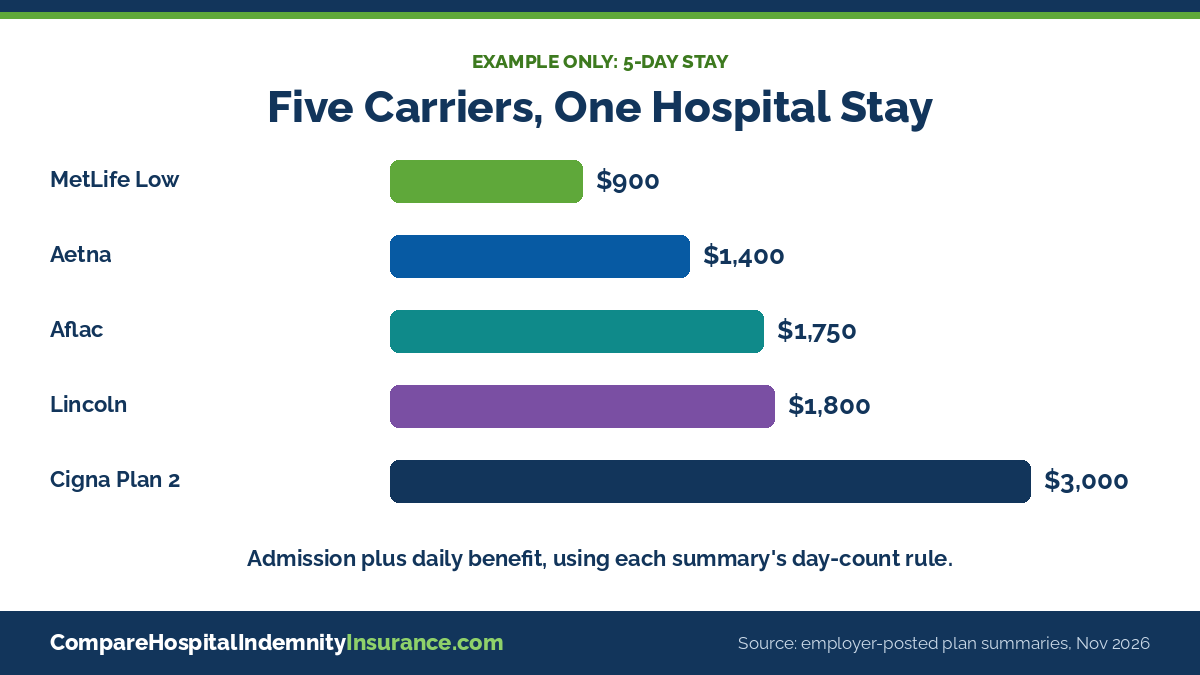
Aetna, Bates College (2026) $1,000 $100 from day 2 $1,200 $1,400
Aflac, Jordan School District, UT (2025-26) $1,000 $150 a day $1,450 $1,750
Cigna Hospital Care, Plan 1 / Plan 2 (HC110988) $1,000 / $2,000 $100 / $200 a day $1,300 / $2,600 $1,500 / $3,000
Lincoln Financial county employer plan $1,000 $200 from day 2 $1,400 $1,800
MetLife, Kansas state employees, Low / High (2026) $500 / $1,000 $100 / $200 from the day after admission $700 / $1,400 $900 / $1,800
Unum, New Mexico State Choice 1 (2023) $2,000 $200 a day* $2,600 $3,000
Guardian sample design $2,000 $100 a day* $2,300 $2,500

Our calculations from employer-posted plan summaries and brochures, checked Nov 2026. *Daily start day not stated in the summary; every day counted. Examples only, not quotes; the certificate controls.

Three things jump out. Admission amounts swing fourfold, from $500 to $2,000, while daily amounts sit between $100 and $200. A plan that starts daily pay on day 2 pays one fewer daily amount on every stay, which costs $100 to $200 a claim. And the cheapest and richest designs here differ by $2,100 on the same five-day stay. Carrier-by-carrier detail sits on our Aflac hospital indemnity payout chart and MetLife hospital indemnity payout chart pages, and our review of hospital indemnity insurance companies compares the insurers.

Russell Noga, licensed insurance agent

Day-count check

Several posted schedules start the daily benefit on the day after admission, so a three-day stay can pay two daily amounts instead of three. The schedule page of the certificate states which day counts first, and that line changes the check by $100 to $200 on every stay.

Russell Noga, Licensed Insurance Agent

Bar chart of how much hospital indemnity pays for an example 5-day stay on posted Aetna, Aflac, MetLife, Lincoln and Cigna plans

Extra Benefits for ICU, Observation, the ER and Outpatient Care

The admission and daily benefits drive most checks, but the add-ons decide whether a short or unusual visit pays anything at all.

  • Intensive care. Most plans pay more for ICU days. On the Lincoln plan, the first ICU day pays $2,000 and later ICU days pay $400. On the Aflac group plan, the $100 ICU amount is added to the $100 daily benefit, for $200 per ICU day.
  • Observation. The Cigna plan pays $100 or $200 per 24 hours of observation after more than 12 hours of care, up to 72 hours. The Aflac group brochure says no benefit is paid for observation unit stays.
  • Emergency room and urgent care. Guardian lists $150 for an ER visit as an optional benefit. Several plans in the table pay nothing for an ER visit that does not end in an admission.
  • Outpatient surgery. Guardian offers $1,000 or $2,000 per day depending on the surgery category, as an option the employer can add.

What a Payout Covers Next to Your Real Bills

A check only matters next to what you owe. We measured four example five-day payouts from the table against three benchmarks: the average single-coverage deductible in job-based plans for 2025 ($1,886, KFF Employer Health Benefits Survey), the 2026 federal out-of-pocket ceiling for self-only coverage ($10,600), and five days of nonprofit hospital expense at the 2023 average of $3,288 a day ($16,440).

Example 5-day payout Amount Share of $1,886 deductible Share of $10,600 out-of-pocket max Share of $16,440 hospital expense
MetLife Low (Kansas 2026) $900 48% 8% 5%
Aetna (Bates College 2026) $1,400 74% 13% 9%
Aflac (Jordan School District 2025-26) $1,750 93% 17% 11%
Cigna Plan 2 (HC110988) $3,000 159% 28% 18%

Our math. KFF 2025 Employer Health Benefits Survey; HHS 2026 cost-sharing limit (revised June 2025); AHA data via Becker’s for 2023 hospital expense per inpatient day. Hospital expense is not the bill you pay; it shows scale only.

What the math says

Most mid-level plans come close to covering an average deductible on one five-day stay, and the richest plan covers it with room to spare. None comes near the out-of-pocket maximum, so the realistic job of a payout is to cover the first bills and household costs, not the whole year of medical spending.

KFF also reports that 34% of covered workers had a single-coverage deductible of $2,000 or more in 2025. For those workers, a low option paying under $1,000 on a typical stay leaves most of the deductible unpaid, which is the main argument for stepping up a level.

Hospital Indemnity Quotes

Call a Licensed Agent Now

A licensed agent can show the admission and daily amounts on plans sold in your state.

☎ 1-888-891-0229

No obligation to enroll

How the Low or High Option Changes Your Check

Many employers offer two levels of the same plan. On both two-level plans in our table, the high option pays exactly double the low option for admission and daily benefits. The MetLife summary also shows the employee-only premium doubling, from $8.66 to $17.32 a month. Our page on hospital indemnity insurance cost covers premiums in detail.

When the high option makes sense
✔

You have a high deductible or high out-of-pocket maximum to fill
✔

A planned surgery or delivery is likely in the coming year
✔

Lost wages during a stay would strain your budget
When the low option may be enough
✕

Your health plan has a low out-of-pocket maximum
✕

You have savings that could absorb a short stay
✕

You mainly want a small cushion for travel and meals
Timeline showing how much hospital indemnity pays on each day of an example 3-day stay when the daily benefit starts on day 2

What Can Shrink or Stop a Payment

Most denied or smaller-than-expected claims trace back to a handful of contract rules. These are the ones that change the dollar amount.

Rules that change the check
  • ✔
    Readmission within 90 days. The MetLife and Cigna summaries treat a stay within 90 days for the same or a related condition as one stay, so the second admission benefit is not paid.
  • ✔
    Observation status. Time billed as outpatient observation is not an inpatient admission. Unless the plan has an observation benefit, it pays nothing.
  • ✔
    Pre-existing condition limits. Some plans exclude sickness stays tied to a condition treated before coverage began, for a set look-back period. The Lincoln summary lists pre-existing conditions as not applicable; the MetLife summary says a limitation may apply.
  • ✔
    Waiting periods. Some policies refuse sickness or maternity claims during the first months of coverage. Accident claims usually have no wait.
  • ✔
    Day and admission caps. Once you reach 15, 30 or 31 days, or the yearly admission count, the plan stops paying that benefit.

Getting Paid: Paperwork and Timing

Speed depends on how complete the claim is. Insurers generally ask for a claim form plus proof of the inpatient stay, such as discharge papers or an itemized bill showing admission and discharge dates and any ICU dates.

Before you file
  • ✔
    Request discharge papers that list inpatient status and both dates.
  • ✔
    Ask for ICU transfer dates in writing if you spent time in intensive care.
  • ✔
    File online with every document attached at once.
  • ✔
    Choose direct deposit instead of a paper check.

Fast-pay example

Aflac says certain individual-policy claims sent online with all required documents by 3 p.m. ET are reviewed within one business day under its One Day Pay program. It does not apply to every claim or plan.

Free comparison

Pick the Benefit Level That Fits Your Budget

Line up low and high options side by side before you enroll.

Plan availability, eligibility, and benefits vary by state and policy.

How Much Hospital Indemnity Pays: Questions We Hear Most

➤ How much does hospital indemnity pay per day?

Most plans in our comparison pay $100 to $200 for each covered day, on top of a one-time admission benefit. ICU days pay more, often double the regular daily amount or a separate ICU admission benefit.

➤ How much does Cigna hospital indemnity pay?

On the Cigna Hospital Care summary reviewed (HC110988), Plan 1 pays $1,000 on admission and $100 a day, and Plan 2 pays $2,000 and $200 a day. An example five-day stay works out to $1,500 or $3,000.

➤ How much does Aetna hospital indemnity pay?

The Bates College Aetna plan for 2026 pays $1,000 per admission and $100 a day starting on day 2, so an example five-day stay pays $1,400. Other Aetna groups choose higher or lower amounts.

➤ How much does Unum or Aflac hospital indemnity pay?

Posted Unum plans pay $1,000 to $2,000 on admission and $100 to $200 a day. The Aflac group plan for Jordan School District pays $1,000 on admission and $150 a day, or $1,750 for an example five-day stay.

➤ Do any employer plans pay $3,000 or more per benefit?

Some do. A Guardian sample design lets employers choose admission benefits from $250 up to $10,000, so larger amounts exist when the employer picks them, at a higher premium.

➤ Does hospital indemnity pay me or the hospital?

It pays you unless you assign benefits to someone else. You can spend it on the hospital bill, rent, groceries or anything else.

➤ Will my payout shrink because my health insurance paid?

No. Indemnity benefits are fixed amounts paid regardless of what your medical plan covered.

➤ Is a hospital indemnity payout taxable?

Benefits from a policy bought with after-tax money are generally not taxable. If premiums came out of your paycheck pre-tax, the tax treatment can differ, so check with a tax professional or your benefits office.

Payout Comparison

Call a Licensed Agent Now

See benefit amounts from several insurers before you choose a plan level.

☎ 1-888-891-0229

No obligation to enroll

Russell Noga, licensed insurance agent

About the Author: Russell Noga

Russell Noga is a licensed insurance agent and the founder of ZRN Health & Financial Services, LLC. He has helped people compare health and supplemental insurance for more than 16 years and reviews every page on Compare Hospital Indemnity Insurance before it is published. Learn more about us or read our Editorial Standards.

CompareHospitalIndemnityInsurance.com is operated by ZRN Health & Financial Services, LLC, a Texas limited liability company based in Austin, Texas. We are not connected with or endorsed by any government agency.