Speak with a licensed insurance agent

1-888-891-0229

Kaiser Hospital Indemnity: What Kaiser Permanente Offers and How Members Add Hospital Cash

Reviewed by Russell Noga, Licensed Insurance Agent — Last updated November 10, 2026

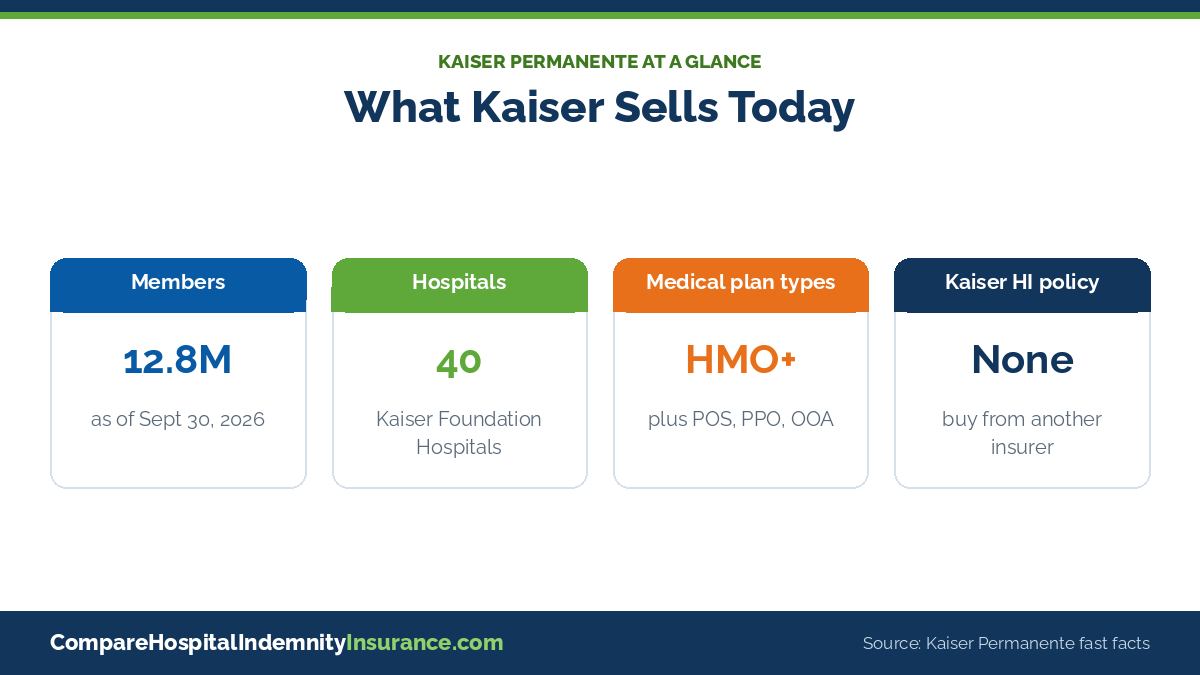
Kaiser Permanente does not sell a Kaiser-branded hospital indemnity policy; its plans are HMO, point-of-service, PPO and out-of-area medical coverage, so a Kaiser member who wants fixed cash for a hospital stay buys hospital indemnity from a separate insurance company, often through an employer. That separate policy pays you directly and sits on top of whatever your Kaiser plan pays.

For Kaiser members

Have Kaiser? See Hospital Cash Plans That Pair With It

Enter your ZIP to view hospital indemnity policies sold in your state.

Plan availability, eligibility, and benefits vary by state and policy.

We checked Kaiser’s own product pages, plan summaries and member handbooks and found no fixed indemnity hospital product sold under the Kaiser name, to individuals or to employers. If that changes in your region, the carrier’s filed brochure is the place to confirm it. Until then, the real choice is which outside carrier to pair with Kaiser, and our guide to hospital indemnity insurance companies covers the insurers that sell these plans.

Hospital indemnity is supplemental, limited-benefit coverage. It is not minimum essential coverage under the Affordable Care Act and it never replaces your Kaiser medical plan. It only adds a cash payment when a covered stay happens. To see what is sold where you live, you can compare hospital indemnity insurance plans by ZIP code.

Bottom line first

There is no Kaiser hospital indemnity policy to buy; Kaiser Permanente sells medical plans, and members who want a fixed cash benefit for hospital stays add a policy from another insurer, which pays the member regardless of Kaiser’s network rules.

What Kaiser Permanente Actually Sells

Kaiser Permanente is a combined health plan and care system. Its fast-facts page lists three parts, Kaiser Foundation Health Plan, Kaiser Foundation Hospitals and The Permanente Medical Groups, serving 12.8 million members in nine regions as of September 30, 2026. Its insurance arm, Kaiser Permanente Insurance Company (KPIC), sells the products that let members see doctors outside Kaiser’s own system.

  • HMO plans: the core Kaiser product, with care from Kaiser doctors and hospitals.
  • Kaiser Permanente Plus: HMO coverage plus a yearly allotment of outpatient visits with other licensed providers, per KPIC’s California product page.
  • Point-of-service and PPO plans: access to Kaiser, participating and non-participating providers.
  • Out-of-Area Indemnity (OOA): a KPIC medical plan that covers any licensed provider you choose.

Name trap:

The word indemnity in Kaiser’s Out-of-Area Indemnity plan does not mean hospital indemnity. KPIC’s member handbook describes a full medical plan that pays based on usual, customary and reasonable charges, not a fixed cash amount per hospital day. Someone searching for Kaiser hospital cash coverage can land on this plan by mistake.

Kaiser hospital indemnity at a glance: Kaiser Permanente members, hospitals, and no Kaiser-branded hospital cash policy

What a Kaiser Plan Charges for a Hospital Stay

A hospital indemnity policy is meant to cover the part of a stay your medical plan leaves to you. Kaiser’s 2026 benefit highlights for California individual and family plans show how wide that gap runs. We pulled the inpatient line from that document and put it next to each plan’s deductible and out-of-pocket limit.

2026 Kaiser California plan Deductible (self) Inpatient stay cost Out-of-pocket max (self)
Platinum 90 HMO None $225 per day, up to 5 days $5,000
Gold 80 HMO (copay version) None $375 per day, up to 5 days $9,200
Gold 80 HMO 0/30 PCP None $600 per day, up to 5 days $7,800
Silver 70 HMO $5,200 30% after deductible $9,800
Bronze 60 HMO $5,800 40% after deductible $9,800
Bronze 60 HDHP HMO $7,200 No charge after deductible $7,200

Source: Kaiser Permanente, 2026 Non-Grandfathered Health Plan Benefit Highlights (California). Other regions, employer plans and 2027 plans differ; check your own plan summary.

Two patterns stand out. On copay-style plans, the most you pay for one stay is the daily copay times five, so $1,125 on Platinum 90 and $3,000 on the Gold 80 0/30 plan. On deductible plans, a single admission early in the year can use up most or all of the out-of-pocket limit, which is $9,800 on Silver 70 and Bronze 60.

Russell Noga, licensed insurance agent

Agent’s desk note

Before picking a benefit level, find the inpatient hospital line in the Kaiser plan’s summary of benefits. On a copay plan, multiply the daily copay by the day limit; on a deductible plan, note the deductible and the out-of-pocket maximum. That figure is the gap a hospital indemnity policy is meant to fill, and it changes every plan year.

Russell Noga, Licensed Insurance Agent

Reasons a Kaiser Member Adds Hospital Cash Coverage

A high deductible
Silver, Bronze and HDHP members can owe thousands before Kaiser starts sharing inpatient costs.
Daily copays
Copay plans still bill per day, and a family can face more than one stay in a year.
Upfront bills away from home
Kaiser says members getting urgent or emergency care in the U.S. outside a Kaiser area may be asked to pay the full cost upfront and file for reimbursement.
Costs no plan covers
Lost wages, travel, parking and child care during a stay are outside any medical plan.

That third point is specific to Kaiser’s model. Kaiser’s travel claims page says reimbursement depends on your plan’s coverage and that claims can take about 45 days to process. A cash benefit paid on a separate claim can cover the bill in the meantime. Our page on fixed indemnity insurance explains why these plans pay a set amount rather than a share of the bill.

How a Separate Policy Works With a Kaiser HMO

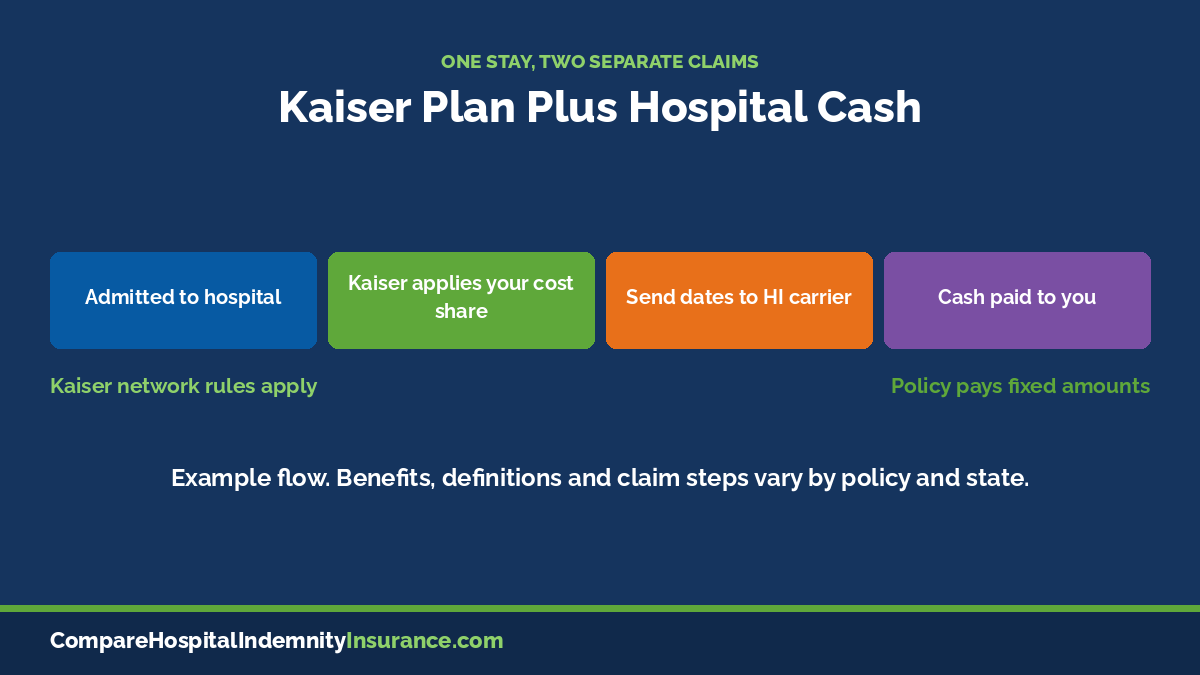
Hospital indemnity and a Kaiser HMO run on two separate tracks. Kaiser decides what it covers under its own network rules. The indemnity carrier pays a fixed amount when its policy terms are met, usually a covered inpatient admission to a licensed hospital.

1
Kaiser handles the medical bill. The hospital stay is billed under your Kaiser plan, and you owe the copay, deductible or coinsurance shown in your plan summary.
2
You file a separate claim. The indemnity carrier asks for proof of the stay, usually admission and discharge dates from the hospital records.
3
The carrier pays you. Benefits go to the policyholder, not to Kaiser or the hospital, for each covered event in the schedule.
4
You decide where the money goes. Pay the Kaiser balance, cover rent, or hold it for a stay that happens out of the area.

Most policies are not tied to a provider network, though each one defines what counts as a hospital and what counts as an admission. Observation stays, nursing homes and rehab units are common exclusions or separate benefits, so read the definitions page of the certificate before buying.

A Real Workplace Pairing: Kaiser HMO Plus Prudential

Large California employers often offer Kaiser medical and a hospital indemnity plan from a different insurer in the same enrollment. The University of California lists a Kaiser HMO among its medical plans, and a 2026 hospital indemnity summary posted by UC Riverside names The Prudential Insurance Company of America as the carrier.

Prudential medium plan, effective 1/1/2026
$1,200
hospital admission benefit
$200
hospital confinement, starting day 2
$400
ICU confinement, starting day 2
$16.19
monthly rate, employee only

The summary says the plan pays you regardless of what your medical plan covers and that benefits are paid directly to you. As an example only: a three-day admission under that schedule would pay the $1,200 admission benefit plus confinement for days two and three, about $1,600 in total. That alone exceeds the $1,125 most a Platinum 90 member could owe for one stay, but it covers only part of a Bronze deductible.

Worth knowing:

Kaiser’s own 2026 summary plan description for its salaried employees and resident physicians in Hawaii names Aflac, not Kaiser, as the carrier for voluntary accident and critical illness insurance. Even Kaiser’s workforce gets supplemental cash coverage from an outside insurer.

If your employer offers a plan like this, our guide to voluntary hospital indemnity insurance covers payroll deduction, portability and enrollment windows.


Kaiser hospital indemnity claim flow: Kaiser bills the stay while a separate insurer pays cash to the member

Hospital Indemnity Quotes

Call a Licensed Agent Now

A licensed agent can match a hospital cash plan to the cost sharing in your Kaiser coverage.

☎ 1-888-891-0229

No obligation to enroll

Kaiser HDHP Members and the HSA Rule

Kaiser sells high-deductible HMO plans built to pair with a health savings account, such as the Bronze 60 HDHP HMO in the table above. A common worry is that adding another health policy will break HSA eligibility. For hospital cash coverage, IRS Publication 969 answers that directly.

Coverage IRS Publication 969 allows alongside an HSA
  • ✔
    Insurance that pays a fixed amount per day (or other period) of hospitalization
  • ✔
    Insurance for a specific disease or illness
  • ✔
    Coverage for accidents, disability, dental care, vision care and long-term care

The catch is the policy design. A plan that pays a fixed amount per hospital day fits that list. A hybrid that also pays for doctor visits or other medical services before your deductible may not, so ask the carrier or your HSA administrator in writing before you enroll.

Weighing a Cash Plan Next to Kaiser Coverage

Where it helps a Kaiser member
✔

Turns a high deductible or daily copay into a smaller, known monthly premium
✔

Pays even when the stay is outside a Kaiser area
✔

Money can go to non-medical costs during recovery
Where it falls short
✕

Pays a fixed amount, which may be far below a large Bronze or Silver bill
✕

Limited benefit with exclusions and possible waiting periods
✕

Premium is wasted in years with no covered stay

A useful test is to compare the benefit with the number in your plan’s inpatient line. Platinum and copay Gold members have a small, capped gap, so a modest daily benefit covers it. Deductible-plan members carry the larger exposure and get the most from a richer admission benefit. Our breakdown of how much hospital indemnity pays shows typical benefit ranges. Kaiser Senior Advantage members are in Medicare, where different hospital cost rules apply, so Medicare hospital cash plans are a separate topic.

No-cost comparison

Price a Hospital Cash Policy to Sit Beside Your Kaiser Plan

Line up admission and daily amounts from several carriers in one place.

Plan availability, eligibility, and benefits vary by state and policy.

Kaiser Members and Hospital Indemnity: Questions People Ask

➤ Does Kaiser Permanente offer hospital indemnity insurance?

Not under the Kaiser name, based on Kaiser’s own product pages and plan documents. Kaiser sells HMO, point-of-service, PPO and out-of-area medical plans. Members who want fixed hospital cash buy it from a separate insurer, often through an employer.

➤ Is the Kaiser Out-of-Area Indemnity plan a hospital indemnity plan?

No. It is a Kaiser Permanente Insurance Company medical plan that lets members use any licensed provider and pays based on usual, customary and reasonable charges. A hospital indemnity policy pays a fixed dollar amount per covered event instead.

➤ Will a hospital indemnity policy pay if I stay in a Kaiser hospital?

Generally yes, as long as the stay meets the policy’s definition of a covered inpatient admission to a licensed hospital. The carrier pays you, not Kaiser, and the payment does not depend on what Kaiser covers.

➤ Can I keep my HSA if I add hospital indemnity to a Kaiser HDHP?

IRS Publication 969 lists insurance that pays a fixed amount per day of hospitalization as coverage you can have without losing HSA eligibility. Hybrid plans that pay for other medical services before the deductible need a closer look.

➤ Does Kaiser coordinate benefits with my hospital indemnity plan?

Hospital indemnity is a fixed cash benefit paid to you, so it is not the kind of coverage medical plans normally coordinate with. Your Kaiser cost sharing stays the same and the indemnity payment arrives separately.

➤ Is hospital indemnity a substitute for Kaiser coverage?

No. It is a supplemental, limited-benefit policy and is not minimum essential coverage. It pays set amounts for listed events and leaves the rest of a hospital bill to your medical plan and to you.

Kaiser Member? Compare Options

Call a Licensed Agent Now

Review hospital indemnity policies from several insurers that work beside any medical plan.

☎ 1-888-891-0229

No obligation to enroll

Russell Noga, licensed insurance agent

About the Author: Russell Noga

Russell Noga is a licensed insurance agent and the founder of ZRN Health & Financial Services, LLC. He has helped people compare health and supplemental insurance for more than 16 years and reviews every page on Compare Hospital Indemnity Insurance before it is published. Learn more about us or read our Editorial Standards.

CompareHospitalIndemnityInsurance.com is operated by ZRN Health & Financial Services, LLC, a Texas limited liability company based in Austin, Texas. We are not connected with or endorsed by any government agency.