Speak with a licensed insurance agent

1-888-891-0229

MetLife Hospital Indemnity Pregnancy Coverage: What a Delivery Stay Pays and When It Doesn’t

Reviewed by Russell Noga, Licensed Insurance Agent — Last updated November 7, 2026

MetLife hospital indemnity pregnancy coverage works like this: most MetLife group plans treat a routine childbirth as a covered sickness, so the admission for delivery pays the plan’s admission benefit plus a daily amount, and many plans add a small benefit for a healthy newborn’s nursery days. Routine prenatal care is not covered, and a pregnancy that was already under way when coverage began can be denied under the pre-existing condition limit.

Plan for the delivery

Expecting? Compare Hospital Plans Before Enrollment Closes

Enter your ZIP to see hospital indemnity plans with clear maternity terms.

Plan availability, eligibility, and benefits vary by state and policy.

Every employer builds its own MetLife plan, so the dollar amounts and the waiting rules change from one benefits guide to the next. Below we line up what three published employer plans would pay for a delivery, then walk through the rules that decide whether a birth claim pays at all. For the plan basics, start with our overview of MetLife hospital indemnity, see how it stacks up against other hospital indemnity insurance companies, or compare hospital indemnity insurance you can buy on your own.

MetLife hospital coverage is a limited-benefit fixed indemnity policy. It pays you cash on top of your medical plan. It is not health insurance, it does not replace your medical coverage for the delivery bill, and it is not minimum essential coverage.

What to know

MetLife group hospital indemnity usually pays its admission and daily benefits for a hospital delivery, because routine childbirth counts as a covered sickness, but routine pregnancy care is excluded. Some MetLife plans also wait 10 months before paying for routine childbirth, and a pregnancy that existed before your effective date may fall under the pre-existing condition limit.

How MetLife Classifies Pregnancy and Childbirth

A MetLife certificate pays for hospital stays caused by a covered accident or a covered sickness. Pregnancy sits inside the sickness definition, but only parts of it count. The MetLife outline of coverage posted by Trinity Health, and the plan summaries we read, split it into pieces.

Under MetLife’s sickness definition
  • ✔
    Routine childbirth counts, which covers a vaginal delivery and, on the plans that spell it out, a planned C-section
  • ✔
    Complications of pregnancy and an emergency C-section count
  • ✔
    Routine pregnancy, meaning the months before delivery with no complications, does not count
  • ✔
    Well-baby or nursing care for a newborn is not a sickness, so it pays only through a separate newborn nursery benefit if your plan has one

In practice, the hospital admission for labor and delivery is the event that triggers a payment. Prenatal visits, ultrasounds and a labor check that ends with you going home do not, since none of them is an inpatient confinement. Older plans can be stricter: a MetLife outline for the Harris County Department of Education listed routine vaginal delivery and non-emergency C-sections as exclusions, so read the version your employer uses.

The Pre-Existing Condition Limit and a Pregnancy That Started Earlier

Since pregnancy is part of the sickness definition, MetLife can treat a pregnancy that began before your coverage as a pre-existing condition. Plan summaries usually say only that there may be a preexisting condition limitation for hospital sickness benefits. The plans that give details use a 12-month rule.

12 and 12 rule
Occidental College’s MetLife summary says that if care was sought or received in the 12 months before coverage began, sickness benefits are not paid during the first 12 months, in most states.
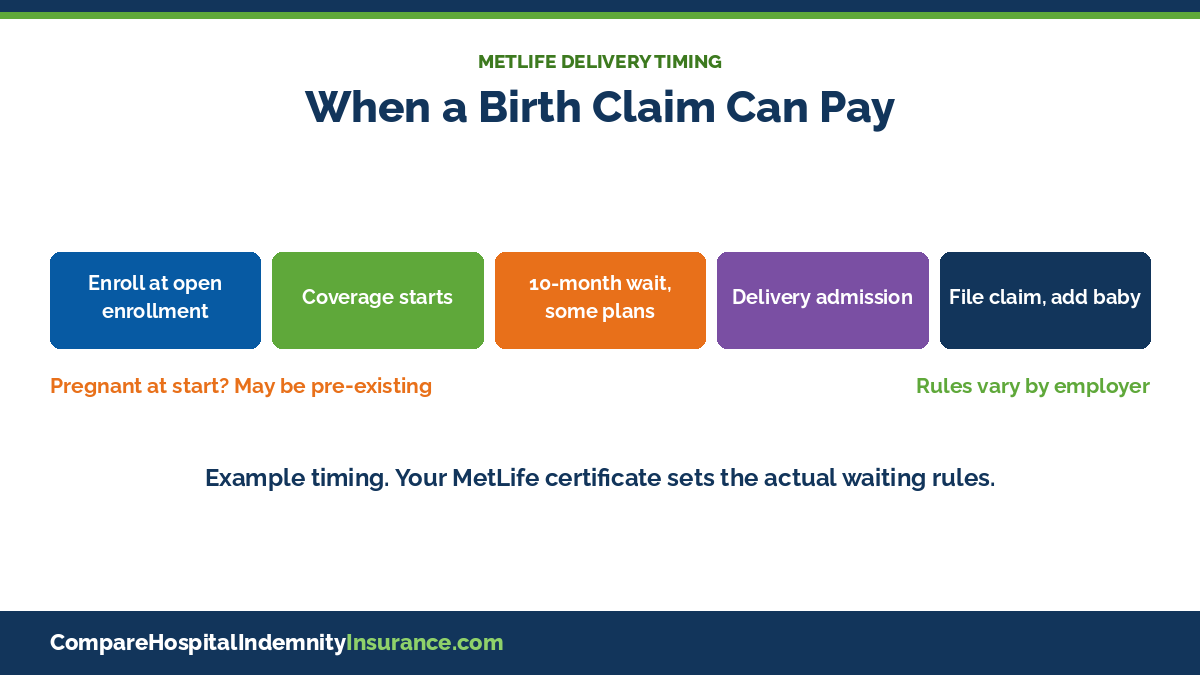
10-month childbirth wait
The same summary adds an elimination period for routine childbirth: no benefit for the first ten months of coverage, in most states.
Neither rule
A separate MetLife plan summary posted on an employer benefits portal marks both the pre-existing limit and the routine childbirth elimination period as not included.

Real denial on record:

In January 2025, Scripps News reported that MetLife denied a Colorado couple’s 2024 birth claim under a pre-existing condition limit because the mother was pregnant when they enrolled through work.

If you are already expecting, the rules for any carrier are covered on our page about getting hospital indemnity if already pregnant. For a MetLife plan, the answer comes from your certificate, not the summary.

Timeline of MetLife hospital indemnity pregnancy coverage from enrollment to the delivery claim

What Three Published MetLife Plans Pay for a Delivery Stay

MetLife has no single national schedule. These three employer plans were posted publicly, and none of them is on our main MetLife page. We show the High plan where there are two levels, since that is the option most expecting parents look at.

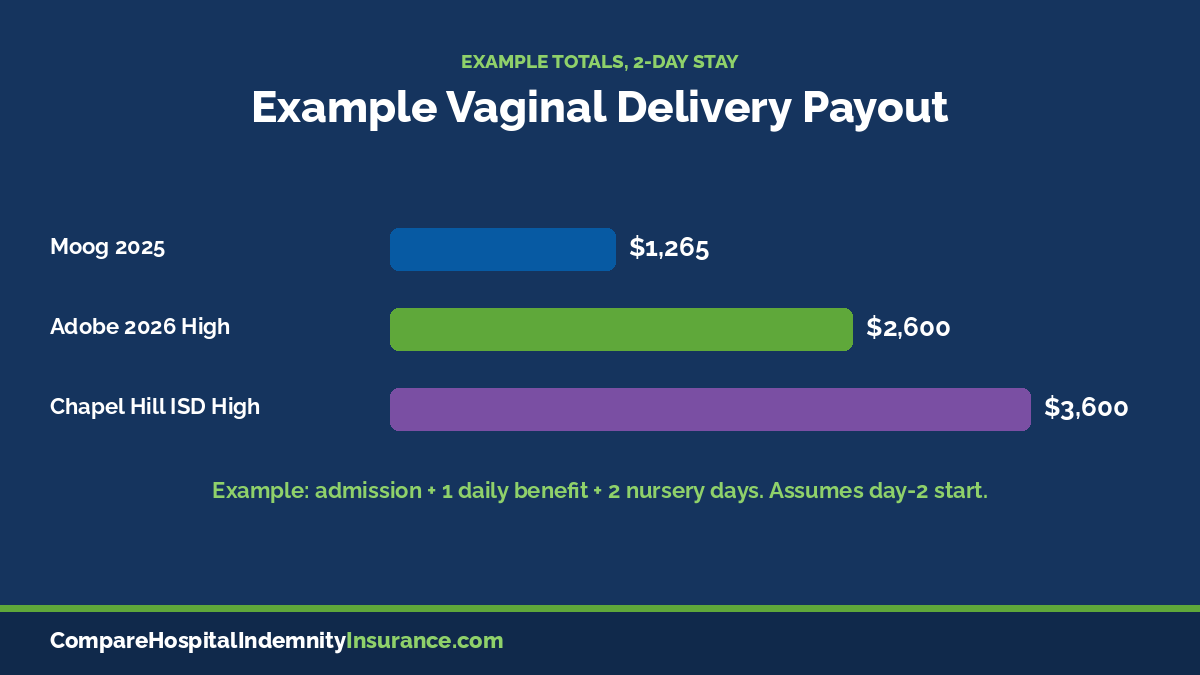
Delivery benefit Adobe, 2026 (High) Moog, 2025 Chapel Hill ISD, eff. 9/1/2025 (High)
Admission benefit $2,000, up to 4 a year $1,000, up to 4 a year $3,000, up to 4 a year
Daily confinement $200, up to 31 days $165, up to 365 days $200, up to 31 days
When daily pay starts Not stated Day 2 Not stated
Healthy newborn nursery $200 a day, up to 3 days $50 a day, up to 2 days $200 a day, up to 3 days
Low plan admission, if offered $1,000 One level only $1,500

Sources: MetLife plan summaries posted by Adobe (2026 benefits), Moog (2025 plan summary) and Chapel Hill ISD (coverage effective Sept. 1, 2025). Summaries say plan designs vary and the certificate controls. Checked Nov. 2026.

What the table shows

The admission benefit drives most of a delivery payout. Across these three plans it ranges from $1,000 to $3,000, while the nursery benefit swings from $50 to $200 a day.

Russell Noga, licensed insurance agent

Before your due date

MetLife plan summaries that include an elimination period for routine childbirth set it at ten months in most states, which is longer than a full-term pregnancy. On those plans, coverage that starts after conception cannot pay a routine delivery, so compare the effective date plus ten months with the due date before counting on the benefit.

Russell Noga, Licensed Insurance Agent

Vaginal Birth vs. C-Section on a MetLife Plan

A C-section usually means a longer stay, so more daily benefits. How much more depends on when daily pay starts. Moog’s plan, like several others, starts the confinement benefit on day 2 when the plan also pays an admission benefit, so the day you are admitted pays the lump sum only.

  • Vaginal birth: a short stay often means the admission benefit plus one or two daily benefits.
  • C-section: extra days each add one daily benefit, up to the plan’s day limit.
  • Nursery days: most plans cap the healthy-baby benefit at 2 or 3 days, even when the mother stays longer.
  • ICU: if the mother is moved to intensive care, an ICU supplemental benefit is paid on top on the plans above.

State quirk:

In the Ohio section of Trinity Health’s MetLife outline, the newborn nursery benefit runs up to 2 days after a vaginal delivery or 4 days after a C-section. The base version allows 2 days either way.

Your Newborn: Nursery Pay, a Sick Baby and Adding the Child

MetLife pays the newborn nursery benefit for a baby who is not sick or injured, starting right after birth. A baby who is sick, such as one admitted to the NICU, is a patient in their own right, and that stay is judged as the baby’s own confinement under the child’s coverage.

What usually pays
✔

Nursery days for a healthy baby, up to the plan’s 2 or 3 day limit
✔

A sick newborn’s own hospital stay, once the child is a covered person
✔

The mother’s admission and daily benefits for the delivery
What usually does not
✕

Routine childbirth of a covered dependent daughter, which MetLife outlines exclude
✕

Well-baby care for a dependent daughter’s newborn
✕

Nursery days past the plan’s limit

To keep benefits flowing for the baby, add the child to your MetLife coverage. Ask HR how long you have, since the deadline is set by your employer’s enrollment rules and the certificate.

Hospital Indemnity Quotes

Call a Licensed Agent Now

Licensed agents can check childbirth waiting rules on individual plans sold in your state.

☎ 1-888-891-0229

No obligation to enroll

Open Enrollment vs. a Qualifying Life Event

MetLife group plans are elected during your employer’s enrollment period, and you must be actively at work for coverage to take effect. That timing is what decides whether a future pregnancy is covered.

1
Enroll before you plan to conceive. On a plan with a 10-month childbirth wait or a 12-month pre-existing rule, an earlier effective date gives the clock time to run out.
2
Check for a newborn enrollment window. Birth is a change in status under IRS cafeteria plan rules, so many employers let you add a child or switch to family coverage mid-year.
3
Know what a mid-year change does not do. Joining after a birth can cover the baby going forward. It does not reach back to pay the delivery stay that already happened.
4
Review the plan each fall. Employers can change benefit levels or the carrier at renewal, so compare your summary year to year.

For benefit levels by state and carrier, see our pregnancy guide to hospital indemnity insurance for pregnancy.


Example MetLife hospital indemnity pregnancy payouts for a two-day vaginal delivery stay under three employer plans

Filing a MetLife Delivery Claim

You can file in MyBenefits at mybenefits.metlife.com, in the MetLife mobile app, or by email, fax or mail, according to the Kansas State Employee Health Plan claim guide for its MetLife coverage.

Your hospital papers must show
  • ✔
    The patient’s name, for the mother and separately for the baby
  • ✔
    Admission and discharge dates
  • ✔
    A verified diagnosis, which for a delivery is the birth itself
  • ✔
    The room assignment, ICU or non-ICU

MetLife says clean claims, meaning those with all required information, generally take 10 business days to process, with payment 7 to 10 business days after approval. An itemized bill or an explanation of benefits from your medical plan can speed things up.

Free side-by-side

Line Up Your MetLife Plan Against Other Carriers

See admission, daily and newborn benefits from insurers in your state.

Plan availability, eligibility, and benefits vary by state and policy.

MetLife Pregnancy Coverage: Common Questions

➤ Does MetLife hospital indemnity pay for a planned C-section?

On most current plans, yes. MetLife plan documents list delivery by non-emergency C-section as routine childbirth, which is a covered sickness, and an emergency C-section is covered as a complication.

➤ Will MetLife pay for my prenatal visits or ultrasounds?

No. Routine pregnancy is excluded, and these are not inpatient stays. Only a hospital confinement, such as the delivery admission, triggers the hospital benefits.

➤ Is there a waiting period for childbirth on MetLife plans?

Some plans have one. Occidental College’s summary lists a 10-month elimination period for routine childbirth in most states, while another posted MetLife summary marks it as not included.

➤ Can MetLife deny my birth claim if I was pregnant when I enrolled?

Yes, on plans with a pre-existing condition limit, because pregnancy is part of the sickness definition. Check your certificate for the look-back and exclusion periods.

➤ Does the newborn nursery benefit pay if my baby is in the NICU?

No. The nursery benefit is for a baby who is not sick or injured. A NICU stay is the baby’s own confinement and pays only if the child is a covered person under the plan.

➤ Is my teenage daughter’s delivery covered on my family plan?

Usually not. MetLife outlines exclude a dependent child’s routine childbirth and well-baby care for that child’s newborn.

➤ Can I keep MetLife coverage during maternity leave?

Ask HR. Coverage generally continues while premiums are paid, and MetLife offers continuation after you leave a job, subject to its eligibility rules.

Maternity Plan Review

Call a Licensed Agent Now

Compare delivery and newborn benefits from several carriers before your next enrollment.

☎ 1-888-891-0229

No obligation to enroll

Russell Noga, licensed insurance agent

About the Author: Russell Noga

Russell Noga is a licensed insurance agent and the founder of ZRN Health & Financial Services, LLC. He has helped people compare health and supplemental insurance for more than 16 years and reviews every page on Compare Hospital Indemnity Insurance before it is published. Learn more about us or read our Editorial Standards.

CompareHospitalIndemnityInsurance.com is operated by ZRN Health & Financial Services, LLC, a Texas limited liability company based in Austin, Texas. We are not connected with or endorsed by any government agency.