Speak with a licensed insurance agent

1-888-891-0229

Can You Get Hospital Indemnity If Already Pregnant? Enrollment Doors, Look-Backs and Due Dates

Reviewed by Russell Noga, Licensed Insurance Agent — Last updated November 7, 2026

Yes, you can get hospital indemnity if already pregnant, but whether the policy pays for this delivery depends on how you buy it. A workplace plan picked at open enrollment is often guaranteed issue and some state no pre-existing limit, so the birth may be paid; a new individual policy usually treats a pregnancy that began before the start date as a pre-existing condition and will not pay for that birth.

Already pregnant

Expecting Already? See Which Plans Near You Could Still Help

Enter your ZIP to compare hospital indemnity plans and their pregnancy terms.

Plan availability, eligibility, and benefits vary by state and policy.

The difference between those outcomes sits in a few certificate clauses: the look-back, the limitation period and any separate childbirth exclusion. Below we compare how four insurers handle a pregnancy already underway and run the dates against a due date. For the bigger picture, see our guide to hospital indemnity insurance for pregnancy, or compare hospital indemnity insurance plans sold in your state.

Keep in mind that hospital indemnity is supplemental, limited-benefit coverage. It does not replace health insurance and is not minimum essential coverage.

Yes or no first

Yes, you can usually enroll while pregnant, but most new individual policies will not pay for the current birth because the pregnancy counts as pre-existing. Your best chance is a workplace plan at open enrollment or first eligibility whose certificate has no pre-existing limitation and no childbirth waiting period.

Three Ways In, Three Different Answers

Most people who search this have just seen a positive test and want to know if it is too late. It is not too late to buy a policy. It may be too late for that policy to pay for this baby, and the route you take decides which.

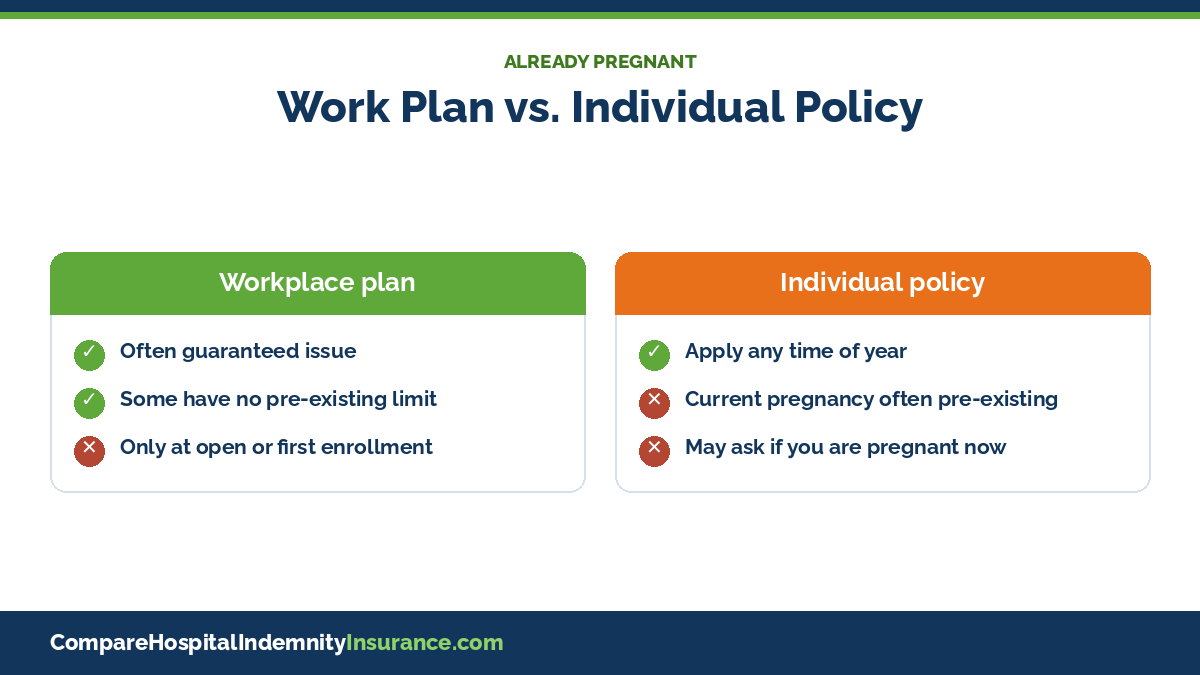
Workplace open enrollment
Coverage is often guaranteed issue with no health questions. The birth is paid only if the certificate has no pre-existing limit that reaches back to your conception date and no childbirth exclusion that outlasts your due date.
New job or first eligibility
Joining a new employer’s plan in your first enrollment window works the same way as open enrollment, and it can happen at any point in a pregnancy.
Individual application
You apply on your own any time of year. Expect a pre-existing clause that names a current pregnancy, and on some forms a question asking whether you are pregnant now.

Even when this birth is excluded, the policy can still pay for an unrelated stay, such as an injury, once its normal waiting rules are met.

Workplace Plans: Guaranteed Issue Is Only Half the Question

Guaranteed issue means the insurer must accept you, not that it will pay every claim. Group certificates handle an existing pregnancy in one of three ways. Our guide to voluntary hospital indemnity insurance explains how employers pick these features.

  • No pre-existing limitation. Some employer brochures say so in plain words. If there is also no childbirth waiting period, a pregnancy already underway on the start date can be paid like any other covered sickness.
  • A look-back and limitation pair. The certificate looks back over a set window before the effective date, often 12 months, for any condition you had. A pregnancy that began in that window is excluded for a set period after the start date, also often 12 months.
  • A separate birth exclusion. Some certificates add a rule that no benefit is paid for giving birth within the first several months of coverage, often 9 or 10, on top of any pre-existing clause.

Watch for:

Benefit guides handed out at enrollment are summaries. When a summary is silent on pre-existing conditions, that does not mean the certificate has no limit. Ask HR or the carrier for the certificate itself.

Russell Noga, licensed insurance agent

Timing rule

Pre-existing look-backs and limitation periods run from the certificate effective date, not the enrollment date. An election made in November for a January 1 start measures both windows from January 1, so a pregnancy that began in the fall is already inside the look-back on day one.

Russell Noga, Licensed Insurance Agent

Comparison of a workplace plan and an individual policy when buying hospital indemnity if already pregnant

How Four Insurers’ Documents Treat a Pregnancy That Already Exists

We read employer brochures, a filed disclosure and a carrier help page to see how each handles a pregnancy that started before coverage began. Employers choose features and carriers sell several versions, so treat this as a sample of how wide the rules range.

Carrier and document Guaranteed issue? Look-back / limitation How an existing pregnancy is treated
Allstate Benefits (American Heritage Life), group hospital indemnity, policy form GVSP2, school district brochure Yes, per the brochure Brochure states no pre-existing condition limitation No pregnancy waiting period listed for either plan; a stay that began before the effective date is excluded; a healthy newborn’s first stay is not payable
Colonial Life, group Medical Bridge hospital indemnity, form GMB7000, employer summary Not stated in the summary reviewed 12-month look-back; no benefit for that condition in the first 12 months Giving birth in the first nine months after the certificate date is excluded
Securian Life, group hospital indemnity, form series 19-32690, association summary Yes, with no medical questions at initial eligibility, open enrollment or a family status change Not addressed in the summary Includes pregnancy coverage; a claim can be filed at 36 weeks with proof of gestation
ManhattanLife, Hospital Indemnity Select, policy form AN7003, filed disclosure Not confirmed 12/12 per ManhattanLife’s own help page; 12 months continuous coverage before a pre-existing condition is paid A pregnancy that exists on the effective date is a pre-existing condition; maternity is excluded except complications of pregnancy

Sources: carrier brochures, ManhattanLife disclosure HIS-RTI 0725 and ManhattanLife knowledge base, reviewed November 2026. Terms vary by employer, state and form. The policy or certificate controls, so confirm your own before enrolling.

One employer plan could pay for a birth no matter when you conceived, while an individual form shuts the current pregnancy out. The Securian summary does not say how a pregnancy that began before enrollment is handled, so ask the plan administrator before counting on its 36-week claim option.

Buying on Your Own: The Application and the Exclusion

Individual hospital indemnity is usually medically underwritten to some degree, even when the questions are short. Some applications ask directly. A ManhattanLife Assurance application for an Illinois hospital indemnity product (form GAP15DVH-IL) asks whether you or your spouse are now pregnant and asks for details on a yes.

What a new individual policy can still do
✔

Pay for unrelated accidents and illnesses once its normal waiting rules pass
✔

Be in force, with the clock already run, for a later pregnancy
✔

Pay you directly, whatever your medical plan pays
What it usually will not do
✕

Pay admission or daily benefits for this delivery
✕

Cover a pregnancy-related stay inside the limitation period
✕

Pay for normal childbirth at all, on forms that exclude maternity

Answer every application question truthfully. Leaving out a known pregnancy does not make the birth covered. It gives the insurer grounds to deny the claim or rescind the policy during the contestable period.

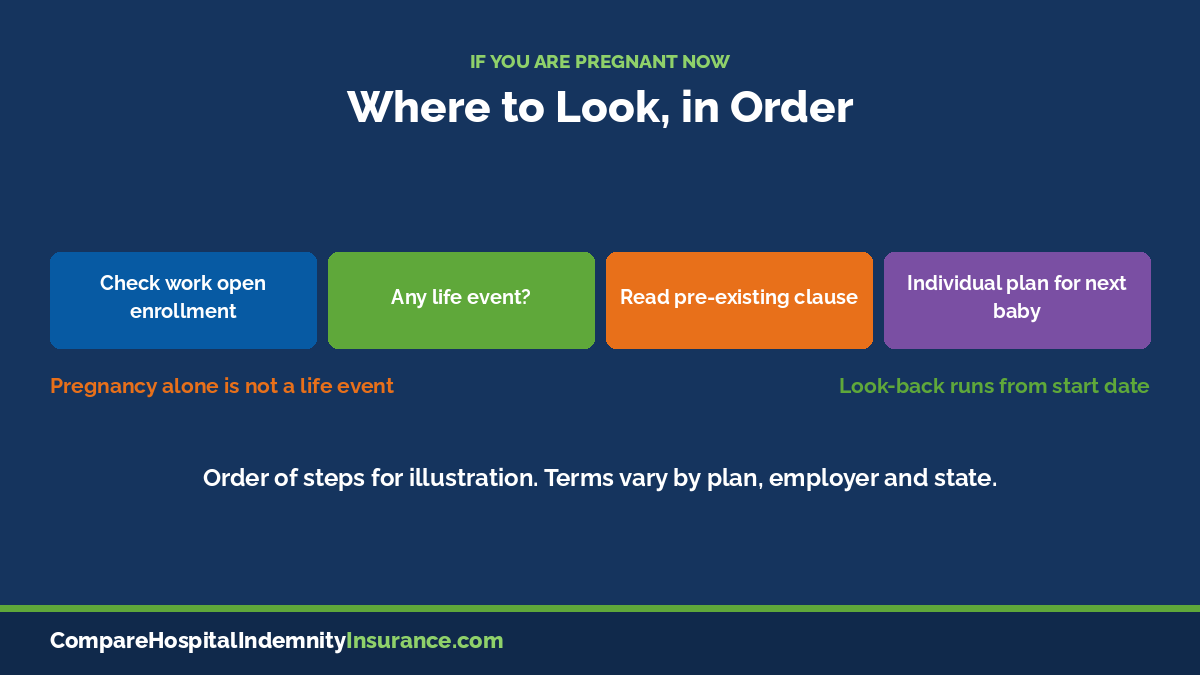
Decision path for getting hospital indemnity if already pregnant, from positive test to certificate check

Finding Out Mid-Year: What Reopens Enrollment and What Does Not

Most payroll-deducted hospital indemnity plans run through a Section 125 cafeteria plan. That ties mid-year changes to the IRS list of change-in-status events, and that list has a gap that catches expecting parents off guard.

Gap fact

The IRS regulation that sets cafeteria-plan election changes (26 CFR 1.125-4) lists birth, adoption and placement for adoption as events that change your number of dependents. Pregnancy is not on the list, so a positive test alone usually does not let you add hospital indemnity mid-year.

Events that can open a window during a pregnancy
  • ✔
    Starting a new job that offers hospital indemnity, during its first enrollment window
  • ✔
    Marriage, which can let you join your new spouse’s plan
  • ✔
    A change in employment status for you or your spouse that affects eligibility
  • ✔
    A move that changes which plans you can get
  • ✔
    Your employer’s annual open enrollment, if it falls before your due date

Birth itself is a qualifying event, but coverage added after delivery comes too late for the delivery stay. Newborn rules are covered in does hospital indemnity cover childbirth.

Hospital Indemnity Quotes

Call a Licensed Agent Now

A licensed agent can compare pre-existing and childbirth terms on plans available to you now.

☎ 1-888-891-0229

No obligation to enroll

Due-Date Math: Run Your Dates Before You Enroll

Two clocks matter, and both start on the certificate effective date, not the day you clicked enroll. Run each one against your due date, then subtract a few weeks in case the baby comes early.

Example dates only
Jan 1
example effective date after November open enrollment
Oct 1
earliest payable birth on a nine-month birth exclusion
Jan 1 next year
end of an example 12-month pre-existing limitation
June
example due date for a pregnancy that began in September

With those example dates, a parent who conceived in September and enrolls for a January start is pregnant on the effective date. A plan with no pre-existing limit and no birth exclusion could pay for the June delivery. A 12/12 plan would not, and a nine-month birth exclusion alone would also block it, since June comes before October.

Complications follow the same clock

On many forms, a complication of a pregnancy that was already pre-existing is treated as part of that same condition. Do not assume preeclampsia or a pre-term admission escapes the limitation just because the policy covers complications in general.

Pages to Find in the Certificate

1
Find the definitions page. Read how it defines pre-existing condition, sickness and complications of pregnancy, and note the look-back length.
2
Find the limitations section. Look for a pre-existing limitation, its length, and any wording that names pregnancy or the effective date.
3
Look for a childbirth clause. Search for giving birth, maternity and normal pregnancy to catch a separate birth exclusion or waiting period.
4
Check the newborn wording. See whether a healthy baby’s first stay is paid and how many days you have to add the child.
5
Note the effective date. Use the date on the certificate or schedule page for all of the math above.

If your workplace plan is through MetLife, see our MetLife hospital indemnity pregnancy page for that carrier’s terms.


Free comparison

Check Pre-Existing Terms Before You Enroll

Line up look-back periods and childbirth rules from carriers in your state.

Plan availability, eligibility, and benefits vary by state and policy.

Already Pregnant: Common Questions

➤ Can you get hospital indemnity insurance if already pregnant?

Yes. Insurers generally let you enroll, and workplace plans are often guaranteed issue. Whether this birth is paid depends on the certificate’s pre-existing limitation and any childbirth exclusion, and most new individual policies exclude it.

➤ Can you use hospital indemnity for childbirth if you enrolled while pregnant?

Only if your plan has no pre-existing limitation that reaches the pregnancy and no birth waiting period that runs past your delivery date. Some employer plans meet both tests; few individual policies do.

➤ Is a pregnancy complication covered if I was pregnant before the policy started?

Often not. Many forms treat a complication of an existing pregnancy as part of the same pre-existing condition, so it falls under the same limitation period. Check how your certificate defines complications of pregnancy.

➤ Can I join my spouse’s workplace plan instead of mine?

If your spouse’s employer offers dependent coverage and the enrollment window is open, yes. The pregnancy terms in that certificate apply, and they may differ from your own employer’s plan.

➤ Would the policy pay for my baby’s own NICU stay?

It may, once the baby is added under the newborn rules, because the baby’s own illness is usually treated separately from the parent’s pregnancy. Some plans pay nothing for a healthy newborn’s first stay, so read the newborn wording.

➤ What happens if I leave a pregnancy off the application?

The birth is still not covered, and a misstatement can lead the insurer to deny claims or rescind the policy during the contestable period. Answer every question accurately.

Pregnancy Coverage Check

Call a Licensed Agent Now

See which plans in your state treat a current pregnancy the most favorably.

☎ 1-888-891-0229

No obligation to enroll

Russell Noga, licensed insurance agent

About the Author: Russell Noga

Russell Noga is a licensed insurance agent and the founder of ZRN Health & Financial Services, LLC. He has helped people compare health and supplemental insurance for more than 16 years and reviews every page on Compare Hospital Indemnity Insurance before it is published. Learn more about us or read our Editorial Standards.

CompareHospitalIndemnityInsurance.com is operated by ZRN Health & Financial Services, LLC, a Texas limited liability company based in Austin, Texas. We are not connected with or endorsed by any government agency.