Speak with a licensed insurance agent

1-888-891-0229

UnitedHealthcare Hospital Indemnity: Golden Rule Policies, Employer Plans and Their Filed Benefits

Reviewed by Russell Noga, Licensed Insurance Agent — Last updated November 6, 2026

UnitedHealthcare hospital indemnity insurance is a fixed-benefit policy that pays you a set dollar amount for each covered day in the hospital, and it comes in two main forms: individual policies underwritten by Golden Rule Insurance Company and sold through UnitedHealthOne, and employer group plans issued by UnitedHealthcare Insurance Company.

Free quotes

Line Up UnitedHealthcare With Other Hospital Plans

Enter your ZIP to see which hospital indemnity policies are sold in your state.

Plan availability, eligibility, and benefits vary by state and policy.

This guide lines up the benefit amounts, age limits and fine print from UnitedHealthcare’s own brochures and employer plan summaries. To weigh UnitedHealthcare against other carriers, start with our review of hospital indemnity insurance companies, or compare hospital indemnity insurance quotes for your ZIP code.

One rule applies to every product below. UnitedHealthcare labels these as limited-benefit policies that supplement health insurance. They are not major medical coverage and they are not minimum essential coverage under the Affordable Care Act.

Bottom line first

UnitedHealthcare hospital indemnity pays a fixed cash benefit per hospital day, either through a Golden Rule individual policy for adults 18 to 64 or through an employer group plan. Benefit levels, waiting rules and state availability differ by product, so the brochure for your state controls.

Where UnitedHealthcare Hospital Coverage Comes From

UnitedHealthcare does not sell a single hospital plan. Its hospital benefits come from separate insurance companies inside UnitedHealth Group, and the company on your policy decides who can apply and how the benefit is built.

  • Golden Rule Insurance Company underwrites the individual hospital and fixed indemnity policies sold on UnitedHealthOne., part of UnitedHealth Group since 2003.
  • Hospital SafeGuard is the Golden Rule hospital confinement policy for adults under 65, with two plan choices.
  • Health ProtectorGuard is a broader Golden Rule fixed indemnity plan that adds doctor visit, prescription and emergency benefits to a hospital benefit.
  • UnitedHealthcare Hospital Indemnity Protection Plans are employer group plans issued by UnitedHealthcare Insurance Company and paid through payroll.
  • AdvantageGuard is a separate Golden Rule hospital policy for applicants 60 through 90, built for people on Medicare. That market sits outside this guide.

Because each product has its own policy form, a benefit described for one does not carry over to another. For a plain-language primer on how this style of coverage pays, see our guide to fixed indemnity insurance.

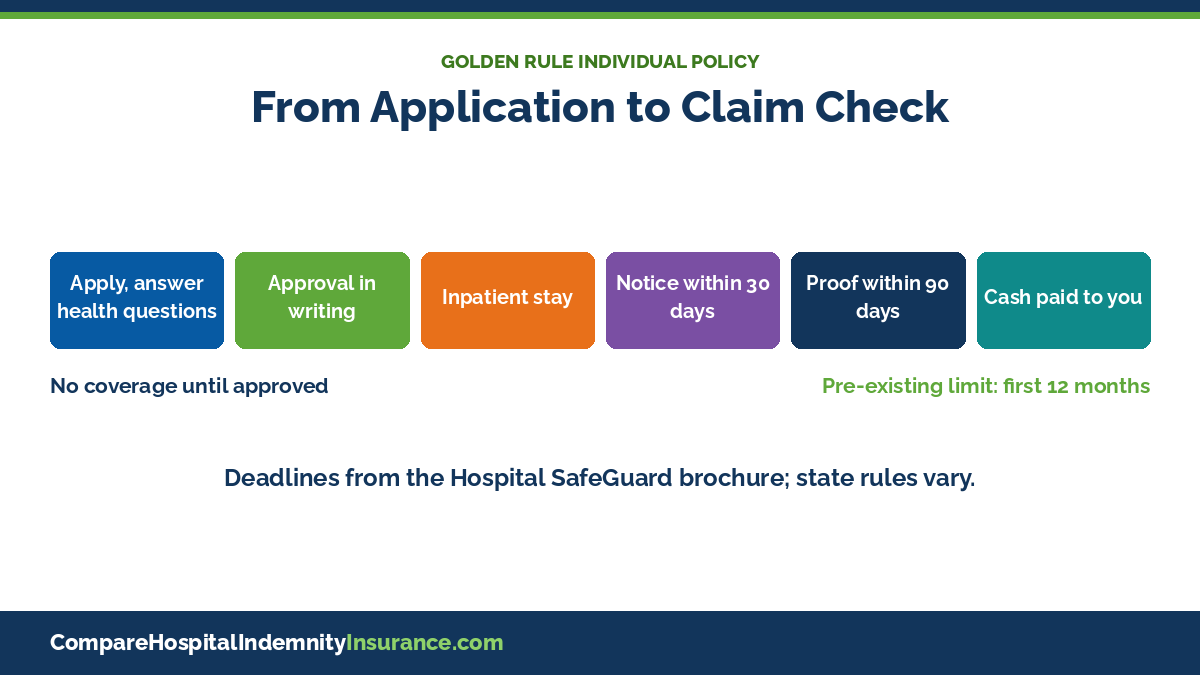
UnitedHealthcare hospital indemnity individual policy timeline from application and approval to hospital stay, claim notice, proof of loss and cash payment

UnitedHealthcare Hospital Plans Side by Side

No UnitedHealthcare page puts its individual and employer hospital products in one view, so the table below was built from three filed or published documents: the Hospital SafeGuard brochure (form 43789-G-0818 with its 2019 state insert), the Health ProtectorGuard brochure (form 46034-G-1122) and a UnitedHealthcare small-group plan summary for employers with 5 to 99 eligible employees.

Feature Hospital SafeGuard Health ProtectorGuard Employer plan (5-99 lives)
Insurer Golden Rule Golden Rule UnitedHealthcare Insurance Company
Who can apply Adults 18-64; children 0-25 Adults 18-64 (18-60 in DE and MD); children 0-25 Employees actively at work 30+ hours a week
Hospital day benefit Plan A: $1,000 a day, up to 31 days. Plan B: $2,000 a day, up to 7 days $1,000, $2,000, $3,000 or $5,000 a day by level, no yearly day cap Option A: $100 a day; Option B: $150 a day, from day 2, up to 364 days
First-day admission benefit None separate $1,000 to $3,000, once a year $500 or $1,000
ICU Extra amount equal to the day benefit (10 days Plan A, 7 days Plan B) Extra amount equal to the day benefit, up to 31 days a year $100 or $150 a day
Underwriting Health questions Health questions Guaranteed issue
Pre-existing rule 12-month look-back, 12-month limit 12-month look-back, 12-month limit (6 months in NV and WY) 12/12 exclusion
Coverage ends Primary insured turns 65 Primary insured turns 65 Leaving the job, with a 12-month portability option

Built from UnitedHealthcare and Golden Rule brochures and a UnitedHealthcare employer plan summary. Amounts vary by state and edition; the policy or certificate controls.

What the table shows

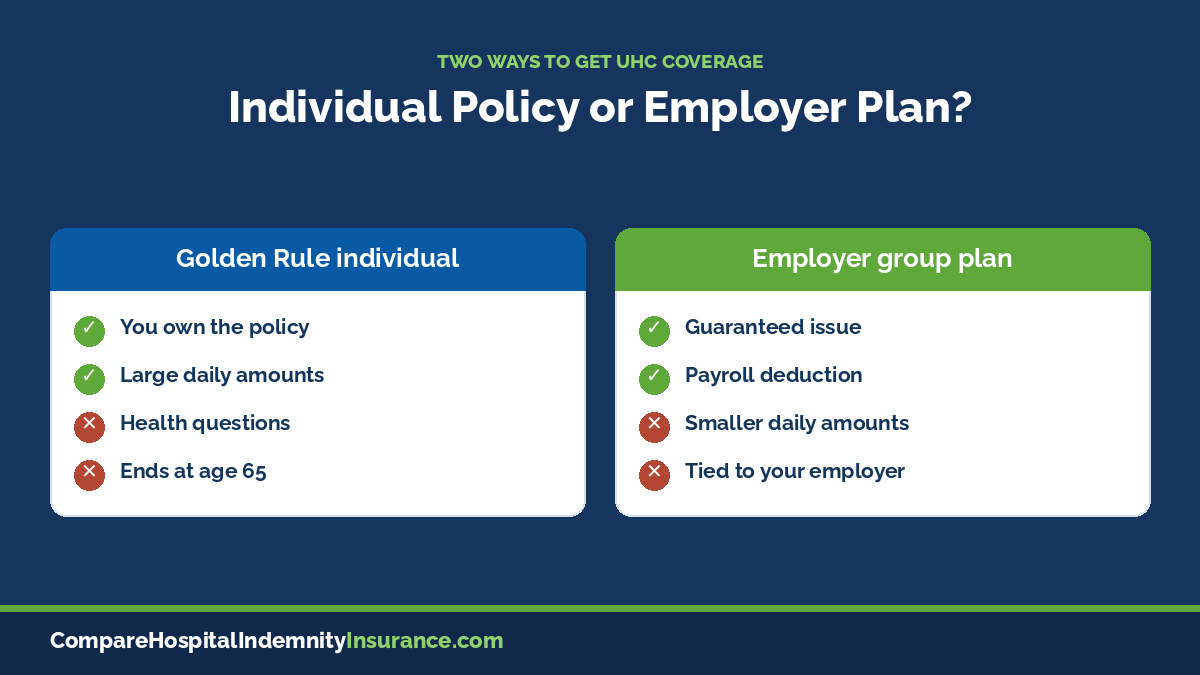
The individual Golden Rule policies pay far larger daily amounts but ask health questions and stop at 65, while the employer plan pays smaller daily amounts, skips health questions and follows the employer’s group rules.

Hospital SafeGuard Plan A and Plan B in Practice

Hospital SafeGuard asks you to choose between depth and duration. Plan A pays $1,000 for each 24 hours of inpatient confinement for up to 31 days in a calendar year. Plan B pays $2,000 for each 24 hours, but only for 7 days a year. Neither has a deductible.

Example payouts only (non-ICU stays, one calendar year)
$5,000 vs $10,000
5-day stay: Plan A vs Plan B
$12,000 vs $14,000
12-day stay: Plan B stops paying after day 7
$31,000 vs $14,000
31 days in the year: where Plan A pulls ahead

Short stays favor Plan B, while long recoveries or several admissions in one year favor Plan A. State rules shift the math. Plan B is not offered in Pennsylvania or Texas, Pennsylvania counts benefits per period of confinement instead of per calendar year, and Florida’s Plan B adds $10 a day for days 8 through 31.

Pregnancy note:

Hospital SafeGuard excludes normal pregnancy and childbirth and covers only complications of pregnancy, with an exception in Kansas. Anyone shopping for a delivery stay should read our hospital indemnity insurance for pregnancy guide first.

Russell Noga, licensed insurance agent

Fine-print fact

Hospital SafeGuard pays its ICU benefit on top of the inpatient day benefit, at the same dollar amount. Once the yearly inpatient day maximum is used up, an ICU day pays only the ICU benefit, so the same ICU day pays half as much late in a heavy claim year as it did early on.

Russell Noga, Licensed Insurance Agent

Health ProtectorGuard Goes Beyond the Hospital Bed

Health ProtectorGuard pairs one of four hospital levels, named Choice, Select, Preferred and Premier, with one of three outpatient levels called WORx 1, 2 and 3, for twelve possible combinations. The hospital side counts observation unit stays of 24 hours or more as inpatient time.

Benefits listed in the Health ProtectorGuard brochure
  • ✔
    Emergency room benefit of $400 to $1,000 a day, depending on the hospital level
  • ✔
    Ambulance benefit of $500 to $1,000 per ground trip and $5,000 per air trip, two trips a year
  • ✔
    Doctor, specialist and urgent care visit benefits from $80 to $150 per visit on the WORx levels
  • ✔
    Fixed amounts per prescription fill, plus a wellness exam benefit after a 30-day wait (no wait in Maryland or Utah)
  • ✔
    An inpatient injury benefit that rises 100% in the second policy year; the increase does not apply to sickness

Watch for:

The Health ProtectorGuard brochure excludes a hospital confinement that begins on a Friday or Saturday unless it is an emergency. A scheduled weekend admission for a planned procedure could pay nothing, so set planned admission dates with the policy in hand.


UnitedHealthcare hospital indemnity individual Golden Rule policy compared with an employer group hospital indemnity plan

UnitedHealthcare Hospital Indemnity Through an Employer

UnitedHealthcare launched its Hospital Indemnity Protection Plans for employers on November 1, 2017. The announcement described lump-sum benefits ranging from about $700 to more than $5,000 after a hospital stay, group availability in 45 states plus Washington, D.C., and designs that work with health savings accounts.

  • Groups of 5 to 9 employees: the employer pays the full premium and every eligible employee is enrolled
  • Groups of 10 to 99: no employer contribution is required if more than 20% of employees, or at least five, enroll
  • Four coverage tiers: employee, employee plus spouse, employee plus child, and family
  • A two-year rate guarantee on the small-group design

One public university benefits page lists an admission benefit of $500, $1,000 or $1,500, a $100 daily confinement benefit, a $100 daily ICU benefit and a $50 yearly wellness benefit for one preventive screening. Payroll plans like this are covered in more depth in our voluntary hospital indemnity insurance guide.

Hospital Indemnity Quotes

Call a Licensed Agent Now

A licensed agent can check which UnitedHealthcare hospital plans are sold in your state and how they compare.

☎ 1-888-891-0229

No obligation to enroll

Tax Rules and the Limited-Benefit Label

Every UnitedHealthcare hospital product carries the same core warning: it provides limited benefits in a stated amount regardless of actual expenses. Because it is not minimum essential coverage, going without a major medical plan can still trigger a tax penalty in states that run their own coverage mandate.

HSA eligibility
IRS rules let HSA owners carry coverage that pays a fixed amount per day of hospitalization. Plans that also pay for doctor visits or prescriptions may not qualify, and the Hospital SafeGuard brochure warns that buying it may affect tax-deductible HSA contributions.
Federal notice rule
A March 2024 federal rule required a consumer notice on employer fixed indemnity plans, but a federal court in the Eastern District of Texas vacated that notice requirement on December 4, 2024.
Cash use
Benefits are paid to you unless you assign them to a hospital or provider, and the money can go toward a deductible, rent or travel.

Filing a Claim and Confirming Your State

UnitedHealthcare hospital claims are not paid automatically. Claim forms and instructions for the individual Golden Rule policies are posted on the UHC member hub, and the Hospital SafeGuard brochure sets these deadlines.

1
Give notice within 30 days. Report the hospital stay to the insurer within 30 days of the loss, or as soon as reasonably possible.
2
Send proof of loss within 90 days. Include the itemized bill or discharge summary showing inpatient dates. North Carolina allows 180 days.
3
Do not miss the one-year outer limit. Proof sent more than a year late is not accepted unless the insured lacked legal capacity.
4
Decide where the check goes. Keep the cash, or assign benefits to the provider, which some plans require for discounted provider rates.

The individual brochures list state variations rather than a full sales map, and UnitedHealthOne notes that some states are excluded, so a quote for your ZIP code is the only reliable way to see which UnitedHealthcare hospital product is sold where you live.

Related guide: what does UnitedHealthcare hospital indemnity cover Covered events, exclusions and the inpatient and ICU definitions in UHC individual and employer documents.

Free comparison

Not Sure a UHC Policy Fits? Compare Daily Benefits First

Check day limits, ICU pay and pre-existing rules across carriers before you apply.

Plan availability, eligibility, and benefits vary by state and policy.

UnitedHealthcare Hospital Indemnity FAQs

➤ Which company actually issues UnitedHealthcare hospital indemnity insurance?

Individual policies sold through UnitedHealthOne are underwritten by Golden Rule Insurance Company, a UnitedHealthcare company. Employer group plans are issued by UnitedHealthcare Insurance Company.

➤ Can I buy a UnitedHealthcare hospital policy at age 65 or older?

Hospital SafeGuard and Health ProtectorGuard accept applicants 18 to 64 and end at the primary insured’s 65th birthday. Golden Rule sells a separate policy called AdvantageGuard to applicants 60 through 90, aimed at people with Medicare.

➤ Is there a waiting period before benefits start?

UnitedHealthOne says most benefits have no waiting period, but the individual policies limit pre-existing conditions for the first 12 months. Some add-on benefits, such as wellness on Health ProtectorGuard, carry a 30-day wait.

➤ Will a UnitedHealthcare hospital policy pay for having a baby?

The individual Golden Rule policies exclude normal pregnancy and childbirth and pay only for complications, with limited state exceptions. Employer plan certificates differ, so check the maternity section of your group certificate.

➤ Do I have to use UnitedHealthcare network hospitals?

No. UnitedHealthcare says its branded hospital plans have no network requirements and pay the same wherever you get care. Health ProtectorGuard adds access to Choice Plus network discounts when benefits are assigned to the provider.

➤ What happens to my employer UnitedHealthcare hospital plan if I quit?

The small-group plan summary allows coverage to continue at the employer’s group rates for the first 12 months after you leave. The certificate of coverage explains the conversion and portability terms.

➤ Does a UnitedHealthcare hospital plan replace my health insurance?

No. It is a limited-benefit supplement that pays fixed cash amounts and does not count as minimum essential coverage under the Affordable Care Act.

Free Policy Review

Call a Licensed Agent Now

Have your UnitedHealthcare brochure or certificate ready to compare day limits and ICU pay with other carriers.

☎ 1-888-891-0229

No obligation to enroll

Russell Noga, licensed insurance agent

About the Author: Russell Noga

Russell Noga is a licensed insurance agent and the founder of ZRN Health & Financial Services, LLC. He has helped people compare health and supplemental insurance for more than 16 years and reviews every page on Compare Hospital Indemnity Insurance before it is published. Learn more about us or read our Editorial Standards.

CompareHospitalIndemnityInsurance.com is operated by ZRN Health & Financial Services, LLC, a Texas limited liability company based in Austin, Texas. We are not connected with or endorsed by any government agency.