The Events That Start a MetLife Payment
Every core benefit depends on the word Confined, and both certificates define it the same way.
- Inpatient bed. You are assigned a bed as a resident inpatient, including in an ICU, on a physician’s advice.
- Long observation. You spend no less than 20 continuous hours in a hospital observation area on a physician’s advice.
- Covered cause. The stay results from an accidental injury or a sickness as defined.
- Follow-on rehab. Where offered, you move to an inpatient rehab facility right after a paid confinement.
The admission benefit is not payable for emergency room or outpatient treatment. The St. James certificate also treats a short-stay observation unit that sorts patients in under 20 hours as part of the ER.
Coverage gap closed by a rider:
The ConocoPhillips certificate adds an Observation Unit Benefit rider (form GCR25-HI-OUB) that pays a flat amount once per calendar year for an observation stay under 20 hours. Without a rider like this, a 12-hour observation stay pays nothing.
What Qualifies as a Hospital, an ICU or a Rehab Facility
A stay counts only if the building and the unit meet MetLife’s definitions.
Hospital
A short-term, acute care, general facility with 24-hour R.N. nursing and a state license. Units licensed as hospice, nursing home, skilled nursing or outpatient surgery do not count, even inside a hospital.
Intensive Care Unit
An area restricted to critically ill or injured patients, separate from recovery and general rooms, with lifesaving equipment, trained nurses and a full-time physician. Coronary, neonatal, pulmonary, burn and transplant units are named.
Rehabilitation Facility
An inpatient rehab provider, separate or a designated unit. The ConocoPhillips rehab line pays only after a transfer straight from a paid hospital stay.
Units to ask about
Neither certificate names step-down, progressive care or telemetry units. A day there earns the ICU add-on only if the unit meets every part of the ICU definition, so ask the hospital how it is classified.
Covered vs Excluded: Two MetLife Certificates Side by Side
No MetLife document lines up two employers’ rulebooks. This table does, for the two certificates above. It shows whether an event pays, not how much.
| Event or cause |
ConocoPhillips (DE version, 2026) |
St. James Hospital (NY version) |
| Inpatient admission on a physician’s advice |
Covered |
Covered |
| Observation of 20+ continuous hours |
Counts as confinement |
Counts as confinement |
| Observation under 20 hours |
Paid once a year through the observation rider |
Treated as ER care, not covered |
| ER or outpatient treatment alone |
Not covered |
Not covered |
| Routine childbirth, employee or spouse |
Covered as a sickness |
Covered as a sickness |
| Routine childbirth of a dependent child |
No exclusion found |
Excluded |
| Mental or emotional disorder |
No exclusion found; sickness is defined as physical |
Excluded |
| Alcoholism, drug addiction or chemical dependency |
No exclusion found; addiction treatment centers are not hospitals |
Excluded for sickness |
| Suicide attempt or intentional self-injury |
No exclusion found |
Excluded |
| Intoxication |
Excluded only when driving at .08% or higher |
Excluded |
| War, felony or riot |
Excluded |
Excluded |
| Aviation other than as a fare-paying passenger |
Excluded for injuries |
Excluded for injuries |
| Treatment outside the U.S., Canada or Mexico |
No location limit found |
Excluded |
| Incarceration |
Excluded |
Not listed |
| Turning 65 or 70 |
No age reduction found |
Benefits cut 25% at 65-69 and 50% at 70+ |
Our comparison. Sources: MetLife certificate GCERT16-HI, ConocoPhillips group policy 0105686 (Low Plan, DE version, rider GCR25-HI-OUB eff. Jan. 1, 2026), posted on metlife.com; GCERT16-HI-fp NY, St. James Hospital group policy 0114946, posted by University of Rochester Medicine. No exclusion found = none in the text reviewed. Checked Nov. 2026.
The newer ConocoPhillips document is far shorter on exclusions, while the New York certificate keeps the traditional long list. A plan summary rarely tells you which kind you hold.
Certificate check
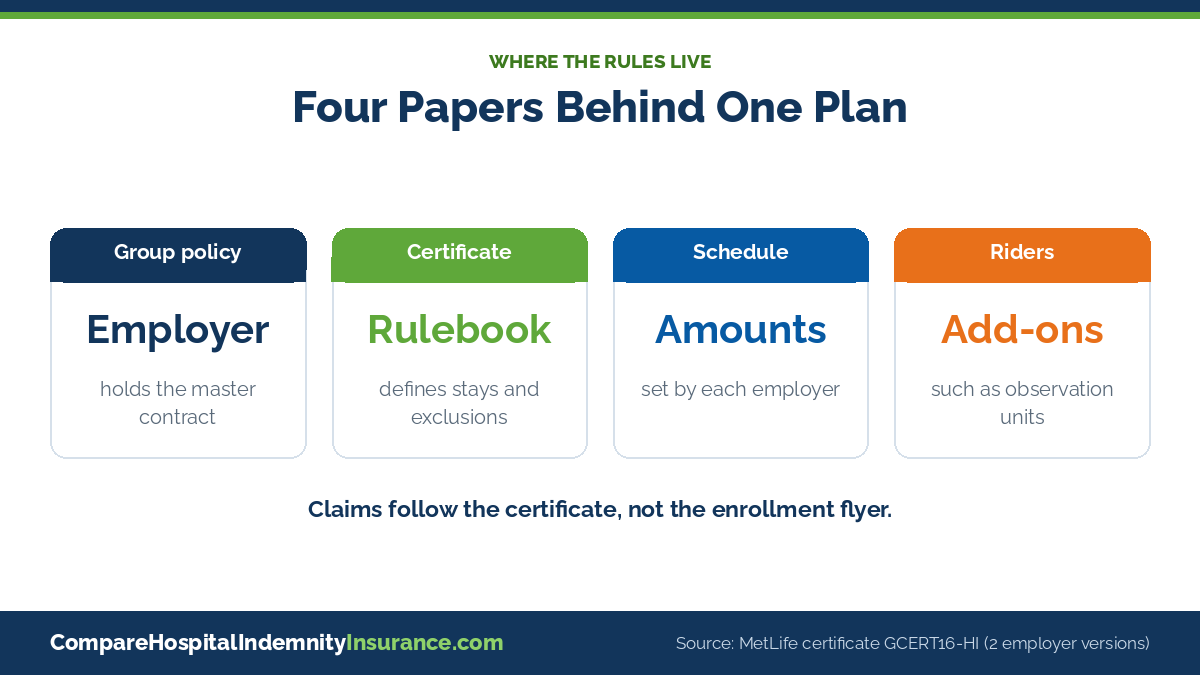
Two MetLife certificates printed on the same GCERT16-HI form can carry different exclusion lists, because state versions and employer choices change the pages. The certificate number and state code in the page footer identify the exact version, and that is the version a claim examiner applies, not the enrollment flyer.
Russell Noga, Licensed Insurance Agent
Injury Exclusions vs Sickness Exclusions
MetLife sorts exclusions into three buckets: every claim, injury claims only and sickness claims only. The same stay can pass or fail depending on its cause.
Blocked only when an injury caused the stay
✔
Driving while intoxicated, at .08% blood alcohol or more
✔
Flying other than as a fare-paying passenger, and parachuting except to save your life
✔
Motor vehicle racing, stunts or speed tests
✔
Semi-pro or pro sports played for pay
✔
Bungee or base jumping, hang gliding, scuba deeper than 130 feet, spelunking, rope mountaineering
Blocked only when a sickness caused the stay
✕
A dependent child’s routine childbirth, in the New York certificate
✕
Alcoholism, drug addiction and chemical dependency, in the New York certificate
✕
Routine pregnancy with no complications, which neither counts as a sickness
✕
Any pre-existing condition limit the employer adds
The injury list targets dangerous hobbies and jobs. A recreational skier, or a diver who stays above 130 feet, is not excluded by it.
Mental health stays:
Both certificates define sickness as a physical illness, infirmity or disease, and the New York version also excludes mental or emotional disorders. Confirm with MetLife before a planned behavioral health stay.
Newborns, Start Dates and Keeping Coverage After a Job Ends
These timing rules sit in the eligibility pages, not the benefit pages, so they are easy to miss.
1
Be actively at work on the effective date. If not, coverage starts when you return. A dependent hospitalized on that date also starts later.
2
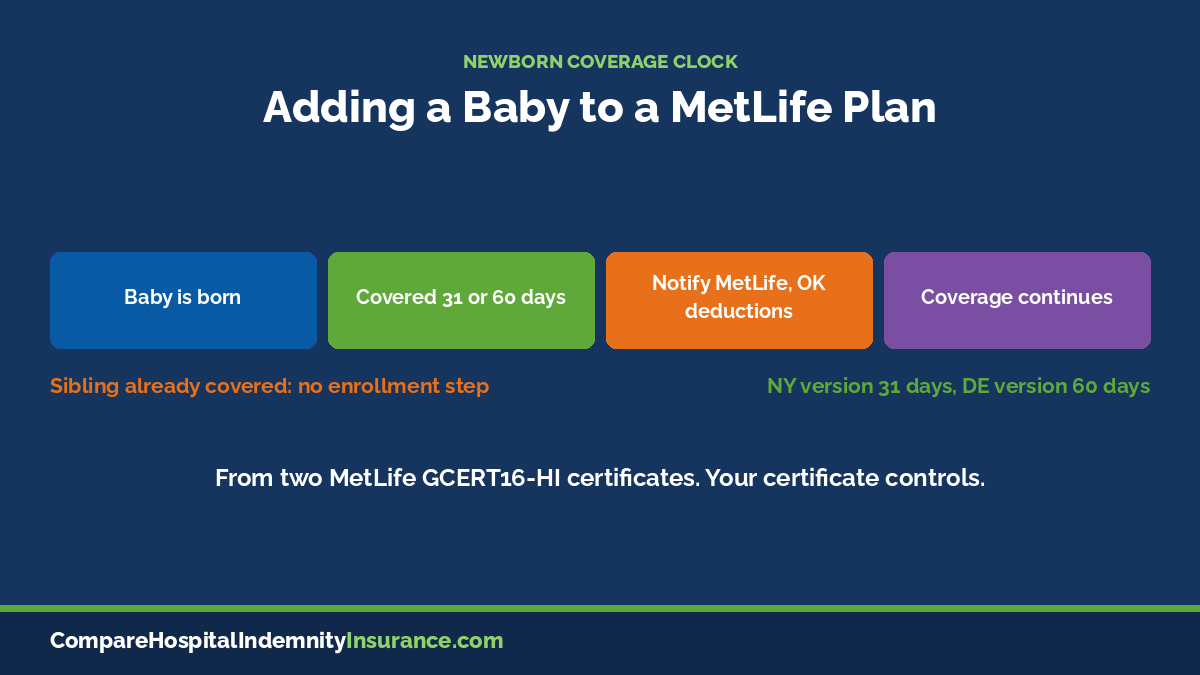
Watch the newborn clock. A baby is covered from birth with no enrollment if another child is already covered. Otherwise coverage lasts 31 days (New York) or 60 days (ConocoPhillips) unless you notify MetLife and authorize deductions.
3
Know when a newborn’s own admission pays. Only when the baby enters an ICU for a sickness or injury. A healthy baby gets nursery days, where the plan has them.
4
Request continuation within 31 days. If group coverage ends for a reason other than unpaid premium, a written request keeps it, with no health questions. You can lower it later but not raise it.
In the New York certificate, continuation is unavailable if the group policy ends and you become eligible for similar group coverage within 30 days. For delivery timing, see MetLife hospital indemnity pregnancy coverage.