Speak with a licensed insurance agent

1-888-891-0229

Does Hospital Indemnity Cover Childbirth? Payouts for a Vaginal Birth and a C-Section

Reviewed by Russell Noga, Licensed Insurance Agent — Last updated November 15, 2026

Yes, hospital indemnity insurance covers childbirth on most plans that include pregnancy: an inpatient delivery stay triggers the same admission and daily cash benefits as any other covered hospital stay. Three things can still block the payment, namely a birth waiting period, a pregnancy that began before coverage started, or a delivery that never becomes an inpatient admission.

Before the due date

See What a Delivery Stay Would Pay in Your State

Compare admission and daily amounts from several insurers.

Plan availability, eligibility, and benefits vary by state and policy.

To show what that means in dollars, we read five employer plan summaries from Unum, Cigna, Sun Life, Aetna and Aflac and worked out what each one would pay for a two-day vaginal birth and a four-day C-section. The broader buying questions live in our main guide to hospital indemnity insurance pregnancy coverage, and you can compare hospital indemnity insurance plans from several carriers in one place.

Keep one limit in mind throughout. Hospital indemnity is supplemental, limited-benefit coverage that pays you a set amount of cash. It is not health insurance, it is not minimum essential coverage, and it does not pay the hospital’s delivery bill for you.

Bottom line first

Hospital indemnity covers childbirth when the plan includes pregnancy, the birth is an inpatient hospital stay, and any birth waiting period has passed; in the five workplace plans we checked, example payouts ran from $1,200 to $1,700 for a two-day vaginal birth.

Can Hospital Indemnity Be Used for Childbirth? The Three-Part Test

A hospital indemnity plan pays for a hospital confinement caused by a covered sickness or injury. Most group plans count pregnancy as a covered sickness. The Aflac group brochure reviewed here defines sickness to include pregnancy, and the Cigna summary lists pregnancy and its complications as a covered illness. So the birth itself is rarely the problem; timing and paperwork are.

1
Is pregnancy a covered reason? Look for the words pregnancy, childbirth or routine pregnancy in the covered illness or sickness definition. If the plan lists only complications of pregnancy, a normal delivery will not pay.
2
Did coverage start in time? A plan may refuse a birth in its first months, or treat a pregnancy that existed on the start date as a pre-existing condition.
3
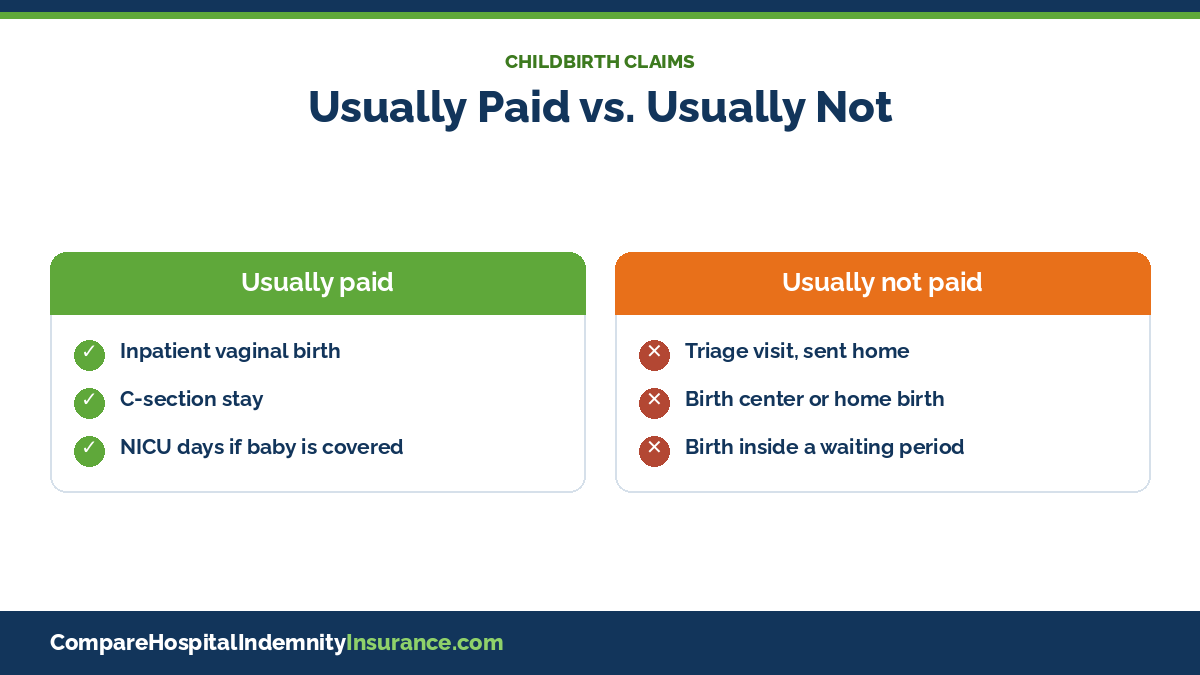
Were you admitted as an inpatient? Hours in labor triage or an outpatient birth do not count as a hospital admission on most plans.

If all three answers are yes, the delivery is paid like any other stay. If you were pregnant before the policy began, the rules change enough that we cover them on a separate page about hospital indemnity if already pregnant.

Comparison of when hospital indemnity covers childbirth and when a delivery is not paid

Does Voluntary Hospital Indemnity Cover Childbirth at Work?

Most people asking this have a voluntary plan offered through their job. Group plans are often the easiest route to a paid birth, because enrollment is usually guaranteed and several summaries we read state no pregnancy waiting period.

Unum (employee summary, form 9-24)
Pays childbirth for any insured after the coverage effective date and states the plan has no pre-existing condition limitation.
Cigna (National Jewish Health, 2025)
Covered illness includes pregnancy, and the summary states no benefit waiting period unless otherwise stated.
Guardian (carrier website)
Guardian says its plan benefits are not payable for a birth in the first 9 months of coverage.

Timing at open enrollment:

Group coverage usually starts on the plan year date, not the day you sign up. A plan with a 9-month birth rule that starts January 1 would not pay for a birth before October 1 of that year.

Our guide to voluntary hospital indemnity insurance explains payroll deduction, portability and what happens to the plan if you leave the job after the baby arrives.

Russell Noga, licensed insurance agent

Before you file

Most plans pay a birth claim from the hospital’s admission and discharge dates. An itemized bill or discharge summary that shows inpatient status and both dates is the usual proof, and a separate claim covers any NICU stay for the baby.

Russell Noga, Licensed Insurance Agent

Five Employer Plans, One Delivery: Our Payout Math

Plan summaries list benefit amounts but rarely show what a birth would pay. We took each plan’s own admission and daily amounts and applied them to two typical stays: two days for a vaginal birth and four days for a C-section. The newborn column is a separate payment some plans make for a healthy baby’s nursery stay.

Plan reviewed Admission + daily benefit Childbirth covered? Example: 2-day vaginal Example: 4-day C-section Healthy newborn stay
Unum group, employee summary (form 9-24) $1,500 + $100/day Yes, after effective date; no pre-existing limit $1,700 $1,900 Excluded unless baby is sick or injured
Cigna group, National Jewish Health (2025), Tier 1 $1,250 + $125/day Yes, pregnancy is a covered illness $1,500 $1,750 $625 once per newborn
Sun Life group, University of the South (rates eff. July 1, 2026) $1,000 first day + $100/day Yes, routine pregnancy listed $1,200 $1,400 $100/day, up to 3 days
Aetna group, Hearne ISD (High plan) $1,500 + $200/day from day two Yes, stays to deliver a baby $1,700 $2,100 $200 lump sum per birth
Aflac group, ICUBA (High plan, brochure exp. 12/25) $1,000 + $100/day Yes, pregnancy is in the sickness definition $1,200 $1,400 Not paid unless baby needs ICU

Our calculation from each employer’s published plan summary, checked November 2026. Payouts are examples only: admission + daily benefit x days, counting every day of the stay except on the Aetna plan, which states daily benefits begin on day two. The Aflac brochure’s own two-day example also totals $1,200. Certificates control, and your employer’s amounts may differ.

What the math shows

On these plans the admission benefit does most of the work. Two extra days in the hospital after a C-section added only $200 to $400, while the one-time admission payment ran from $1,000 to $1,500.

Watch the per-year limits. The Unum plan pays its admission benefit once per year, and the Cigna plan once every 60 days. A pregnancy complication stay a few weeks before delivery could use up that admission benefit, leaving only daily pay for the birth itself. For how other stays compare, see how much hospital indemnity pays.

Do Hospital Indemnity Plans Cover a C-Section Differently?

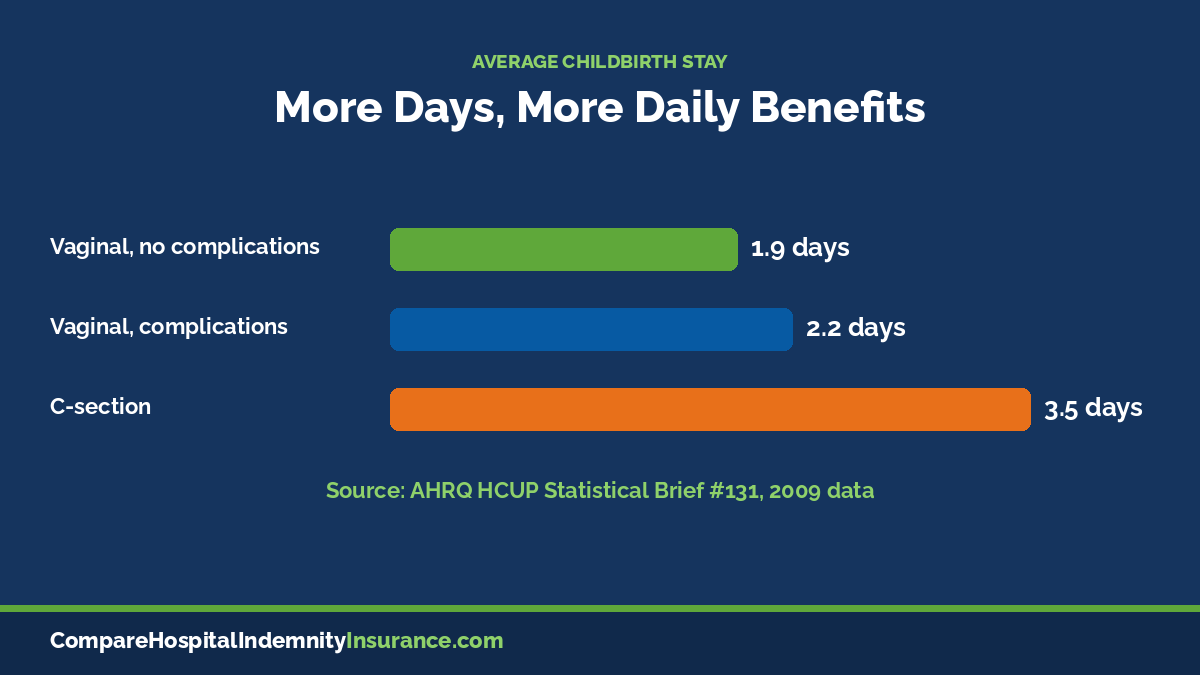
None of the five plans pays a separate C-section rate. A cesarean pays more only because the stay runs longer, so more daily benefits add up. Plans that include a surgery benefit or a rider may add money for the operation itself.

Births in the United States, 2024 final data (CDC)
3,628,934
births registered in 2024
32.4%
of births were by cesarean
26.6%
low-risk cesarean rate, unchanged from 2023

Do not count on complication pay:

The Aflac Choice individual outline of coverage, form B40125IA, states that elective cesarean deliveries are not considered complications of pregnancy, so a planned C-section is paid, or excluded, under the normal birth rules.


Bar chart of average hospital days for vaginal and cesarean births, which shapes how hospital indemnity covers childbirth

Hospital Indemnity Quotes

Call a Licensed Agent Now

A licensed agent can check pregnancy terms and newborn benefits on plans sold in your state.

☎ 1-888-891-0229

No obligation to enroll

Your Baby’s Benefits Are a Separate Line Item

A mother’s delivery stay and her baby’s nursery stay are often treated as two different events. The table shows how much this varies. Cigna, Sun Life and Aetna pay something for a healthy newborn, while Unum and the Aflac group plan exclude a routine newborn admission and pay only if the baby is sick, injured or in intensive care.

Newborn terms to find in your summary
  • ✔
    Whether a healthy baby’s nursery stay pays, and for how many days.
  • ✔
    How long a newborn is covered automatically. The Aflac group brochure covers newborns from birth for 60 days.
  • ✔
    Whether the newborn benefit pays even if you did not buy child coverage. The Cigna summary says it does.
  • ✔
    Whether a NICU stay pays at the intensive care rate, and the daily limit.

How the Cash Stacks Up Against a Birth’s Real Costs

A KFF analysis of employer health plan claims from 2018 to 2020 found that women who gave birth paid about $2,655 more out of pocket for a vaginal delivery and $3,214 more for a cesarean, counting pregnancy, birth and postpartum care. The 2025 KFF Employer Health Benefits Survey put the average single-coverage deductible at $1,886. Against those figures, the example payouts above would cover a large share of a typical out-of-pocket bill.

What the Newborns’ Act protects
✔

Group health plans and insurers that cover childbirth generally cannot limit the stay to less than 48 hours after a vaginal birth or 96 hours after a cesarean
✔

Plans cannot require pre-approval for a stay of that length
✔

The clock starts at delivery, or at admission if the baby is born outside the hospital
What it leaves to your indemnity contract
✕

The law does not require any plan to cover childbirth
✕

It does not set how many days a fixed indemnity plan pays
✕

Your doctor may still discharge you earlier after talking with you

The stay rule comes from U.S. Department of Labor guidance on the Newborns’ and Mothers’ Health Protection Act, and insured plans may follow a state version instead. It shapes how long your health plan pays for; the indemnity plan pays only for the days you were actually admitted.

When a Policy Pays Little or Nothing for the Birth

Individual policies sold outside work tend to have tighter pregnancy terms than the employer plans in the table. One Aflac individual outline of coverage, form B40125RIA, states that a pregnancy existing on the effective date is a pre-existing condition, and its base policy pays a flat $250 when a covered person gives birth in a hospital.

  • A birth inside a waiting period, such as Guardian’s 9-month rule.
  • A pregnancy that began before the effective date on plans with a pre-existing condition clause.
  • A plan that lists only complications of pregnancy as covered.
  • A home birth, a birth center delivery or an outpatient birth. The Aetna summary states its newborn benefit will not pay for an outpatient birth.
  • A delivery after you have already used the year’s admission benefit on an earlier stay.

No-cost quotes

Get Hospital Indemnity Quotes Built Around a Birth

Check newborn benefits and waiting periods side by side.

Plan availability, eligibility, and benefits vary by state and policy.

Childbirth and Hospital Indemnity: Common Questions

➤ Does hospital indemnity insurance cover childbirth if I bought it through work?

Usually yes. Most group plans count pregnancy as a covered sickness, and several employer summaries we read state no pregnancy waiting period. Guardian is an exception, with no birth benefit in the first 9 months of coverage.

➤ Can you use hospital indemnity for childbirth and still have your health plan pay the hospital?

Yes. The indemnity plan pays cash to you, and your health plan handles the hospital bill under its own terms. You can spend the indemnity cash on the deductible, rent or anything else.

➤ Does hospital indemnity for childbirth pay more for a C-section?

Not at a special rate. A C-section stay is usually longer, so more daily benefits are paid, and some plans add a surgery benefit.

➤ Do hospital indemnity plans cover childbirth if I am already pregnant when I enroll?

Some do and some do not. A plan with no pre-existing condition limit, like the Unum summary we reviewed, can pay. Plans that treat an existing pregnancy as pre-existing will not pay for that birth.

➤ Will the plan pay for a birth at a birth center or at home?

Usually not. Benefits are tied to an inpatient admission to a hospital as the policy defines it, and a freestanding birth center or home birth does not meet that test on most plans.

➤ Does the newborn get a separate payout?

On some plans. Of the five plans we compared, three paid a healthy newborn benefit, from a $200 lump sum to a one-time $625 payment, while two paid only if the baby was sick or in intensive care.

Delivery Benefit Check

Call a Licensed Agent Now

Compare admission and daily amounts before your plan’s start date.

☎ 1-888-891-0229

No obligation to enroll

Russell Noga, licensed insurance agent

About the Author: Russell Noga

Russell Noga is a licensed insurance agent and the founder of ZRN Health & Financial Services, LLC. He has helped people compare health and supplemental insurance for more than 16 years and reviews every page on Compare Hospital Indemnity Insurance before it is published. Learn more about us or read our Editorial Standards.

CompareHospitalIndemnityInsurance.com is operated by ZRN Health & Financial Services, LLC, a Texas limited liability company based in Austin, Texas. We are not connected with or endorsed by any government agency.