Fixed Indemnity Plan Designs: Per Day or Per Service
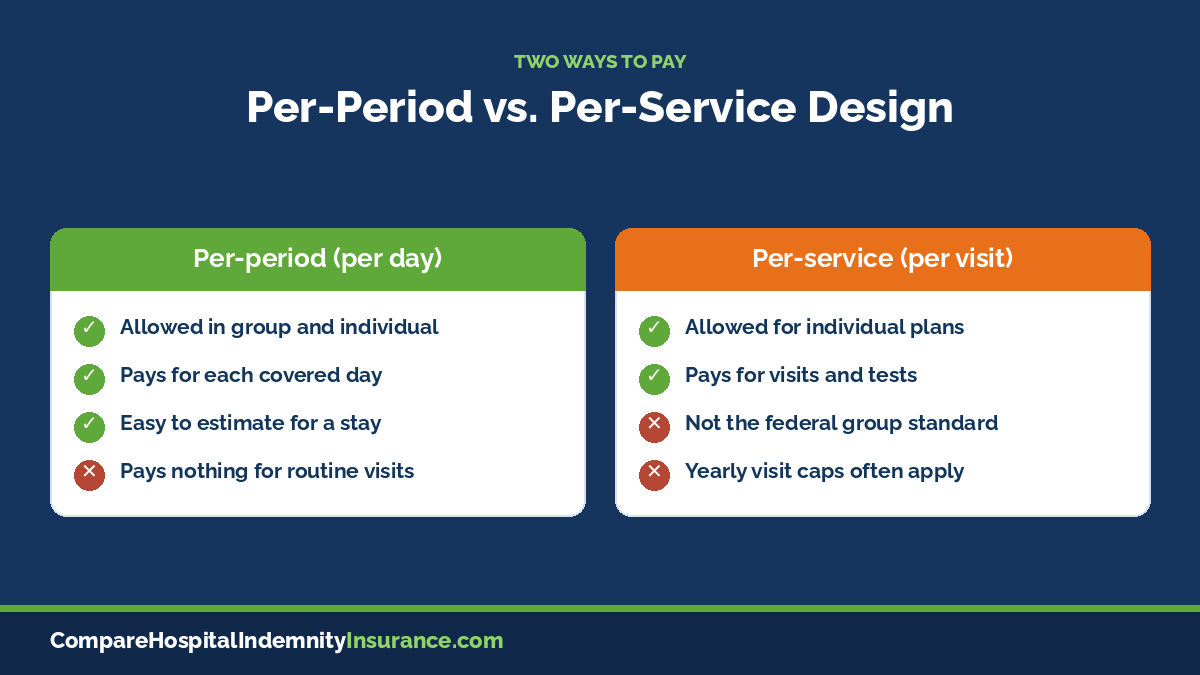
Fixed indemnity plans pay in one of two ways. A per-period design pays for time, such as $150 for each day you are hospitalized (example amount). A per-service design pays a scheduled amount for each item of care, such as $50 for an office visit (example amount). Which design is allowed depends on whether the plan is sold to an employer group or to an individual.
| Year |
What changed |
What it means today |
| January 2013 |
Federal guidance says group fixed indemnity must pay per period, not per service |
Workplace plans are expected to pay by the day or other time period |
| 2014 (for coverage starting 2015) |
Individual plans allowed to pay per period and/or per service, but only for buyers who attest they have minimum essential coverage, plus a printed notice |
Per-service individual plans became permitted under federal rules |
| July 2016 |
Federal appeals court in Washington, D.C., strikes the attestation requirement in Central United Life v. Burwell |
Anyone can buy an individual fixed indemnity plan, even with no other coverage |
| April 2024 |
New rule finalized a revised notice but did not finalize a proposed per-period-only standard or a tax change |
The agencies said existing group rules still require per-period payment |
Sources: Federal Register, April 3, 2024 final rule; D.C. Circuit opinion, July 2016; Montana insurance commissioner memo, August 2024. State law can add limits.
So an individual policy that pays a set amount per doctor visit fits federal rules, while a workplace plan built the same way may not fit the group standard. Many employer hospital plans pay per admission and per day, and states review the forms filed in their markets. For real daily amounts, see how much hospital indemnity pays.
Watch for:
Per-service schedules can look generous line by line but often cap visits or tests each year. Add up the yearly maximums before judging what a plan could pay.
Read the notice
Before paying the first premium, find the boxed notice in large capital letters on the application. On an individual fixed indemnity policy, it states the policy supplements health insurance and is not a substitute for major medical coverage. A product sold as complete health coverage that carries this notice is a limited plan, and the state department of insurance can confirm how it is filed.
Russell Noga, Licensed Insurance Agent
The Notice on Your Application and the Court Fight Over It
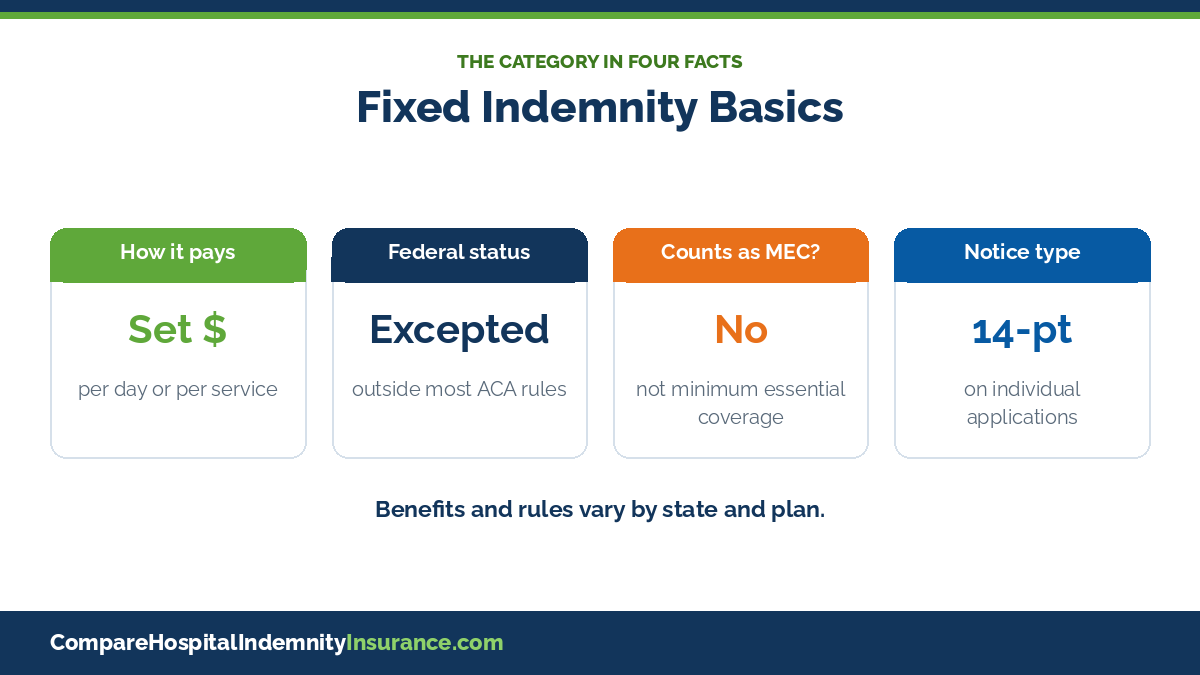
Since 2015, individual fixed indemnity applications have had to carry a federal notice, in at least 14-point type, stating that the policy supplements health insurance and is not a substitute for major medical coverage. A second line warns that lacking minimum essential coverage may mean an extra payment with your taxes.
How the notice rules stand
Dec 4, 2024
federal court in eastern Texas vacates that revised notice
June 2025
federal agencies drop their appeal at the Fifth Circuit
14-point
minimum type size for the 2014 individual notice still in force
The 2024 rule would have put a new notice, saying in plain terms that the product is not health insurance, on the first page of marketing and enrollment materials for workplace and individual plans. In ManhattanLife Insurance and Annuity Co. v. HHS, the federal court in eastern Texas ruled the agencies exceeded their authority and set it aside. The government appealed in February 2025, then asked the Fifth Circuit to dismiss, and the appeal was dismissed on June 10, 2025.
Where things stand:
Based on the court record, the 2014 notice still applies to individual policies, and no federal notice is required for group plans. States can require their own disclosures, so wording may differ by state.
One detail the older notice has not caught up with: the federal penalty for going without coverage has been $0 since 2019. A tax payment can still apply in places with their own mandate, currently California, Massachusetts, New Jersey, Rhode Island and the District of Columbia.
When a Fixed Indemnity Plan Is Pitched as Your Only Coverage
The real risk is the sales pitch, not the product. A $100-a-day plan (example) can be a sensible add-on to a high-deductible health plan, yet a poor stand-in for one when a surgery runs into five figures. Georgetown University’s navigator guide notes that payments often fall far below actual costs and that buyers can pay more in premiums than they collect.
1
It is called a PPO or full coverage. Fixed indemnity plans pay set amounts; they do not cap your out-of-pocket costs like major medical coverage.
2
You are pushed to sign on the first call. Individual plans can usually be bought any time of year.
3
No benefit schedule is offered. Ask for the outline of coverage with every dollar amount, day limit and yearly maximum.
Regulators have acted on this pattern. In 2018 the Federal Trade Commission shut down Simple Health Plans, a Florida operation that sold limited benefit and discount plans as comprehensive coverage; a typical plan paid $50 per doctor visit for up to three visits a year and up to $100 a day in the hospital. In February 2024 the FTC announced a $195 million judgment and a ban on the company and its owner. If a plan was sold to you as health insurance, report it to your state department of insurance.