Speak with a licensed insurance agent

1-888-891-0229

Voluntary Hospital Indemnity Insurance: Workplace Plans, Real 2026 Rates and Tax Rules

Reviewed by Russell Noga, Licensed Insurance Agent — Last updated November 18, 2026

Voluntary hospital indemnity insurance is optional group coverage offered through your job that you pay for by payroll deduction, and it sends you a fixed cash amount when you are admitted to a hospital. In the five 2026 employer plans we compared, one admission pays $500 to $1,500 and employee-only coverage costs about $11 to $28 a month.

Side-by-side check

Compare Your Workplace Option With Plans Sold Direct

Enter your ZIP code to see individual hospital indemnity plans near you.

Plan availability, eligibility, and benefits vary by state and policy.

The 30-second answer

Voluntary hospital indemnity insurance is a workplace hospital cash plan you choose and fund yourself through your paycheck. It pays set dollar amounts per admission and per day in the hospital, on top of your medical plan, and it is not health insurance or minimum essential coverage.

Voluntary, Employer-Paid or Individual: Three Ways to Get Hospital Cash

On an enrollment screen, the label voluntary tells you who pays. Your employer chooses the insurance company and the benefit levels, and you cover the premium. Pay stubs often shorten it to something like vol hospital indemnity or VOL HI, which is the same product. Like every hospital indemnity policy, it is supplemental, limited-benefit coverage: it does not replace a medical plan and it is not minimum essential coverage. For the full menu of plan designs, start with our guide to hospital indemnity insurance plans.

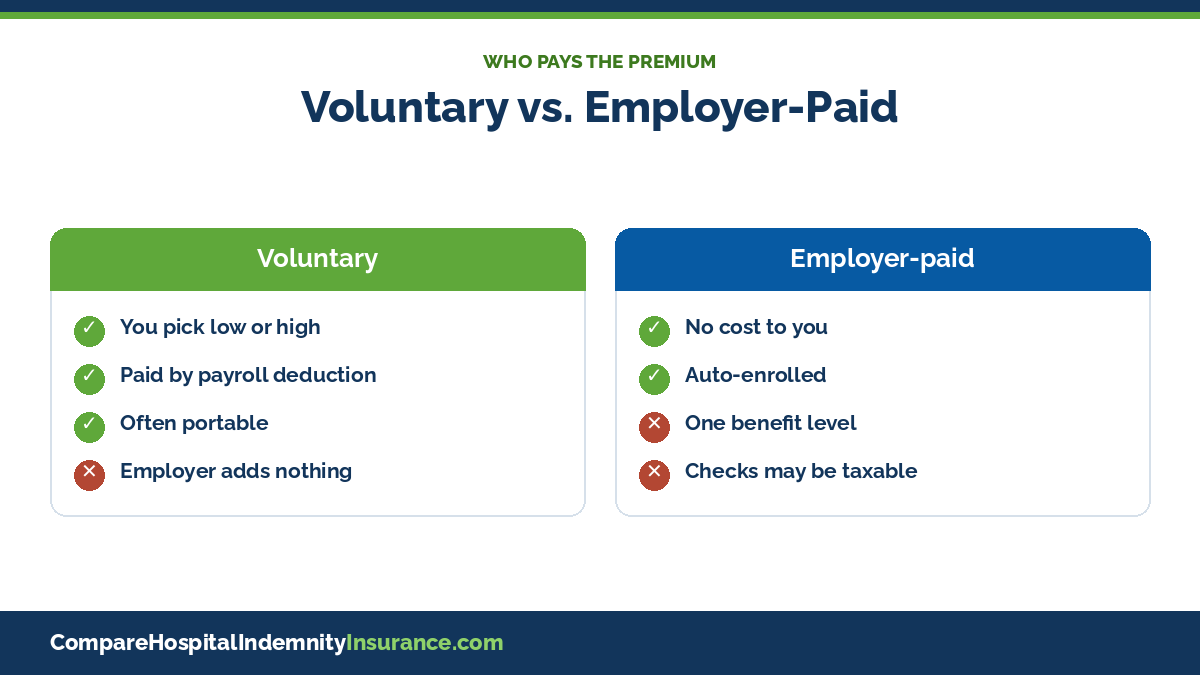
Voluntary (employee-paid)
You elect it, often choose a low or high option, and the premium comes out of each paycheck.
Employer-paid
The employer funds it, sometimes only for workers on a high-deductible plan. You get one fixed benefit level.
Individual policy
Bought on your own from an insurer, priced by age, and not tied to any job.

Employer-paid versions do exist. Oregon Health & Science University (OHSU) automatically enrolls employees on its high-deductible HSA plan in a MetLife hospital indemnity plan at no cost for 2026, while staff on other medical plans can buy the same coverage through payroll deduction.

Comparison of voluntary hospital indemnity insurance paid by the employee versus hospital indemnity coverage paid by the employer

Five 2026 Employer Plans Compared, With Our Own Math

Benefits guides describe one plan at a time. We lined up five published workplace plans and added two columns of our own: how many years of employee-only premium one admission check returns, and how many times more the family tier costs than employee-only coverage.

Employer, carrier Admission / daily Employee-only premium Family premium Admission check ÷ yearly premium (our math) Family vs. employee-only (our math)
State of Michigan, Trustmark (issue age 18-49) $1,500 / $200 a day from day 2 $12.84 bi-weekly ($333.84 a year) $35.90 bi-weekly 4.5 years 2.8x
OHSU, MetLife, 2026 $1,300 / $200 a day, 30 days $22.52 a month ($270.24 a year) $58.22 a month 4.8 years 2.6x
Floyd County, Ind., Atlantic American, 2026 $1,000 / $100 a day, 31 days $6.83 per pay, 24 pays ($163.92 a year) $18.86 per pay 6.1 years 2.8x
Lewis County, Wash., MetLife Low, 2026 $500 / $100 confinement $11.21 a month ($134.52 a year) $29.41 a month 3.7 years 2.6x
Lewis County, Wash., MetLife High, 2026 $1,000 / $200 confinement $20.55 a month ($246.60 a year) $53.92 a month 4.1 years 2.6x

Our comparison of published employer benefit materials, checked November 2026: State of Michigan civil service voluntary benefits page (plan year not shown), OHSU 2026 Employee Benefits Guide, Floyd County Government 2026 Employee Benefit Guide, Lewis County 2026 Benefit Guide. Yearly premium = published rate x pay periods or x 12. Examples only; your employer’s plan will differ.

What our math shows

In every plan, a single admission check equals 3.7 to 6.1 years of employee-only premium, and covering a whole family costs about 2.6 to 2.8 times as much as covering yourself.

The admission check is only the start. A daily benefit adds to it for each night, within the plan’s day limit. To estimate a full stay, see how much hospital indemnity pays.

Measured Against What a Hospital Stay Costs

These checks are sized to soften out-of-pocket costs, not to cover a hospital bill. The 2025 KFF Employer Health Benefits Survey puts the average single-coverage deductible at $1,886 for workers whose plan has one, and 34% of covered workers face a deductible of $2,000 or more.

Hospital cost markers
$1,886
average single deductible, KFF 2025 survey
34%
of covered workers with a $2,000+ deductible
$3,449
nonprofit hospital expense per adjusted inpatient day, 2024
$2,623
for-profit hospital expense per adjusted inpatient day, 2024

The per-day figures come from KFF State Health Facts using the 2024 American Hospital Association Annual Survey. They measure what hospitals spend, not what a patient pays. Our comparison: Michigan’s $1,500 first-day check alone covers about 80% of that average deductible, and adding two $200 days pushes the total past it. Floyd County’s $1,000 admission covers a little over half.

Fine print that changes the math:

Most plans pay only for an inpatient admission. Several in our table start the daily benefit on day two, cap days per stay, or limit admissions per year.

Family Tiers, Age Bands and the Low-to-High Upgrade

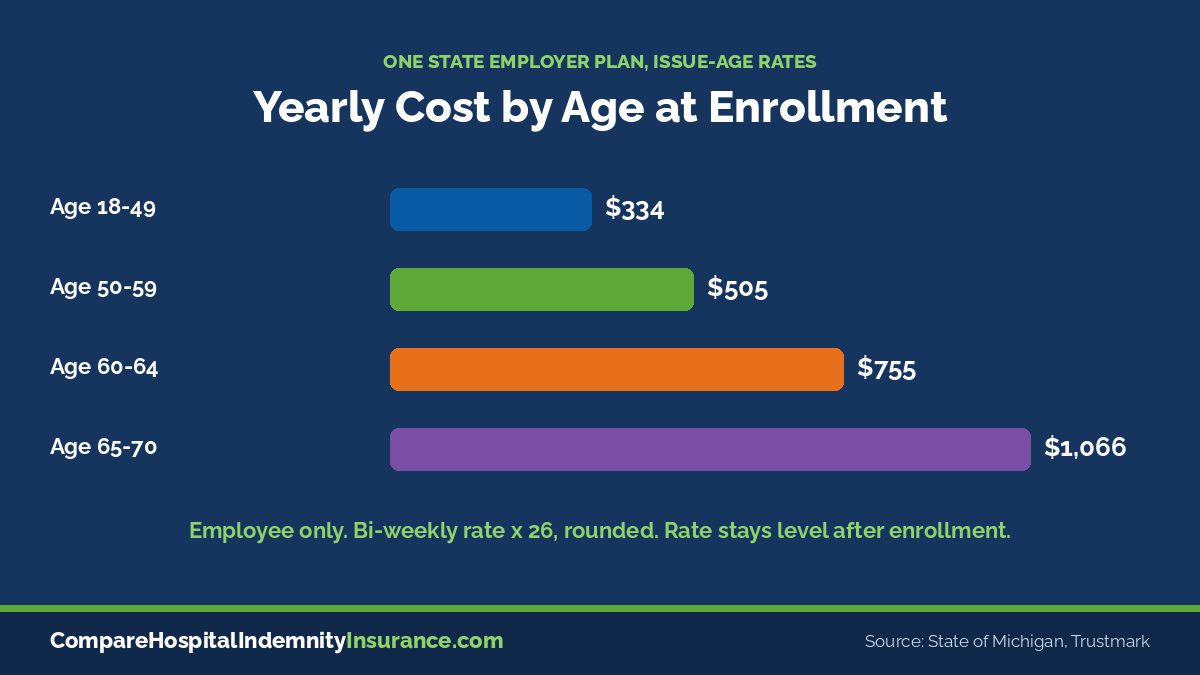
Most workplace rate sheets charge one price per coverage tier regardless of age. Michigan’s Trustmark plan is an exception: it sets the rate by age at enrollment, then keeps it level. An employee who joins at 55 pays $19.42 every two weeks for as long as the policy runs, while one who joins at 62 pays $29.04.

  • Children can cost more than a spouse. In Michigan’s youngest band, employee plus children is $25.92 bi-weekly versus $22.83 for employee plus spouse. Floyd County and OHSU run the other way.
  • The upgrade is about $9 a month. Lewis County’s High option costs $9.34 more a month for one employee ($112.08 a year) and doubles the admission check from $500 to $1,000.
  • Coverage length can be capped. Michigan’s coverage lasts to age 70 or five years from issue, whichever is longer.

For a deeper look at choosing between options on one menu, read hospital indemnity low vs. high plans.


Bar chart of yearly employee-only premium by issue age for one voluntary hospital indemnity insurance plan with level rates

Hospital Indemnity Quotes

Call a Licensed Agent Now

Hold your workplace rate up against individual plans from several insurers.

☎ 1-888-891-0229

No obligation to enroll

Pre-Tax or After-Tax Deductions and a Taxable Check

How the premium leaves your paycheck can decide whether a benefit check counts as income. Employers set the method for the whole plan, and many guides do not mention it.

The IRS position

IRS Chief Counsel Advice 201703013 (released January 2017) concludes that when fixed indemnity premiums are paid with after-tax dollars, benefits are generally not taxable. When premiums are paid pre-tax through a Section 125 cafeteria plan, or by the employer, benefits paid without regard to your actual medical costs are treated as taxable income and wages.

Where the rules stand in 2026

Federal agencies proposed writing that tax treatment into regulations in 2023. The April 2024 final rule deferred the tax piece, so it remains guidance rather than a final regulation. That same rule added a consumer notice for group fixed indemnity coverage, but a federal court in Texas vacated the notice in December 2024, and it stayed vacated after the government dropped its appeal in June 2025.

Not tax advice:

Ask HR whether your hospital indemnity deduction is pre-tax or after-tax, and check with a tax professional about how a claim payment should be reported.

Russell Noga, licensed insurance agent

Pay stub check

Pay stubs usually group deductions into pre-tax and after-tax sections. Where the hospital indemnity line appears is the quickest way to confirm how the premium is paid, and that payment method is what the IRS looks at when deciding whether a claim check counts as taxable income.

Russell Noga, Licensed Insurance Agent

Enrollment Windows and the Fastest Way to Get Covered

Workplace plans trade flexibility for easy entry. Michigan’s plan is guaranteed issue with no health questions or exam, and the UT System’s Securian plan likewise asks none. The catch is timing.

1
New-hire window. Usually about a month. OHSU gives new employees 31 days from hire.
2
Open enrollment. Elections made in the fall typically start with the new plan year. OHSU’s 2026 window ran October 20 to November 7, 2025, effective January 1, 2026.
3
Qualifying life event. Marriage, a birth or loss of other coverage can reopen enrollment for a short period, often 31 days.
4
Actively at work. Many plans, including Michigan’s, require you to be actively at work on the date coverage would begin.

So the fastest start date is rarely at work unless you are a new hire. Individual policies can usually be applied for any time of year, with a start date set by the carrier and state, though they may ask health questions. Pre-existing condition rules vary by plan: Michigan lists a waiver of pre-existing conditions, while other certificates limit early claims, so read yours.

Leaving the Job: Portability and Buying on Your Own

Many group hospital plans are portable. Michigan’s plan lets departing employees keep the same benefits and premium. The UT System’s Securian plan lets you pay the carrier directly, at active-employee rates that may change later. Employer-paid coverage, such as OHSU’s for HSA enrollees, may not follow you, so check the certificate.

Keep the workplace plan when
✔

It is portable at the same rate
✔

Your health makes new coverage hard to get
✔

An issue-age rate locks in a younger price
Shop individual plans when
✕

The plan ends with your job
✕

You want a different benefit level
✕

A younger age makes individual rates lower

Before your last day, get a quote for the same admission and daily amounts and set it next to the portable rate. You can compare hospital indemnity insurance from several carriers in one place.

Coverage you keep

Changing Jobs or Past Your Enrollment Window?

See individual hospital cash plans that do not depend on an employer.

Plan availability, eligibility, and benefits vary by state and policy.

Voluntary Hospital Indemnity: Common Questions

➤ What does vol hospital indemnity mean on my pay stub?

It is usually the payroll deduction for voluntary hospital indemnity coverage you elected at work. The premium is yours, and the cash benefit is paid to you when you are admitted to a hospital.

➤ What is usually included in an employer-paid hospital indemnity plan?

Typically an admission benefit, a daily hospital benefit and sometimes small extras. OHSU’s 2026 employer-paid MetLife plan, for example, pays $1,300 per admission, $200 a day for up to 30 days, a $50 health screening benefit and newborn nursery days.

➤ Which supplemental plan offers the fastest enrollment and coverage start date?

At work, the fastest route is the new-hire window, since open enrollment elections usually wait for the next plan year. Outside those windows, individual hospital indemnity policies can usually be applied for any time, with start dates set by the carrier and state.

➤ Are voluntary hospital indemnity benefits taxable?

It depends on how the premium is paid. IRS Chief Counsel advice says benefits are generally tax-free with after-tax premiums but can be taxable income when premiums are paid pre-tax or by the employer.

➤ Can I keep my voluntary hospital indemnity plan if I quit?

Often yes, if the plan is portable. Michigan’s and the UT System’s plans both allow it, with direct billing from the insurer. Check your certificate for the deadline to elect it.

➤ Do I need to answer health questions to enroll at work?

Usually not during your enrollment window. Group plans such as Michigan’s are guaranteed issue, though some certificates still limit benefits for conditions treated shortly before coverage began.

Free Plan Comparison

Call a Licensed Agent Now

Get a second opinion on your enrollment choices before the window closes.

☎ 1-888-891-0229

No obligation to enroll

Russell Noga, licensed insurance agent

About the Author: Russell Noga

Russell Noga is a licensed insurance agent and the founder of ZRN Health & Financial Services, LLC. He has helped people compare health and supplemental insurance for more than 16 years and reviews every page on Compare Hospital Indemnity Insurance before it is published. Learn more about us or read our Editorial Standards.

CompareHospitalIndemnityInsurance.com is operated by ZRN Health & Financial Services, LLC, a Texas limited liability company based in Austin, Texas. We are not connected with or endorsed by any government agency.