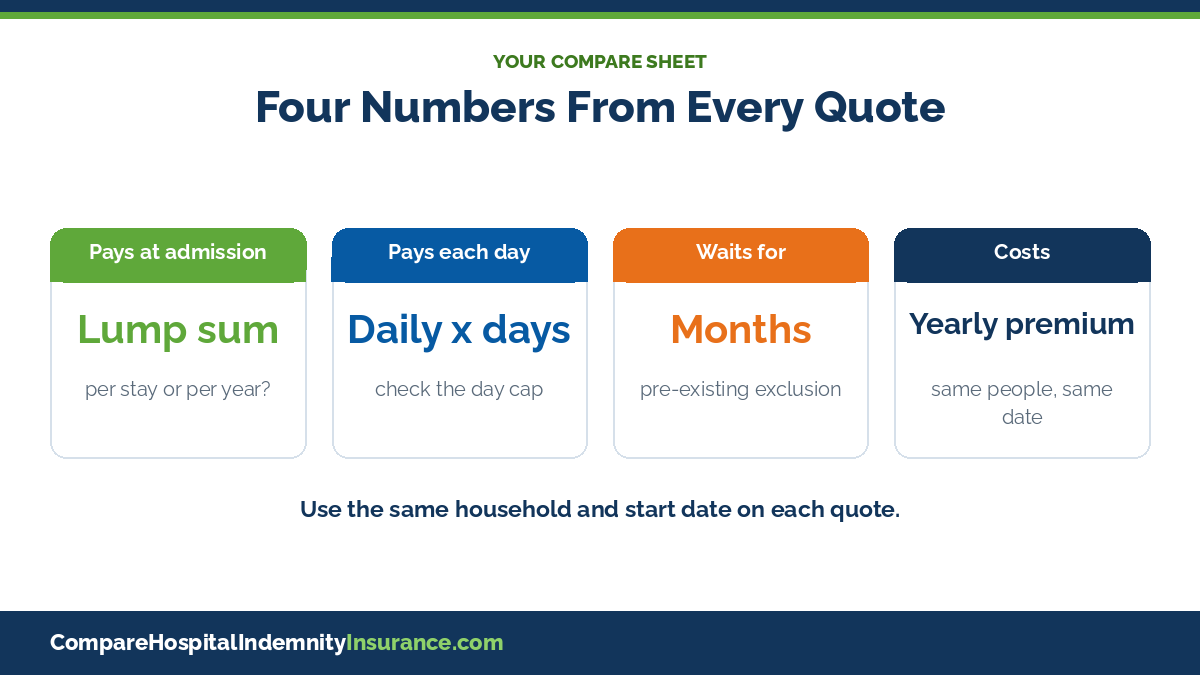
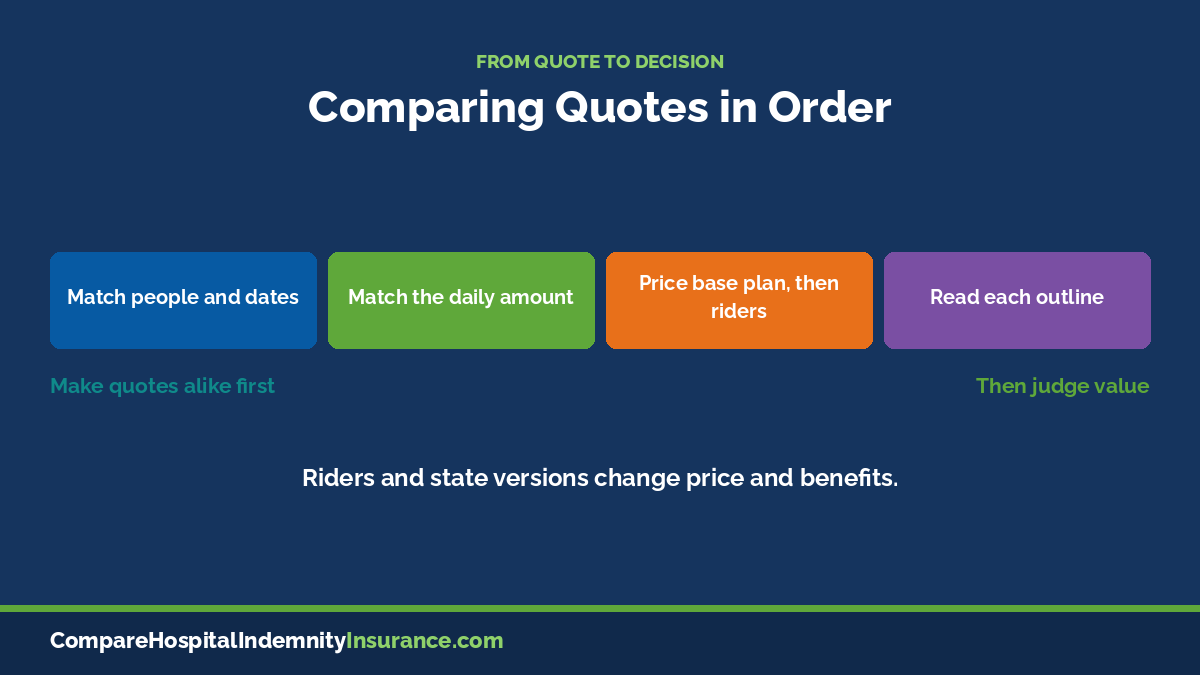
This page is the method, not a ranking. If you want to know who sells these plans and how each company is set up, start with our guide to hospital indemnity insurance companies. Here we focus on the criteria, a worksheet for quotes and a table we built from five carriers’ own brochures. When you are ready to see plans sold in your ZIP code, you can compare hospital indemnity insurance quotes with a licensed agent.
Every plan here is supplemental, limited-benefit coverage. None replaces health insurance or counts as minimum essential coverage.
Where to start
Compare hospital indemnity insurance by putting each provider’s admission benefit, daily benefit, day limit, observation rule, pre-existing waiting period and premium in one grid for the same people and the same start date. The plan that pays the most for the kind of stay you are likely to have, per dollar of premium, is usually the better buy.
Twelve Terms That Separate One Provider From Another
Two plans can cost the same and still pay very different amounts for the same stay. These terms create the gap.
| What to compare |
What a stronger answer looks like |
Where to find it |
| Daily confinement benefit |
A daily amount that fits your deductible, paid from day 1 |
Schedule of benefits |
| Admission benefit |
A lump sum that pays per stay, not once a year |
Schedule of benefits, footnotes |
| Day limit |
Enough days per stay or per year for a long admission |
Schedule of benefits |
| ICU benefit |
Extra daily pay on top of the regular amount |
Schedule of benefits |
| Observation and outpatient |
A set number of hours that counts, or a rider for ER and outpatient surgery |
Definitions page, rider list |
| Pre-existing look-back |
Short look-back and short exclusion window, or none |
Limitations and exclusions |
| Issue ages |
Your age and your spouse’s age both fall inside the range |
Eligibility section |
| Guaranteed vs. simplified issue |
No health questions, or questions you can answer no to |
Application |
| Portability |
You can keep it after leaving a job |
Termination section |
| Rate stability |
Guaranteed renewable, with rates changed only by class |
Renewability clause |
| AM Best rating |
A range or higher for the issuing company |
AM Best website, carrier site |
| State availability |
Sold in your state with the riders you want |
State brochure or outline of coverage |
Group plans sold through work add one more row: whether your employer chose the low or the high option.
Leave a cell blank when the brochure is silent. A blank is a question to ask before you sign.
Weighing Benefits Against Overall Cost
People often ask how to compare hospital indemnity plans based on benefits and overall cost at the same time. The cleanest way is to price one realistic stay, then divide by the premium.
1
Pick a test stay. Use a three-day inpatient admission with no ICU time.
2
Add up what each plan pays. Admission lump sum plus the daily benefit times three, minus any days the plan skips.
3
Find the yearly premium. Multiply the monthly rate for the same people by 12 and add any policy fee.
4
Divide payout by premium. A higher ratio means more cash per premium dollar for that kind of stay.
5
Repeat with a long stay. Plans with low day limits can win a short test and lose a 10-day one.
Example only:
A plan paying $1,000 at admission and $200 a day would pay $1,600 for a three-day stay. If it costs $40 a month, that is $480 a year, so the ratio is about 3.3 to 1. These figures are made up to show the math and are not quotes.
A low premium often means a smaller daily amount, fewer covered days or a longer wait for sickness claims. To see how two benefit tiers trade off, read our guide to low vs. high hospital indemnity plans.