Speak with a licensed insurance agent

1-888-891-0229

Hospital Indemnity Insurance Exclusions: What Filed Policies Refuse to Pay

Reviewed by Russell Noga, Licensed Insurance Agent — Last updated November 13, 2026

Hospital indemnity insurance exclusions are the causes of loss, types of care and places of treatment a policy will not pay for, such as intentionally self-inflicted injury, war, cosmetic surgery, stays tied to a recent pre-existing condition and, on many plans, care outside the United States. They differ by insurer and by state, and they decide whether a hospital stay produces a check at all.

Read the fine print first

Find Hospital Plans With Fewer Strings Attached

Compare exclusion lists and waiting periods before you enroll.

Plan availability, eligibility, and benefits vary by state and policy.

These plans are supplemental, limited-benefit policies. They pay fixed cash when you are admitted, they do not replace health insurance and they are not minimum essential coverage. For the benefits side, see our overview of hospital indemnity insurance coverage.

This page reads the fine print. We pulled exclusion wording from five filed carrier documents, lined the key rules up in one table and flagged where state versions change the answer. When you are ready to weigh plans, you can compare hospital indemnity insurance from several companies.

Plain answer

Most hospital indemnity policies exclude self-harm, war and military service, felonies, non-prescribed drug use, cosmetic or elective surgery and stays tied to a recent pre-existing condition. Rules on pregnancy, mental health, substance use and foreign travel vary the most, so the certificate for your state is the final word.

Exclusion, Limitation or Waiting Period: Three Different Problems

Claim denials on these plans come from three separate parts of the contract. Knowing which one applies tells you whether the answer is no, not yet or only partly.

Exclusion
A cause or type of care the policy never pays for, such as war or attempted suicide.
Limitation
A cap on a covered benefit, such as a maximum number of paid days per stay.
Waiting or exclusion period
Time after the effective date when certain claims are not paid yet, such as pre-existing or pregnancy waits.

Limitations hide inside the benefit schedule. Standard Insurance’s 2026 Broward County certificate pays the admission benefit once per person per calendar year and caps daily confinement at 31 days per stay.

How the Pre-Existing Condition Clause Works

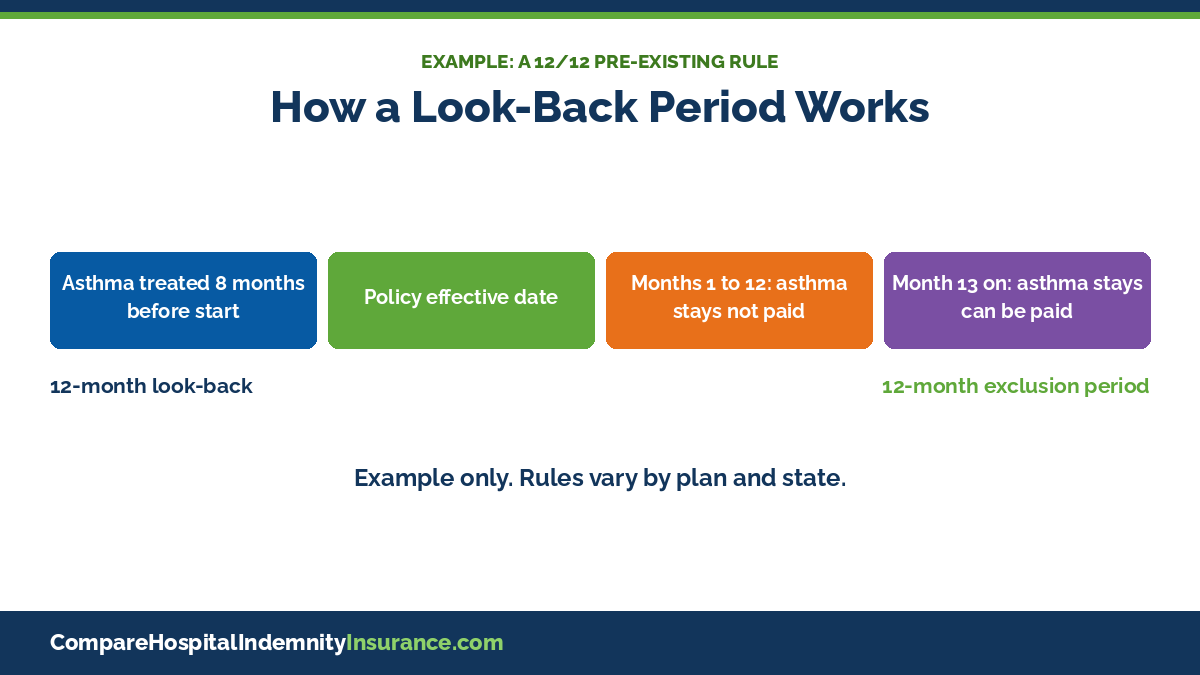
Most pre-existing clauses have two clocks. The look-back is the window before your start date in which treatment, testing, advice or prescriptions for a condition make it pre-existing. The exclusion period is how long after your start date related claims stay unpaid. Aflac’s Hospital Advantage brochure for Washington (form A49H75WA) uses 12 months for both.

1
Find the look-back. Count the months before the effective date the insurer looks at. Shorter is better if you had recent care.
2
Find the exclusion period. This is how long related stays go unpaid, often 12 months in the documents we read.
3
Check the state version. New York Life’s Vanderbilt certificate carries a Colorado amendment capping any limitation at six months and an Idaho change shortening the look-back to six months.
4
Check for age rules. ManhattanLife’s Hospital Indemnity Select (form AN7003) uses 12 months, but its Texas version cuts that to six months at age 65 or older.

Employer plans often let the company choose. The Hartford’s voluntary hospital indemnity guide (form series GBD-2800 or GBD-2900) lists pre-existing options of none, 12/12, 6/12, 3/12, 6/6 or 3/6. By industry convention the first number is the look-back and the second the exclusion period, though the guide does not spell that out. With no pre-existing clause, it shows an optional 30-day waiting period for illness.


Timeline showing how a 12-month look-back and 12-month exclusion period work in hospital indemnity insurance exclusions

Exclusions That Appear in Nearly Every Filing

Found in all or most of the documents we reviewed
  • ✔
    Suicide, attempted suicide or intentionally self-inflicted injury, while sane or insane.
  • ✔
    War or any act of war, and on several plans active military service, including the National Guard or Reserve.
  • ✔
    Committing or attempting a felony, and on some plans illness or injury during incarceration.
  • ✔
    Voluntary use of drugs not prescribed or taken as directed, plus poisons, gases and fumes.
  • ✔
    Cosmetic surgery, except reconstruction after a covered injury or illness, and dental work not caused by an injury.
  • ✔
    Elective surgery that is not medically necessary; Aflac’s Washington brochure limits this to the first 12 months.

Accident-only exclusions:

Many certificates keep a second list for injuries only. Securian and MetLife’s Kansas outline both exclude flying except as a fare-paying passenger on a scheduled flight, racing, paid athletics and hazardous sports like hang gliding. MetLife also excludes injuries to a driver with a blood alcohol level of .08% or higher.

Russell Noga, licensed insurance agent

Read the headings

Many certificates split exclusions into a list that applies to every claim and a second list that applies only to accidental injuries. A hazardous-sport or aviation exclusion that sits under the accident-only heading does not block a claim for an illness, so the heading above an exclusion matters as much as the exclusion itself.

Russell Noga, Licensed Insurance Agent

Five Filed Documents, Side by Side

No single source compares exclusion wording across insurers, so we built this table from each carrier’s own filed document. Not stated means that document is silent, not that the item is covered.

Carrier and document Pre-existing rule Pregnancy Mental health and substance use Care outside the U.S.
Aflac Hospital Advantage, individual (A49H75WA, 9/24) 12-month look-back, 12-month exclusion Pregnancy or birth in the first 10 months excluded; complications paid as a sickness Mental or emotional disorders excluded (Alzheimer’s excepted); alcoholism and drug addiction treatment excluded Not stated
ManhattanLife Hospital Indemnity Select, individual (AN7003) Look-back not stated in the excerpt; 12-month exclusion (6 months at 65+ in Texas) A pregnancy existing on the start date is pre-existing; maternity care excluded except complications Substance-related care excluded; mental disorders excluded only in some state versions, such as Connecticut and Florida Excluded (Texas version allows emergency treatment)
Trustmark Hospital StayPay, group (HII 520 C) Look-back not stated; 12-month exclusion Normal childbirth within 9 months of the effective date excluded Not stated Limited to 14 days outside the U.S. and its territories
Standard Insurance, group (Broward County, 1/26) None stated Treated as a sickness; routine newborn care excluded Substance misuse exclusion does not apply to a sickness Not stated
Securian, group (exclusions and limitations page) Not stated No pregnancy exclusion listed Alcohol and drug use excluded except under inpatient mental health and substance treatment benefits Excluded outside the U.S. and its territories

Sources: Aflac brochure A49H75WA RC(9/24); ManhattanLife Hospital Indemnity Select disclosure, form AN7003; Trustmark Hospital StayPay disclosure, HII 520 C; Standard Insurance certificate GC0614-HI, policy 758354-F; Securian group exclusions and limitations page. Group terms depend on the employer and state.

What the table shows

The two individual policies carry the strictest pre-existing and pregnancy rules. Employer plans are looser on pre-existing conditions but split on foreign care.

When a Hospital Bed Does Not Count

A stay can be fully medical and still pay nothing if the facility or your admission status falls outside the definitions. Voya’s Hospital Confinement plan through ReliaStar Life does not count hospice units and swing beds, nursing homes, free-standing surgical centers, rehabilitation and extended care facilities or skilled nursing facilities as hospitals, though some employer versions add rehab benefits back.

Timing rules buried in definitions
20 hours
consecutive time needed for an admission under Standard’s Broward County certificate
20 hours
minimum in a bed for a confinement in The Hartford’s guide (may vary by state)
90 days
gap Aflac requires between confinements before another admission benefit is paid
4 hours
minimum ER or observation time for New York Life’s short stay benefit

Observation is the classic trap. A stay under observation is billed as outpatient care, so an admission benefit tied to inpatient status will not trigger. Some designs soften this: The Hartford offers an optional observation benefit, and New York Life’s certificate pays a short stay benefit up to twice a year.

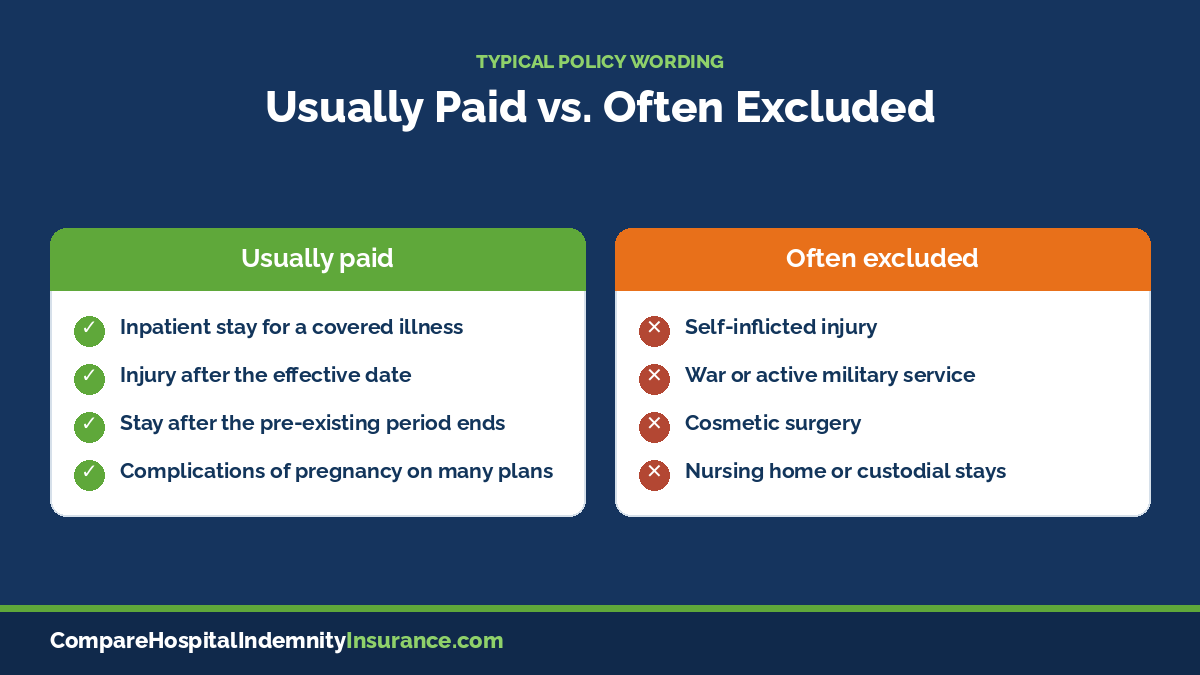
Comparison of hospital stays usually paid versus common hospital indemnity insurance exclusions

Hospital Indemnity Quotes

Call a Licensed Agent Now

A licensed agent can pull the certificate and exclusion list for plans sold in your state.

☎ 1-888-891-0229

No obligation to enroll

Mental Health, Substance Use and Pregnancy: The Least Uniform Rules

These three areas swing the most between policies. Individual policies in our sample excluded more; several group plans pay them as a sickness or through a separate benefit.

Signs of broader treatment
✔

Pregnancy defined as a sickness, as in the Standard and New York Life certificates
✔

Separate inpatient mental health or substance use benefits, as in Securian’s plans
✔

No pre-existing clause, or a short 3/6 or 6/6 design
Signs of a tighter policy
✕

A list of named mental or emotional disorders that are excluded
✕

A pregnancy wait of nine or ten months from the effective date
✕

A rule that a pregnancy already underway counts as pre-existing

If a baby is already on the way, read our guide to hospital indemnity if you are already pregnant before buying.

Federal and State Rules That Shape the Fine Print

Under federal law, a plan that pays a set amount per day or per event, regardless of the bill, is an excepted benefit. That is why it is not held to Affordable Care Act pre-existing condition rules and never counts as minimum essential coverage. Our page on fixed indemnity insurance explains the category.

  • Group notice: a 2024 federal rule would have required group fixed indemnity plans to state that the coverage is not health insurance. A federal court in Texas vacated that notice in December 2024, and the appeal was dismissed in June 2025. Individual policies carry a notice under earlier federal rules; wording varies.
  • Tax warning: Aflac’s Washington brochure still warns that lacking minimum essential coverage may mean an extra tax payment. The federal penalty has been $0 since 2019, but California, Massachusetts, New Jersey, Rhode Island and the District of Columbia have their own mandates.
  • Texas limits: the Texas Department of Insurance checklist for hospital indemnity forms says waiting periods may not apply to accidental injury losses and that confinement in a federal government hospital cannot be excluded.

Why state versions matter:

Trustmark’s group disclosure excludes treatment in a government hospital, and South Dakota’s version of the New York Life certificate drops the substance abuse exclusion. The same product can carry different exclusions depending on where it was issued.

For how claims are triggered and paid once a stay qualifies, see how hospital indemnity insurance works.

No-cost plan check

Line Up Pre-Existing Rules From Several Insurers

See which plans in your ZIP code use shorter look-back periods.

Plan availability, eligibility, and benefits vary by state and policy.

Hospital Indemnity Exclusions: What Shoppers Ask Next

➤ Does hospital indemnity cover outpatient surgery, or only overnight stays?

The core benefit is triggered by an inpatient admission, so a same-day procedure usually does not pay under it. Some plans add an outpatient surgery benefit or rider that pays a set amount per procedure, and certificates such as Standard’s do not count ambulatory surgical centers as hospitals. Look for a separate surgery line in the benefit schedule.

➤ Can a claim be denied for a condition I had before buying?

Yes, if the stay is tied to a condition inside the look-back and happens during the exclusion period. Aflac’s Washington brochure counts conditions with prescription medication, testing or medical advice in the 12 months before coverage. Once the exclusion period ends, related stays are normally payable.

➤ Is a car accident covered if the insured was driving drunk?

Often not. MetLife’s Kansas outline excludes injuries to a driver at .08% blood alcohol or higher, and Securian excludes a driver at or above the state’s legal limit.

➤ Will the policy pay if I am hospitalized on a trip abroad?

It depends on the plan. Securian excludes care outside the U.S. and its territories, MetLife’s Kansas plan covers the U.S., Canada and Mexico, and Trustmark allows 14 days outside the covered area.

➤ Are hospital indemnity exclusions the same in every state?

No. ManhattanLife adds a mental and nervous disorder exclusion in states such as Connecticut, Florida, Hawaii and Nebraska, and New York Life shortens the pre-existing limit in Colorado. Ask for the certificate issued in your state.

➤ Does a pregnancy that began before coverage count as pre-existing?

On some individual plans, yes. ManhattanLife treats a pregnancy that exists on the effective date as pre-existing, while several employer certificates treat pregnancy as a sickness.

Free Plan Comparison

Call a Licensed Agent Now

Compare pre-existing rules and exclusion lists from several insurers before you sign up.

☎ 1-888-891-0229

No obligation to enroll

Russell Noga, licensed insurance agent

About the Author: Russell Noga

Russell Noga is a licensed insurance agent and the founder of ZRN Health & Financial Services, LLC. He has helped people compare health and supplemental insurance for more than 16 years and reviews every page on Compare Hospital Indemnity Insurance before it is published. Learn more about us or read our Editorial Standards.

CompareHospitalIndemnityInsurance.com is operated by ZRN Health & Financial Services, LLC, a Texas limited liability company based in Austin, Texas. We are not connected with or endorsed by any government agency.