This guide skips the basic definition, which is covered in our overview of what is hospital indemnity insurance, and walks through the moving parts instead: the trigger, the paperwork, the fine print on timing and the rules that decide who can buy a policy. When you are ready to see real options side by side, you can compare hospital indemnity insurance from several companies in one place.
One thing to keep in mind the whole way through: these are supplemental, limited-benefit policies. They are not health insurance, they do not count as minimum essential coverage under the Affordable Care Act, and they are meant to sit on top of a real health plan.
Quick answer
A hospital indemnity policy pays you a fixed dollar amount when a stay meets the policy’s definition of an inpatient admission. You file a claim with proof of the stay, and the insurer pays you directly, no matter what your health plan already paid.
What Sets Off a Payment
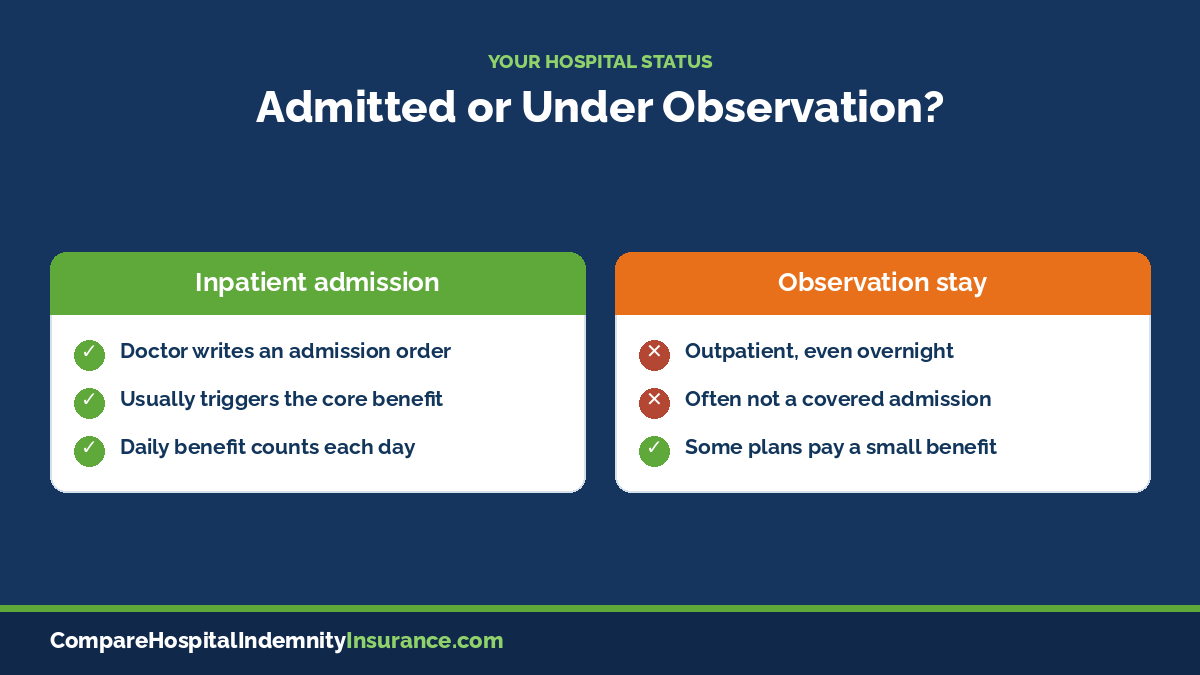
Every policy names an event that unlocks the money. For the core benefit, that event is almost always an inpatient hospital stay for a covered sickness or injury. A trip to the emergency room that ends with you going home is usually not enough on its own. Some policies also set a minimum length of stay before the benefit kicks in.
- Per-admission benefit: one payment for the admission itself, whether you stay two days or ten. Some policies limit how many of these they pay in a calendar year.
- Per-day benefit: a set amount for each day you are confined, up to a cap on the number of days per stay.
- ICU benefit: a separate or higher daily amount for days spent in an intensive care unit, often with its own, shorter day limit.
- Outpatient riders: optional add-ons that pay for things like same-day surgery, an ER visit or an ambulance ride, even when you are never admitted.
Read the definition page:
The words hospital, confinement and intensive care unit are defined in the policy itself, and those definitions control the claim. For example, one filed Aflac outline counts a confinement only after 23 or more hours in a hospital bed with a room charge, and it does not treat an emergency room as a hospital.
Benefit amounts, day limits and rider choices vary by plan and state. Our guide to hospital indemnity insurance coverage lists the common covered events and exclusions in more detail.
Filing a Claim and Getting Paid
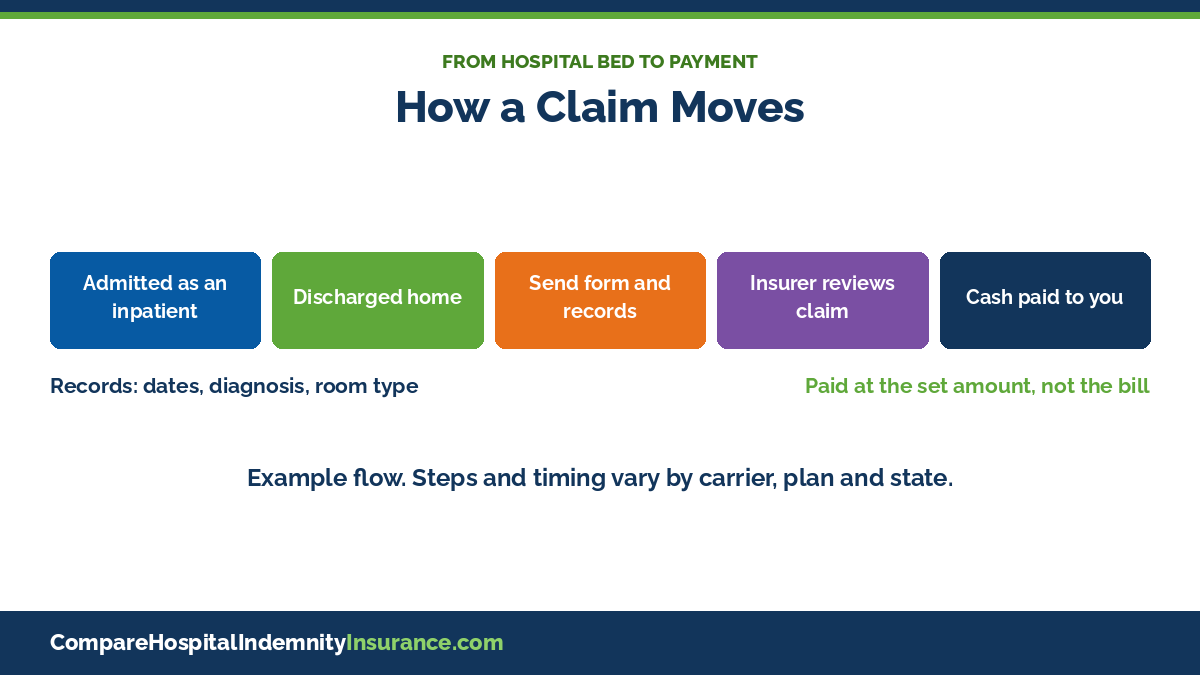
The claim process is mostly paperwork. The insurer needs proof that the stay happened, how long it lasted and why. It does not need to see what your health plan paid, although an explanation of benefits can help fill in gaps.
1
Get the hospital records. Request a discharge summary or other records that show your name, admission and discharge dates, the diagnosis and whether the room was ICU or a regular bed. MetLife’s group claim instructions, for example, list those four items as required.
2
Complete the claim form. Most large carriers let you file online, through an app, or by mail or fax. If you add papers to a claim already open, put your claim or certificate number on every page.
3
Send it on time. State insurance laws set claim deadlines. Texas law, for example, requires written proof of loss before the 91st day after the loss for most claims, and other states use similar rules.
4
Answer any follow-up. A claims examiner may ask for more medical details. Missing pages are the most common reason a payment slows down.
5
Receive the payment. The money goes to the policyholder unless you sign it over to a hospital or provider. Direct deposit or a paper check are the usual choices.
Timing depends on the carrier and how complete the file is. MetLife’s instructions for one state employee group say clean claims generally take about 10 business days to process, with payment 7 to 10 business days after approval. ManhattanLife states a goal of paying eligible claims within 7 to 10 business days once it has every document it needs.