Speak with a licensed insurance agent

1-888-891-0229

Critical Illness Insurance: What It Covers, Costs and Pays

Reviewed by Russell Noga, Licensed Insurance Agent — Last updated October 30, 2026

Critical illness insurance pays you a single lump sum of cash if you are diagnosed with a serious illness your policy covers, such as a heart attack, a stroke or cancer. The money goes to you, not your doctor, and you can use it for anything: medical bills your health plan does not cover, travel to a specialist, the mortgage, or simply replacing your paycheck while you recover.

See Critical Illness Plans in Your Area

Enter your ZIP code to compare lump-sum critical illness coverage.

Plan availability, eligibility, and benefits vary by state and policy.

Health insurance pays for treatment. Critical illness insurance pays for life during treatment, which is often the part that hurts most financially. It is a close cousin of hospital indemnity insurance: hospital indemnity pays when you are admitted, critical illness pays when you are diagnosed, and many people carry both. You can compare hospital indemnity insurance and critical illness plans with our licensed agents.

What Is Critical Illness Insurance?

Critical illness insurance is a supplemental policy that pays a fixed benefit amount, often somewhere between $10,000 and $50,000 or more, when you are diagnosed with a covered condition and meet the policy’s definition of that condition. You choose the benefit amount when you buy, and the insurance company pays it in one payment.

Like hospital indemnity coverage, it is not major medical insurance. It does not pay your doctors or hospital directly, it does not count as minimum essential coverage, and it is meant to sit alongside your health plan. You can buy it through an employer, where it is often called voluntary critical illness insurance, or directly as an individual policy.

In one sentence
Critical illness insurance turns a serious diagnosis into a lump-sum check you can spend however you need, on top of whatever your health insurance pays.

What Does Critical Illness Insurance Cover?

Every policy lists the conditions it covers and defines each one. The core group is similar across most insurance companies.


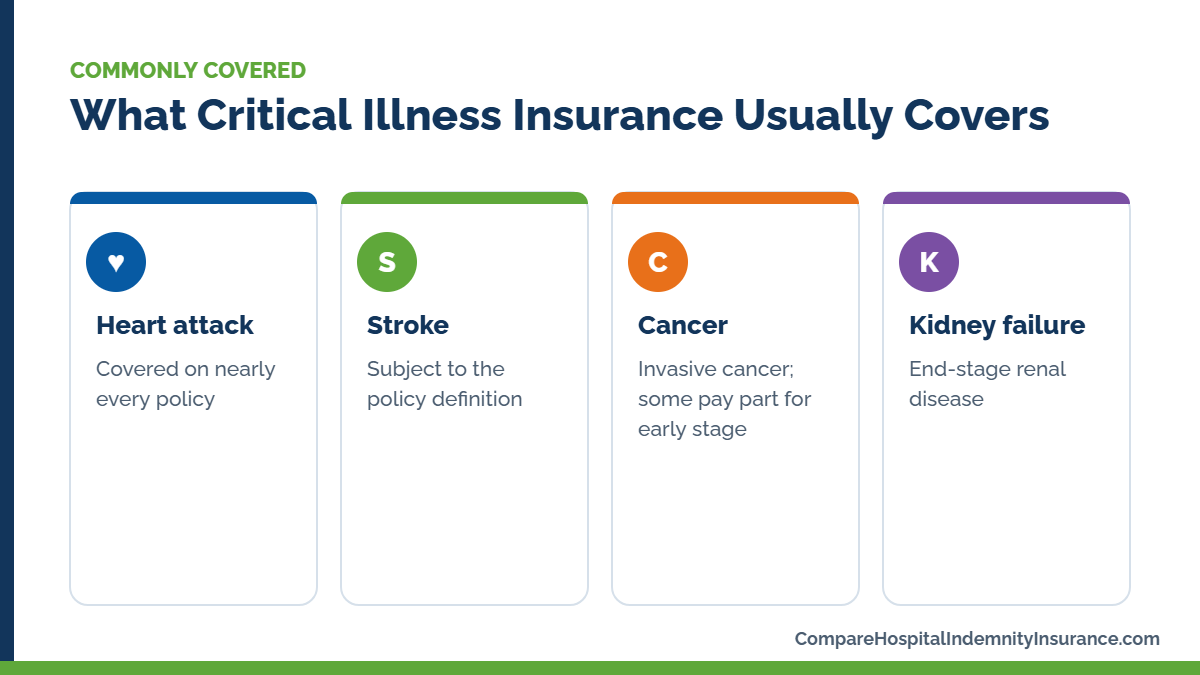
Common conditions covered by critical illness insurance: heart attack, stroke, cancer and kidney failure
Condition How it is usually treated
Heart attack Covered on nearly every policy, based on medical criteria in the policy
Stroke Covered on most plans, often requiring lasting effects
Invasive cancer Full benefit on most plans that include cancer
Carcinoma in situ (early-stage cancer) Often a partial benefit, such as 25% of the full amount
End-stage kidney failure Commonly covered
Major organ transplant Often covered when you are placed on a transplant list
Coronary artery bypass surgery Often a partial benefit
Paralysis, ALS, coma and others Covered on some plans
Check the definitions
Each condition must meet the policy definition to pay. Two plans can both “cover stroke” and still define it differently. A licensed agent can compare definitions for you.

How Critical Illness Insurance Works

1
Choose a benefit amount. Pick a lump sum that would cover your health plan out-of-pocket maximum and a few months of household bills.
2
Pay the premium. Through payroll deduction at work, or by bank draft on an individual policy.
3
Get diagnosed. A covered condition is diagnosed after any waiting period has passed.
4
File a claim. Send the insurance company your diagnosis records and any requested forms.
5
Receive the lump sum. The benefit is paid to you, usually in one payment, to use however you choose.

Many policies also include a recurrence benefit that pays again if the same condition comes back after a set period, a benefit for a second, different covered condition, and a small yearly health screening benefit for routine tests like a mammogram or cholesterol check.

Russell Noga, licensed insurance agent

Choosing an amount

Recovery from a heart attack, stroke or cancer diagnosis often brings costs beyond medical bills: reduced work hours, travel to specialists and time off for family caregivers. One common way to size a lump-sum benefit is the health plan’s out-of-pocket maximum plus three to six months of essential household bills.

Russell Noga, Licensed Insurance Agent

How Much Does Critical Illness Insurance Cost?

The premium depends mostly on your age and the benefit amount, and it is usually lower through an employer than on your own. Group plans may not ask health questions during enrollment; individual plans are priced on your own details.

What affects the premium
  • ✔
    Your age when you buy
  • ✔
    The benefit amount you choose
  • ✔
    Tobacco use
  • ✔
    Which conditions are covered and how they are defined
  • ✔
    Whether you add a spouse or children
  • ✔
    Buying through work versus on your own
Critical Illness Quotes
Call a Licensed Agent Now
Compare critical illness and hospital indemnity plans from several insurance companies in one call.
No obligation to enroll

Is Critical Illness Insurance Worth It?

Pros
✔ Pays a large lump sum soon after diagnosis
✔ Helps with costs health insurance does not cover
✔ Cash can replace lost income during treatment
✔ Often affordable and guaranteed issue through work
✔ Can pay on top of disability and hospital coverage
Cons
✘ Only pays for listed conditions
✘ Each condition must meet the policy definition
✘ Waiting periods and pre-existing condition limits apply
✘ Some early-stage diagnoses pay only part of the benefit
✘ Benefit may reduce at older ages on some plans

Critical illness insurance is usually worth a look if you have a high-deductible health plan, a family history of heart disease, stroke or cancer, or limited savings to fall back on during a long recovery. It is less valuable if your savings and disability coverage would already carry you through a serious illness.

Critical Illness vs. Hospital Indemnity Insurance

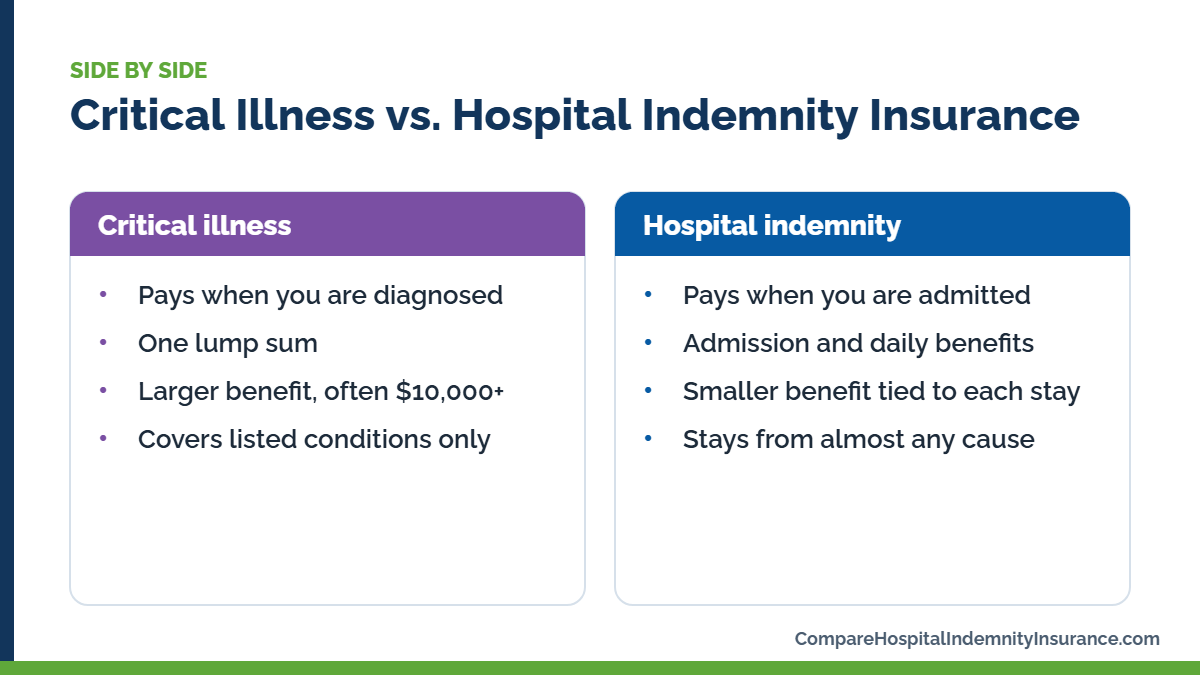
Comparison of critical illness insurance and hospital indemnity insurance
Critical illness insurance Hospital indemnity insurance
What triggers a payment Diagnosis of a covered illness A covered hospital admission
How it pays One lump sum Admission and daily benefits
Typical benefit size Larger, often $10,000 or more Smaller, tied to each stay
Covers stays from any cause No Yes, subject to exclusions
Best for Serious diagnoses with long recoveries Out-of-pocket costs from any hospital stay

The two work well together. A heart attack could trigger a critical illness lump sum and a hospital indemnity payment for the stay. Learn more in what is hospital indemnity insurance, see what hospital indemnity covers, and read is hospital indemnity insurance worth it.

Critical Illness vs. Cancer Insurance

Cancer insurance covers only cancer, but it often pays several types of benefits over the course of treatment, such as a diagnosis benefit plus benefits for chemotherapy, radiation and surgery. Critical illness insurance usually pays one lump sum but covers a broader list of conditions, including heart attack and stroke. If cancer runs in your family, some people carry both.

Critical Illness vs. Accident and Disability Insurance

Critical illness insurance pays for illnesses. Accident insurance pays for injuries from accidents, such as fractures, burns or ER visits after a fall. Disability insurance replaces part of your income when you cannot work for any covered reason, but it usually starts after a waiting period and pays monthly. A critical illness lump sum often bridges the gap before disability payments begin.

How to Buy Critical Illness Insurance

1
Check your employer benefits. Voluntary critical illness coverage at open enrollment is often the simplest and least expensive option.
2
Pick a benefit amount. Start with your out-of-pocket maximum plus several months of essential bills.
3
Compare definitions. Look at how each policy defines heart attack, stroke and cancer, and what partial benefits apply.
4
Compare companies. Several of the best hospital indemnity insurance companies also sell critical illness coverage.

Related guide: what is critical illness insurance How the contract defines conditions, pays partial and repeat benefits, and can shrink at older ages, with filed terms from four insurers.

Free comparison

Compare Critical Illness and Hospital Plans

Many families pair the two. See both side by side for your ZIP code.

Plan availability, eligibility, and benefits vary by state and policy.

Critical Illness Insurance FAQs

➤ What is critical illness insurance?

It is a supplemental policy that pays you a lump sum if you are diagnosed with a covered illness, such as a heart attack, stroke or cancer.

➤ What does critical illness insurance cover?

Most plans cover heart attack, stroke, invasive cancer, kidney failure and major organ transplant. Some add other conditions. Coverage and definitions vary by policy.

➤ Is critical illness insurance worth it?

It can be if you have a high-deductible health plan, limited savings or a family history of serious illness. It is less valuable if your savings and disability coverage already cover a long recovery.

➤ How much does critical illness insurance pay?

Benefits are often $10,000 to $50,000 or more, chosen when you buy. Some plans pay a reduced amount for certain early-stage diagnoses.

➤ Is critical illness insurance the same as hospital indemnity insurance?

No. Critical illness insurance pays a lump sum when you are diagnosed. Hospital indemnity insurance pays when you are admitted to the hospital.

➤ Can I get critical illness insurance through my employer?

Yes. Many employers offer it as a voluntary benefit, often without health questions during open enrollment.

➤ Is critical illness insurance taxable?

Benefits are generally not taxable when you pay premiums with after-tax money. If premiums are paid pre-tax through an employer, check with a tax professional.

➤ Does critical illness insurance cover pre-existing conditions?

Most policies limit or exclude conditions you were diagnosed with or treated for before coverage began, at least for a set period.

Critical Illness Quotes
Call a Licensed Agent Now
Compare critical illness and hospital indemnity plans from several insurance companies in one call.
No obligation to enroll
Russell Noga, licensed insurance agent
About the Author: Russell Noga
Russell Noga is a licensed insurance agent and the founder of ZRN Health & Financial Services, LLC. He has helped people compare health and supplemental insurance for more than 16 years and reviews every page on Compare Hospital Indemnity Insurance before it is published. Learn more about us or read our Editorial Standards.
CompareHospitalIndemnityInsurance.com is operated by ZRN Health & Financial Services, LLC, a Texas limited liability company based in Austin, Texas. We are not connected with or endorsed by any government agency.