Speak with a licensed insurance agent

1-888-891-0229

What Is Critical Illness Insurance? How the Policy Contract Actually Works

Reviewed by Russell Noga, Licensed Insurance Agent — Last updated November 3, 2026

Critical illness insurance is a limited-benefit insurance contract that pays you a fixed lump sum, or a set percentage of it, when a doctor diagnoses a condition that meets the policy’s written definition, such as a heart attack, a stroke or invasive cancer. The diagnosis triggers the payment, not the size of your medical bills.

Plan check

Compare Critical Illness Policy Terms Near You

See benefit amounts and partial-payment rules from several insurers.

Plan availability, eligibility, and benefits vary by state and policy.

That one-line answer hides most of what matters. Whether a claim pays in full, pays a quarter, or pays nothing comes down to the wording inside the certificate: the condition definitions, the percentage schedule, the time rules between claims and any age-based cuts. This guide walks through those parts using filed employer certificates and brochures from Aflac, MetLife, Voya and Guardian. For prices, pros and cons and how this coverage stacks up against other plans, start with our overview of critical illness insurance, or compare hospital indemnity insurance and related plans in your state.

What it means

Critical illness insurance is a supplemental contract that pays a preset cash amount when you are diagnosed with a listed illness that meets the policy definition. Some diagnoses pay only part of that amount, and the certificate decides which.

The Five Parts Inside Every Critical Illness Policy

A critical illness certificate can run 30 pages or more, but nearly all of them are built from the same five pieces. Knowing where each piece sits makes the document much faster to read.

Schedule of benefits
The page with your benefit amount and the percentage each condition pays, often 100% for some and 25% for others.
Definitions
Medical wording a diagnosis must match. A condition named on the schedule pays only if the diagnosis fits this text.
Limitations and exclusions
Rules that block or delay a payment, such as diagnoses made before coverage began or causes the policy leaves out.
Time and age rules
Gaps required between claims, lifetime maximums and, on some filings, benefit cuts at set ages.

The fifth piece is the continuation section, which explains what happens to group coverage if you leave the job. It is easy to skip, yet it decides whether the policy follows you after a layoff or retirement.

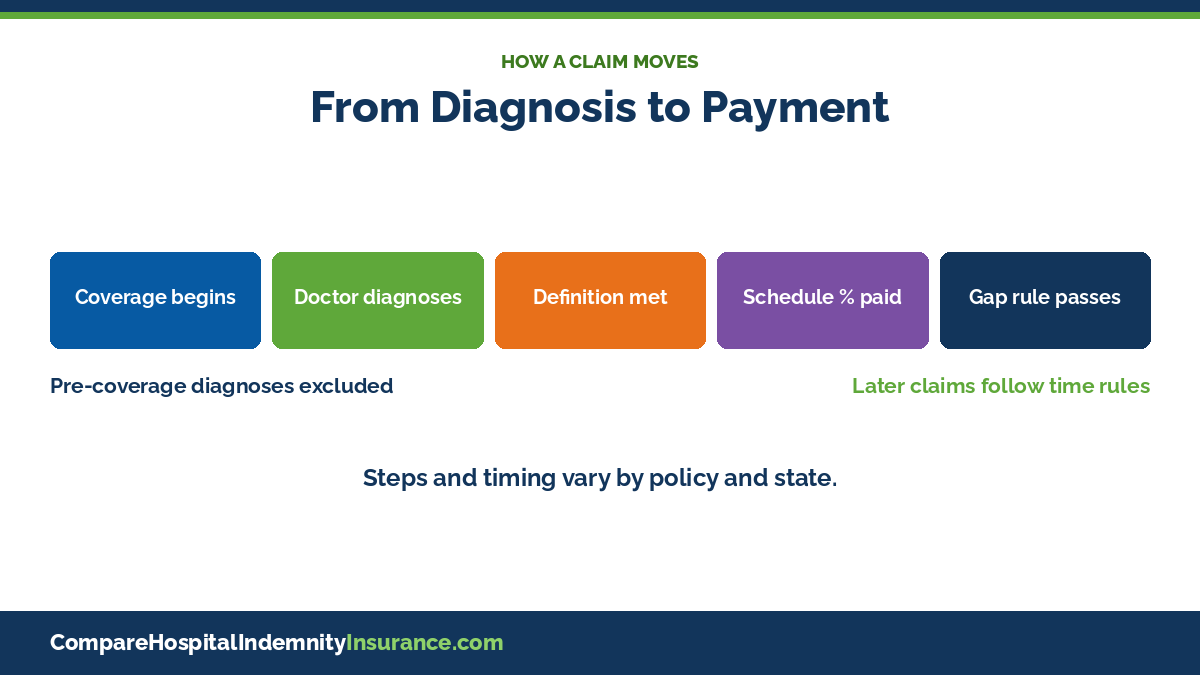
Timeline showing what is critical illness insurance claim path from coverage start to a repeat payment

How Policies Define a Covered Condition

Insurers do not pay on a label alone. Each covered illness carries a definition tied to tests, imaging or a minimum length of time. The examples below come straight from filed group documents.

Condition What the filed wording requires (example) Source document
Heart attack New and serial ECG findings consistent with a heart attack plus cardiac enzymes above normal lab levels Aflac group CI brochure (CAIC series C21000)
Stroke Neurological deficits confirmed by neuroimaging; transient ischemic attacks and head injuries excluded Aflac group CI brochure
Stroke Migraine symptoms and brain injury from trauma or lack of oxygen excluded MetLife group CI disclosure (GCERT14-CI)
Coma Continuous unconsciousness for 14 days or longer Voya group CI certificate (ReliaStar Life)
Paralysis Loss of use of two or more limbs for at least 60 days Voya group CI certificate
Multiple sclerosis Symptoms that persist for 6 months Voya group CI certificate

Wording paraphrased from employer-group certificates and brochures filed by each insurer, checked November 2026. Definitions vary by state, plan and policy form.

Why this matters:

A short-lived stroke-like episode that resolves without lasting damage on imaging may be called a transient ischemic attack, and the definitions above exclude it. The diagnosis on your chart and the definition in your certificate have to line up.

Russell Noga, licensed insurance agent

Policy-reading tip

The schedule of benefits page shows a percentage next to each condition. Any condition listed below 100%, such as carcinoma in situ or bypass surgery, pays only that share of the chosen amount, so multiply before counting on the full lump sum.

Russell Noga, Licensed Insurance Agent

Full Benefit, Partial Benefit and the Percentage Schedule

The schedule assigns each condition a share of your benefit amount. Invasive cancer, heart attack and stroke usually pay 100%. Earlier or less severe diagnoses, such as carcinoma in situ (cancer cells that have not spread into nearby tissue) or coronary bypass surgery, often pay a smaller share.

Example only: a $20,000 benefit amount
$20,000
invasive cancer at 100%
$10,000
carcinoma in situ on a plan that pays 50%
$5,000
non-invasive cancer on a plan that pays 25%
$5,000
bypass surgery on a plan that pays 25%

The percentage is a plan design choice, not an industry rule. Two Voya employer certificates reviewed for this page show the same insurer paying carcinoma in situ at 50% on one plan and 100% on another. The Aflac group brochure lists 25% for non-invasive cancer, and one MetLife summary lists 25% for its partial benefit cancer category.

Four Insurers’ Filed Terms Side by Side

No single public source lines up these contract terms across insurers, so we built the comparison from each company’s own employer brochures, certificates and product pages. Blank spots mean the term was not stated in the documents reviewed.

Insurer and plan Benefit amounts Early-stage cancer Repeat or second diagnosis Screening benefit Continuation and age rules
Aflac group CI (Continental American Insurance Co., C21000) Set by the employer plan 25% for non-invasive cancer Pays again when diagnoses are at least 6 months apart $50 a year, employee and spouse Can be kept after leaving the job, with conditions
MetLife group CI (GCERT14-CI) $15,000 or $30,000 on one plan; lifetime cap of 7 times the amount 25% first payment, 100% if it recurs, on one plan Suspension periods of 30 to 365 days, by plan Once a year; amount set by plan Benefit cut at ages 65 and 70 on one disclosure
Voya group CI (ReliaStar Life) Varies 50% on one plan, 100% on another New cancer diagnosis counts after 1 or 3 months, by plan; most other conditions pay once Varies Elect within 31 days; must be under 70 to continue
Guardian group CI $1,000 to $50,000 Varies $500 to $25,000 for a new occurrence of the same illness Optional, picked by the employer Varies

Source: insurer-filed employer brochures, certificates and disclosure statements, plus Guardian’s own product page, checked November 2026. Terms differ by state, employer and plan version; the certificate you receive controls.

Pattern to notice

The biggest differences are not in the headline benefit amount. They sit in the early-stage cancer percentage and in the waiting gap before a second claim, which can decide whether a cancer that comes back pays anything.

Age Reductions, Prior Diagnoses and Survival Rules

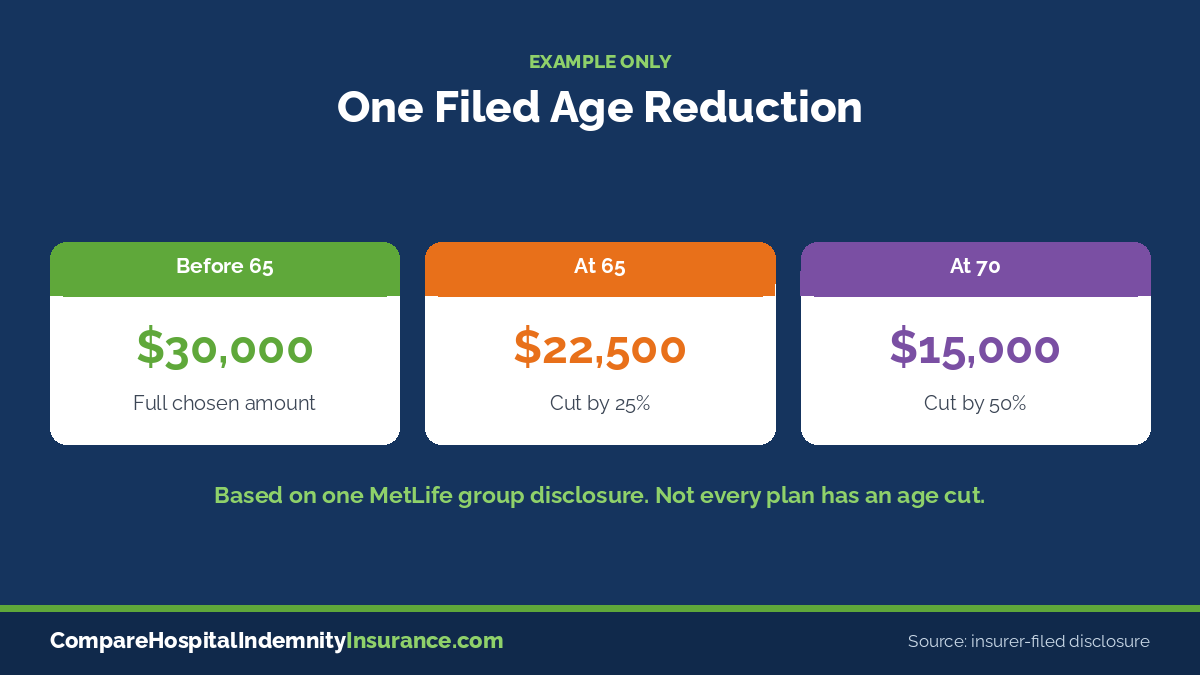
Some contracts shrink the benefit as you get older even though the premium keeps coming out of your paycheck. One MetLife group disclosure reduces both the benefit amount and the lifetime total by 25% at age 65 and by 50% at age 70. It adds that if the reduced lifetime total is at or below what has already been paid, coverage ends on the date of the reduction.

Other limits to look for
  • ✔
    Diagnosis before the start date. One MetLife summary pays nothing for a covered condition diagnosed before the coverage effective date. Some individual policies use a look-back period instead, so read that section closely.
  • ✔
    Eligibility waiting periods. One Voya certificate lists its waiting period as none. Others delay coverage for a set number of days after the start date, which varies by plan and state.
  • ✔
    Survival periods. Policies in Canada and some other countries can require you to live 14 to 30 days after diagnosis. The US group certificates reviewed here did not include a general survival period, though a few conditions carry their own time tests, such as 14 days for coma.

Cards showing what is critical illness insurance benefit after an age-based reduction on an example $30,000 policy

Critical Illness Quotes

Call a Licensed Agent Now

A licensed agent can pull the definitions and percentage schedule for plans sold where you live.

☎ 1-888-891-0229

No obligation to enroll

Recurrence, a Second Condition and the Lifetime Cap

A critical illness policy does not always end after its first payment. Many pay again, but each later claim has to clear its own rules.

1
Check the gap rule. Aflac’s group brochure requires diagnoses at least 6 months apart. One MetLife disclosure sets a 365-day suspension after a condition and requires 180 days without cancer symptoms or treatment before a cancer recurrence pays.
2
Check what a repeat pays. Guardian lists $500 to $25,000 for a new occurrence of the same illness, while one MetLife summary pays 100% again.
3
Check the lifetime total. Once total payments reach the cap, such as 7 times the benefit amount on one MetLife plan, the coverage stops paying.
4
Check the extras. A yearly screening benefit, such as Aflac’s $50 for an eligible test, usually pays on top of the main amount and does not count as a diagnosis claim.

Family members are often covered at a share of the employee amount. One MetLife summary sets a spouse at 50% and children at 25% of the employee’s benefit.

What Critical Illness Coverage Is Not

Federal law treats specified disease coverage as an excepted benefit when it is sold as independent, noncoordinated coverage. In plain terms, it is a limited-benefit supplement. Guardian’s disclosure states that its plan is not minimum essential coverage and will not reimburse hospital or medical expenses.

  • Not health insurance. It does not pay doctors or hospitals and does not replace a major medical plan.
  • Not hospital indemnity. Hospital indemnity insurance pays for an inpatient stay from almost any covered cause, not for a specific diagnosis.
  • Not accident coverage. Injuries from a fall or crash fall under accident insurance, a separate policy.
  • Usually not taxed when you pay with after-tax money. If premiums come out of your paycheck before taxes, the tax result can differ, so a tax professional should confirm your situation.

Free comparison

Find a Lump-Sum Plan That Fits Your Budget

Line up definitions and premiums before you sign an application.

Plan availability, eligibility, and benefits vary by state and policy.

Critical Illness Insurance Questions We Hear Most

➤ Does critical illness insurance pay if I already have health insurance?

Yes. The payment is a fixed amount based on the diagnosis, so it pays regardless of what your health plan covers. Some contracts say benefits are paid in addition to other coverage.

➤ What does carcinoma in situ mean on a policy?

It refers to cancer cells that have not spread into nearby tissue. Many policies pay a partial benefit for it or for non-invasive cancer, and the share varies by plan, from 25% to 100% in the filed documents reviewed.

➤ Can a critical illness policy pay more than once?

Many can, for a recurrence of the same condition or a different covered condition, after a required gap between diagnoses. Payments stop once the lifetime maximum is reached.

➤ Why would my critical illness benefit go down at 65?

Some filed contracts reduce the benefit at set ages, such as 25% at 65 and 50% at 70 on one MetLife disclosure. Not every policy does this, so check the age provisions.

➤ Do I lose employer critical illness coverage if I quit?

Not always. Many group plans let you continue coverage by paying premiums directly, usually if you elect it within a set window such as 31 days.

➤ Is a cancer diagnosed before my coverage started covered?

Usually not. Filed contracts commonly exclude conditions diagnosed before the effective date, and some use a look-back period for conditions treated before coverage began.

Lump-Sum Coverage

Call a Licensed Agent Now

Compare partial-benefit and recurrence terms from several insurers before you enroll.

☎ 1-888-891-0229

No obligation to enroll

Russell Noga, licensed insurance agent

About the Author: Russell Noga

Russell Noga is a licensed insurance agent and the founder of ZRN Health & Financial Services, LLC. He has helped people compare health and supplemental insurance for more than 16 years and reviews every page on Compare Hospital Indemnity Insurance before it is published. Learn more about us or read our Editorial Standards.

CompareHospitalIndemnityInsurance.com is operated by ZRN Health & Financial Services, LLC, a Texas limited liability company based in Austin, Texas. We are not connected with or endorsed by any government agency.