Speak with a licensed insurance agent

1-888-891-0229

Is Hospital Indemnity Insurance Worth It? Pros, Cons and Who Needs It

Reviewed by Russell Noga, Licensed Insurance Agent — Last updated October 30, 2026

Yes, for the right person. Hospital indemnity insurance is worth it when one hospital stay would leave you with a bill you cannot comfortably pay from savings. It is usually not worth it when your health plan already keeps your out-of-pocket costs low, or when you have enough cash set aside to cover your out-of-pocket maximum without stress.

Check Hospital Indemnity Rates in Your Area

Seeing real prices is the fastest way to know if a plan is worth it.

Plan availability, eligibility, and benefits vary by state and policy.

That is the honest answer, and it is the one we give people on the phone every day. The real question is not whether hospital indemnity insurance is good or bad. It is whether the math works for your health plan, your budget and your family. This page walks through that math, the pros and cons, and the situations where a plan pays for itself. If you are brand new to this coverage, start with what hospital indemnity insurance is, or compare hospital indemnity insurance plans from several companies.

Your situation Usually worth it? Why
High-deductible employer or HSA plan Often yes One admission can trigger most of the deductible
Bronze or Silver ACA Marketplace plan Often yes Out-of-pocket limits are high
Medicare Advantage with daily hospital copays Often yes A daily benefit can be matched to the copays
Original Medicare with a Medigap plan Sometimes Medigap already covers most hospital costs
Low-deductible employer plan Often no Little gap left to fill
Healthy, with large emergency savings Often no You can self-insure the gap

The Pros of Hospital Indemnity Insurance

The biggest advantage is control. The money comes to you, not the hospital, and you decide where it goes. That matters more than most people expect, because the medical bill is only part of what a hospital stay costs.

  • Cash paid directly to you. Use it for the deductible, coinsurance, a mortgage payment or groceries.
  • Predictable benefits. You know before you buy exactly what a covered stay will pay.
  • Pays on top of other coverage. It does not matter what your health plan or Medicare already paid.
  • Often guaranteed issue at work. Employer plans usually skip health questions during enrollment.
  • Lower premiums than major medical. Because it covers a narrow set of events, the cost stays modest.

The Cons You Should Know About

  • It only pays for covered events. Most of the benefit is tied to an inpatient admission.
  • Observation stays may not count. A night in the hospital billed as observation can pay little or nothing.
  • Waiting periods apply. Illness, pregnancy and pre-existing condition limits delay coverage on many plans.
  • It does not replace health insurance. You still need major medical coverage.
  • You may never use it. In a healthy year you pay premiums and receive nothing back.
Russell Noga, licensed insurance agent

Before you buy

A simple test decides most cases. If a hospital admission tomorrow would leave the full deductible and coinsurance due, and that amount is not sitting in savings, a fixed cash benefit fills a real gap. If savings already cover the out-of-pocket maximum, the premium buys less protection.

Russell Noga, Licensed Insurance Agent

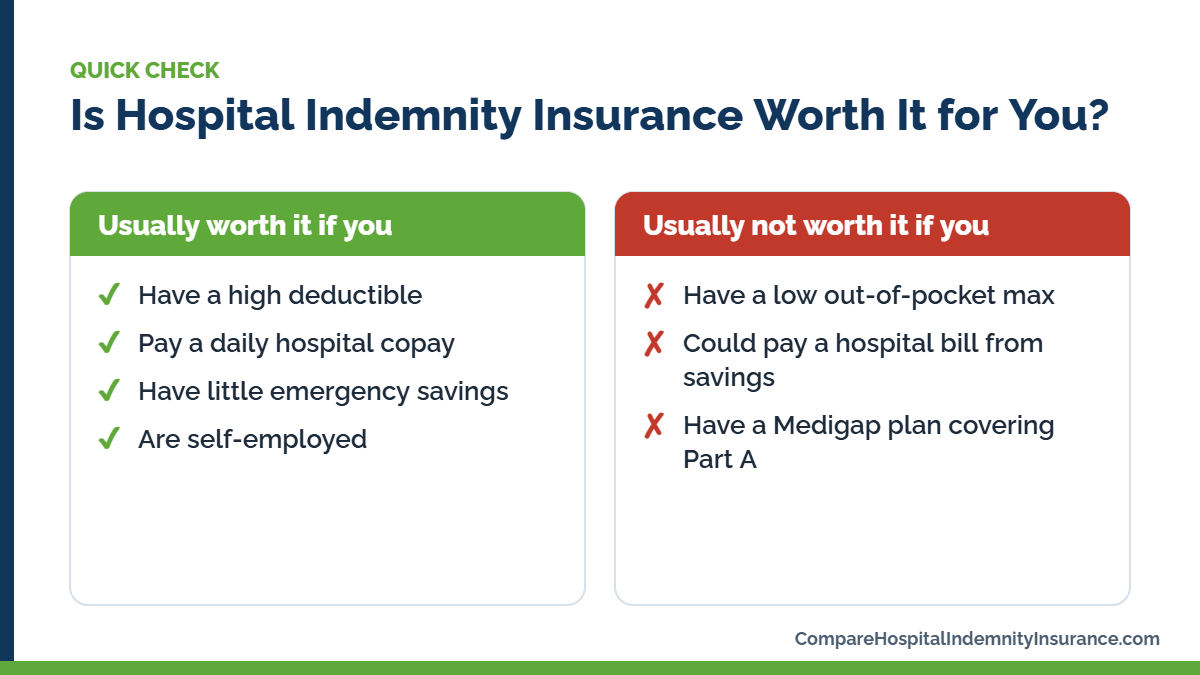
Checklist showing when hospital indemnity insurance is worth it and when it is not

How to Do the Math in Five Minutes

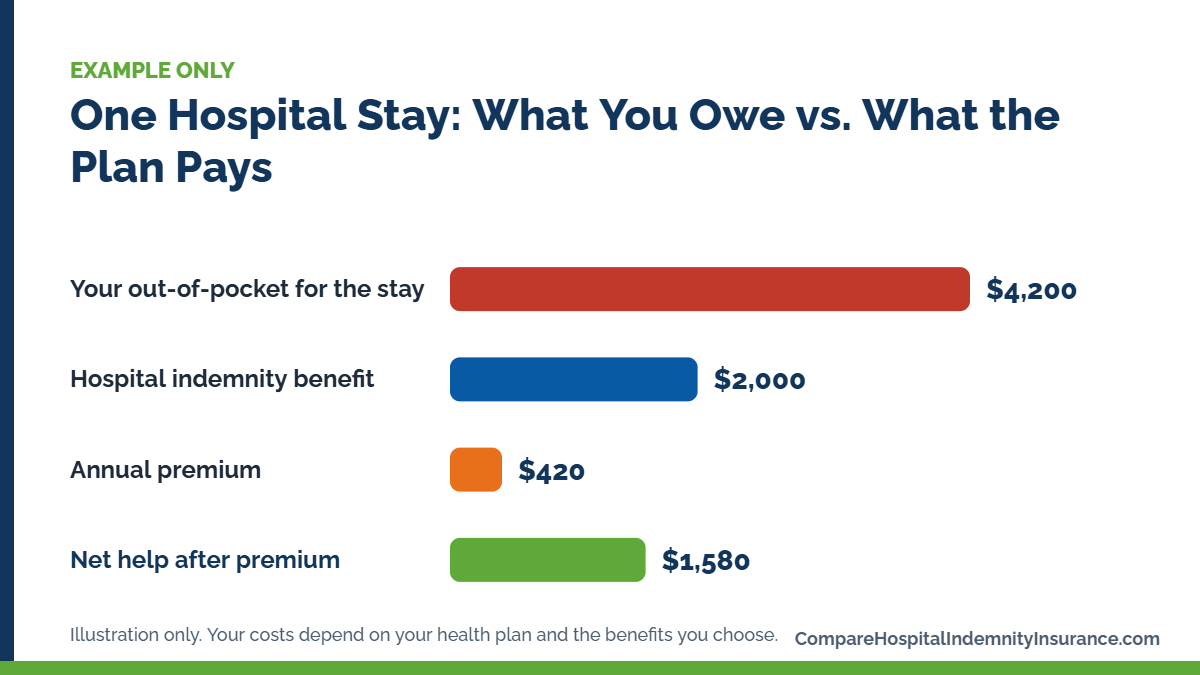
You only need three numbers: what your health plan would leave you to pay for a typical hospital stay, what a hospital indemnity plan would pay you for that stay, and what the plan costs for a year. Here is a worked example. The figures are illustrative.

Item Example amount
Health plan deductible $3,000
Coinsurance owed after the deductible $1,200
Your out-of-pocket for a 4-day stay $4,200
Hospital indemnity benefit ($1,000 admission + $250 a day) $2,000
Annual premium for that plan $420
Net help in a year with one stay $1,580

In a year with no hospital stay, you are out the $420 premium. In a year with one stay, the plan covers almost half of your bill. Whether that trade makes sense depends on how much a surprise $4,200 bill would hurt, and that is a personal call.

Bar chart comparing out-of-pocket hospital costs, hospital indemnity benefit and annual premium
Run the Numbers With an Agent
Call a Licensed Agent Now
Tell us about your health plan and we will show you real quotes side by side.
No obligation to enroll

When Hospital Indemnity Insurance Is Worth It

You have a high deductible or HSA plan

High-deductible plans are where these policies shine. A single admission can wipe out most of your deductible in one day, and the admission benefit lands right when that bill arrives.

You have Medicare Advantage

Many Medicare Advantage plans charge a set copay for each of the first several days in the hospital. A hospital indemnity plan with a matching daily benefit can turn a stay you would have paid for into one that costs you little. See how benefits are structured in our guide to hospital indemnity insurance plans.

You are self-employed or have little sick leave

If you do not get paid when you do not work, the cash benefit doubles as income replacement while you recover.

You are planning a pregnancy

Childbirth is one of the most common reasons for a hospital stay. If you buy early enough to satisfy the waiting period, a plan can help with the delivery bill. Read more about hospital indemnity insurance for pregnancy.

When It Is Probably Not Worth It

If your employer plan has a low deductible and a low out-of-pocket maximum, the gap a hospital indemnity plan fills is small. The same goes for people on Original Medicare with a Medicare Supplement plan such as Plan G, which already covers most Part A hospital costs after the Part A deductible. For them, the benefit is mostly extra cash for non-medical bills. And if you already have strong supplemental coverage at work, buying a second policy may add more cost than value.

What to Check Before You Buy

1
How an admission is defined. Ask whether observation stays count and whether there is a minimum number of hours.
2
Waiting periods. Compare the illness, pregnancy and pre-existing condition waiting periods.
3
Benefit limits. Look at maximum days per stay, admissions per year and any lifetime cap.
4
Renewability. A guaranteed renewable policy cannot be cancelled as long as you pay, though rates can change.
5
The company. Check financial strength ratings and how claims are filed.

Our guide to hospital indemnity insurance coverage explains each of these in detail, and our list of the best hospital indemnity insurance companies shows who sells what.

Is a Different Type of Coverage a Better Fit?

Sometimes the better answer is a different product. If your main worry is a serious diagnosis, critical illness insurance pays a much larger lump sum when you are diagnosed with a covered condition. If you have active kids or a physical job, accident insurance pays for injuries even when nobody is admitted. Hospital indemnity insurance is the broadest of the three because it pays for hospital stays from almost any cause.


Related guide: hospital indemnity insurance cost Real published premiums by tier, age and rider, plus a simple break-even check.

Related guide: hospital indemnity vs critical illness How a per-day hospital plan and a lump-sum diagnosis plan pay differently, where they overlap, and when to pair them.

Free, no obligation

Compare Plans Before You Decide

Enter your ZIP code to see hospital indemnity plans near you.

Plan availability, eligibility, and benefits vary by state and policy.

More Questions About Whether It Is Worth It

➤ Is hospital indemnity insurance a waste of money?

Not if your health plan would leave you with a large out-of-pocket bill for a hospital stay. It can be poor value if your out-of-pocket costs are low and you have savings to cover them.

➤ Should I get hospital indemnity insurance through work?

If your employer offers it during open enrollment, it is often guaranteed issue and paid through payroll deduction, which makes it an easy way to get coverage without health questions.

➤ Do I need hospital indemnity insurance if I have Medicare Advantage?

Many Medicare Advantage plans charge a daily copay for hospital stays, and a hospital indemnity plan can be set up to help pay those copays.

➤ Is hospital indemnity insurance worth it with a high-deductible plan?

It is often a good fit, because the cash benefit can cover much of the deductible you would owe after a hospital admission.

➤ Do I need hospital indemnity insurance with a Medicare Supplement plan?

Usually less so. Plans like Medigap Plan G already cover most hospital costs, so the benefit is mainly extra cash for non-medical expenses.

➤ Is hospital indemnity insurance taxable?

Benefits are generally not taxable when you pay the premium with after-tax money. If you pay through an employer with pre-tax dollars, some benefits may be taxable, so check with a tax professional.

➤ What are the disadvantages of hospital indemnity insurance?

It pays only for covered events, often only inpatient stays, it has waiting periods and pre-existing condition limits, and you may pay premiums for years without a claim.

➤ How do I know if a hospital indemnity plan is a good value?

Compare your health plan out-of-pocket cost for a typical stay with what the plan would pay and its annual premium. A licensed agent can run these numbers for several plans at once.

Run the Numbers With an Agent
Call a Licensed Agent Now
We will compare your health plan costs with real hospital indemnity quotes. Any age.
No obligation to enroll
Russell Noga, licensed insurance agent
About the Author: Russell Noga
Russell Noga is a licensed insurance agent and the founder of ZRN Health & Financial Services, LLC. He has helped people compare health and supplemental insurance for more than 16 years and reviews every page on Compare Hospital Indemnity Insurance before it is published. Learn more about us or read our Editorial Standards.
CompareHospitalIndemnityInsurance.com is operated by ZRN Health & Financial Services, LLC, a Texas limited liability company based in Austin, Texas. We are not connected with or endorsed by any government agency.