Speak with a licensed insurance agent

1-888-891-0229

Hospital Indemnity vs Critical Illness: How Each One Pays and When to Pair Them

Reviewed by Russell Noga, Licensed Insurance Agent — Last updated November 4, 2026

The difference between hospital indemnity and critical illness insurance is the event that pays: hospital indemnity pays fixed cash when you are admitted and for each covered day you stay, while critical illness pays one lump sum when a doctor diagnoses a listed condition such as a heart attack, stroke or cancer, whether or not you ever spend a night in the hospital.

Two policies, one search

Compare Hospital and Critical Illness Plans Side by Side

See admission, daily and lump-sum benefits offered in your ZIP code.

Plan availability, eligibility, and benefits vary by state and policy.

Both are supplemental, limited-benefit policies. Neither pays your doctor or hospital, neither replaces a major medical plan, and neither counts as minimum essential coverage under federal law. Because different events trigger them, the cash arrives at different times and in very different amounts.

Below, the contract terms from four carrier documents sit side by side, and one hospitalized heart attack runs through both policies. If you are still asking is hospital indemnity insurance worth it, start there, and when you want prices you can compare hospital indemnity insurance plans sold in your state.

Bottom line first

Hospital indemnity pays for being in the hospital, from almost any covered illness or injury. Critical illness pays for being diagnosed with one of a short list of serious conditions, in a single larger check.

Admission Versus Diagnosis: What Sets Off Each Payment

These two products do not even look at the same thing. A hospital indemnity insurer asks whether you were formally admitted as an inpatient. A critical illness insurer asks whether your diagnosis matches the medical definition written in the policy.

What starts the claim
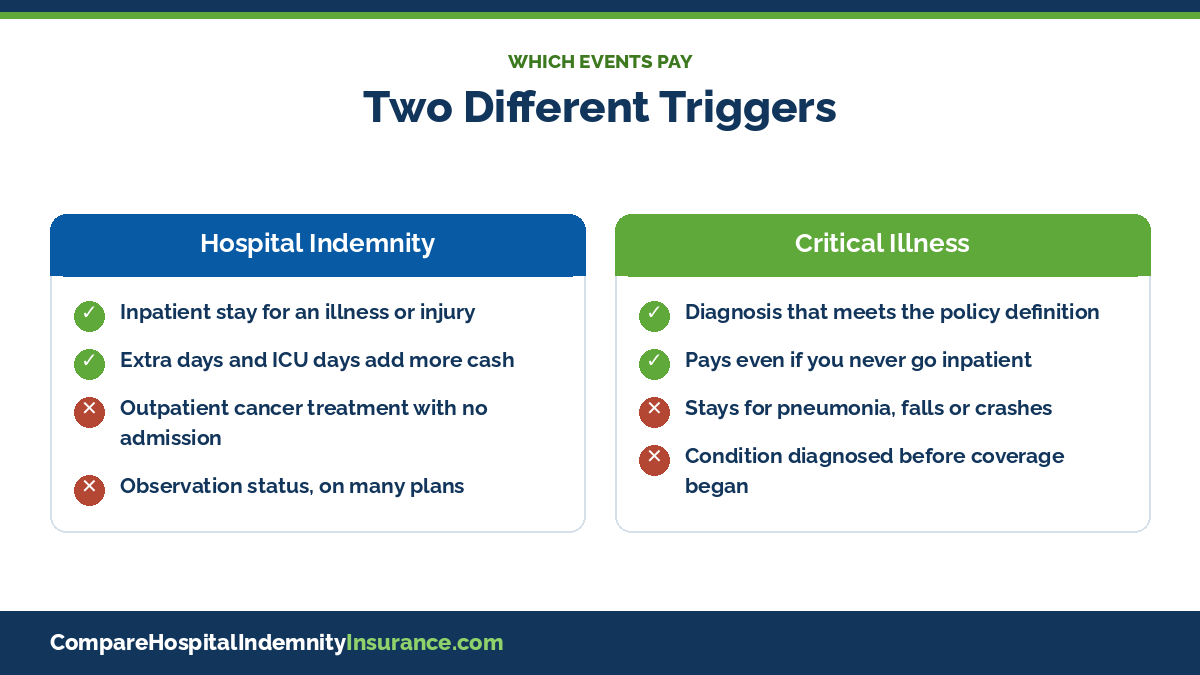
Hospital indemnity: an inpatient admission. Critical illness: a qualifying diagnosis, even if you are treated as an outpatient.
Shape of the payment
Hospital indemnity: a set amount per admission plus a set amount per day. Critical illness: one lump sum, sometimes a partial percentage.
What changes the amount
Hospital indemnity: how long you stay and whether you land in intensive care. Critical illness: which condition you have and the benefit amount you chose.

So a long stay for pneumonia can produce a sizable hospital claim and nothing from critical illness coverage, while an early cancer treated with outpatient surgery and infusions can do the reverse.

Our Side-by-Side Read of Four Carrier Documents

Carrier explainers describe each product in general terms. This table pulls the working rules from two individual outlines of coverage and two employer plan summaries.

Contract term Aflac individual CI (GA outline) MetLife group CI (one employer) Aflac individual HI (TX outline) MetLife group HI (one employer)
Trigger Diagnosis of a listed event, such as heart attack, stroke or internal cancer Diagnosis of a listed condition across several categories Hospital confinement of 23 hours or more; ER time does not count Inpatient admission and each day confined
Main benefit Face amount on the policy schedule; spouse and child at 50% Employee picks $10,000 to $50,000 $500 to $5,000 confinement benefit once per calendar year; rider adds $100 a day $1,000 admission plus $100 a day, up to 365 days a year
Intensive care Not a feature Not a feature Rider pays $500 a day, up to 30 days Extra $1,000 at ICU admission plus $100 a day, up to 90 days
Paying again Later event pays 50% of face; cancer recurrence needs 12 months in a row free of treatment Recurrence pays 100% for listed conditions; cancer needs 365 days free of treatment or symptoms Confinement benefit limited to once per calendar year No new admission benefit for a readmission for the same or related cause within 90 days
Prior conditions Not covered if treated in the 12 months before coverage, unless the loss starts more than 12 months after No benefit for a condition diagnosed before the effective date Same 12-month lookback and 12-month limit; 6 months if issued at 65 or older A limitation may apply; details not in the summary
Early waiting rule Internal cancer diagnosed in the first 30 days never pays Waiting periods may apply 30-day waiting period for sickness Not stated in the summary

Source: Aflac outlines of coverage for form series B71100 (Georgia) and B40100 (Texas), a MetLife critical illness page for one employer group, and a MetLife hospital indemnity summary for one university employer, checked November 2026. Amounts and rules vary by state, employer and plan version.

Pattern to notice

Critical illness documents spend their fine print on repeat diagnoses and treatment-free gaps. Hospital indemnity documents spend it on how often an admission can pay and what counts as a stay.


Comparison of hospital indemnity vs critical illness showing which events each policy pays for and which it does not

Where the Two Policies Overlap and Where Each Leaves a Hole

Overlap happens only when a listed diagnosis also puts you in a hospital bed. A heart attack or major stroke usually does both, and each policy pays its fixed amount without checking the other.

Events only one policy answers

Hospital indemnity alone responds
✔

Inpatient stays for infections, pneumonia, kidney stones or COVID-19 complications
✔

Admissions after a fall, car crash or other injury
✔

Childbirth admissions on many plans, subject to waiting periods
Critical illness alone responds
✕

A cancer diagnosis treated entirely with outpatient chemotherapy or radiation
✕

A heart attack or stroke handled in observation status rather than an inpatient admission
✕

Listed conditions such as kidney failure or multiple sclerosis managed at home

Both share two blind spots: conditions caught by the pre-existing rule, and ordinary office visits, prescriptions or lab work unless a rider adds them.

Russell Noga, licensed insurance agent

Side-by-side check

A heart attack admission can open a claim on both policies, but each insurer asks for different proof. The hospital plan needs admission and discharge dates and the inpatient status from the hospital, while the critical illness plan needs the diagnosis and test results that match its definition. Requesting both sets of records before discharge keeps one claim from waiting on the other.

Russell Noga, Licensed Insurance Agent

The Fine Print That Decides a Claim

Two rules cause most denied or delayed claims: the pre-existing condition lookback and the gap required before a second payment. The Aflac outlines in the table build the lookback the same way on both product types.

1
Count back 12 months from your start date. Any condition you saw a doctor about, were treated for or took medicine for in that window is flagged as pre-existing.
2
Count forward 12 months from your start date. A claim caused by a flagged condition is not paid if the loss begins inside this second window.
3
After both windows pass, the limit falls away. A loss from that same condition that starts more than 12 months after coverage began can be paid like any other claim.
4
Check your age at issue. On the Aflac hospital outline, people issued the policy at 65 or older get a shorter 6-month limit instead of 12.

Second claims work differently:

Guardian’s group critical illness page says a second occurrence of the same illness pays only after at least 6 months in a row with coverage in force, no symptoms and no treatment. MetLife’s employer plan uses 365 days for cancer, and Aflac’s individual outline uses 12 consecutive treatment-free months. Hospital indemnity plans focus instead on readmission rules, such as the 90-day window in the MetLife summary.

One Heart Attack, Two Policies: What Pays When

The Healthcare Cost and Utilization Project, run by the federal Agency for Healthcare Research and Quality, tracks what hospital stays cost to deliver. These are hospital costs, not your bill, but they show the scale.

HCUP national figures, 2018 stays
$22,300
mean hospital cost of a heart attack stay
$14,500
mean cost of all non-maternity adult and child stays
5.1 days
mean length of stays with an operating room procedure
4.5 days
mean length of stays without one

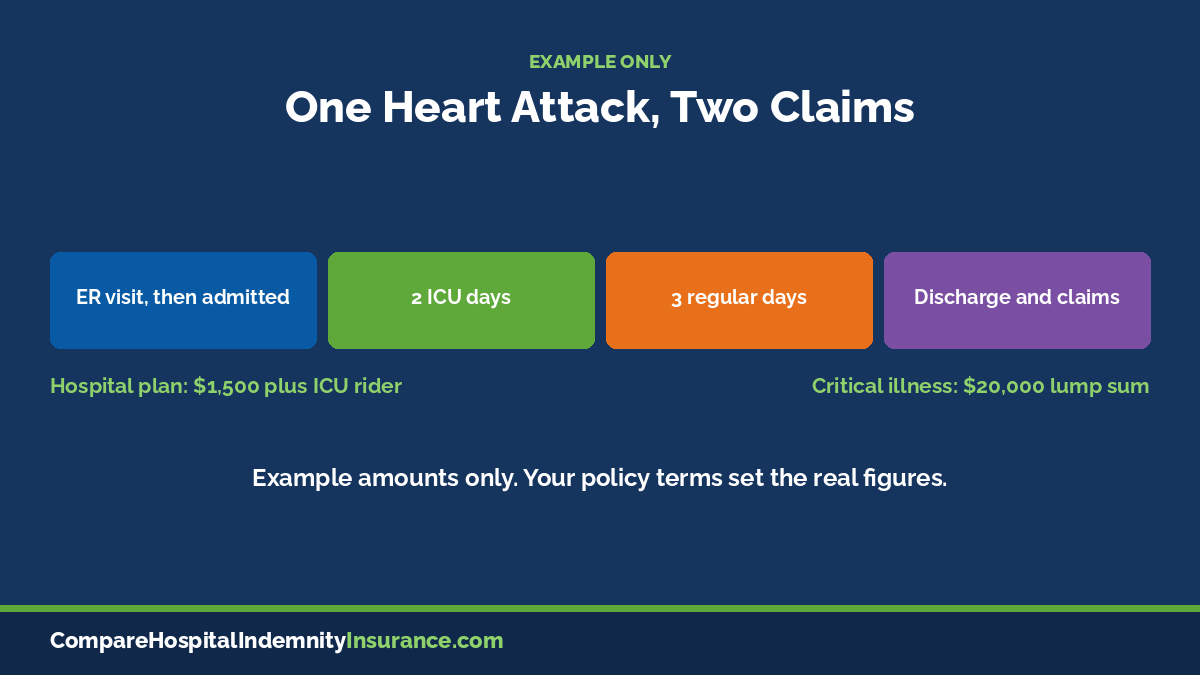
Now an example. Picture someone admitted for a heart attack for five days, two in intensive care, holding a hospital plan with a $1,000 admission benefit, $100 a day and an ICU rider, plus a $20,000 critical illness policy. These amounts are examples only. The hospital plan might pay $1,000 plus $500 for five days, plus its ICU benefit. The critical illness policy would pay $20,000 if the diagnosis meets its heart attack definition. For other kinds of stays, see how much hospital indemnity pays.

Timeline of hospital indemnity vs critical illness payouts during one example five-day heart attack hospital stay

Hospital Indemnity Quotes

Call a Licensed Agent Now

A licensed agent can price a hospital plan and a lump-sum plan together for your ZIP code.

☎ 1-888-891-0229

No obligation to enroll

What Pushes the Premium Up on Each Product

Each price follows the payout. Hospital plans are priced around how often people are admitted; critical illness plans around the odds of a serious diagnosis, which climb steeply with age. For dollar figures on the hospital side, see hospital indemnity insurance cost.

Cost driver Hospital indemnity Critical illness
Size of the benefit Admission amount, daily amount and number of covered days Lump-sum amount you pick, often in steps such as $10,000
Age Matters, but admissions happen at every age Usually the biggest factor, since heart attack, stroke and cancer risk rise with age
Tobacco use Rated by some carriers Commonly asked on applications and often priced higher
Riders ICU, outpatient surgery, ER visits, ambulance Cancer add-ons, screening or wellness payments, recovery benefits

General patterns from carrier documents; actual rating rules vary by insurer, state and whether the plan is individual or through an employer.

How to Decide: One, the Other or a Pair

There is no universal winner. The better fit depends on which shortfall would hurt you more: a run of hospital stays that each trigger a deductible, or one serious diagnosis that keeps you out of work.

Questions that point to an answer
  • ✔
    Is your deductible or inpatient copay high? A hospital plan targets that cost directly, every time you are admitted.
  • ✔
    Would a cancer, heart or stroke diagnosis cost you income? A lump sum covers bills that have nothing to do with the hospital, such as rent while you recover.
  • ✔
    Are you expecting surgery or a baby? Hospital plans with short waiting periods are the product built for planned stays.
  • ✔
    Is cash tight? Pairing both costs two premiums. A modest amount on each can work better than a large amount on one, or one well-chosen policy may be enough.

When more than one answer points each way, many households pair a modest hospital plan with a modest lump sum. For the contract-level view of the lump-sum side, see our guide to critical illness insurance.

Free comparison

Price a Hospital Plan, a Lump-Sum Plan or Both

Line up premiums and benefit amounts before you choose.

Plan availability, eligibility, and benefits vary by state and policy.

Hospital Indemnity vs Critical Illness: What People Ask Before Choosing

➤ Can one hospital stay pay out from both policies at once?

Yes, when the stay is caused by a listed diagnosis such as a heart attack. Each policy pays its own fixed amount, and neither reduces its benefit because the other one paid.

➤ Which policy pays more for a typical cancer diagnosis?

Usually critical illness, because the lump sum is often thousands of dollars while hospital plans pay only for inpatient days. Much cancer treatment happens outpatient, which a basic hospital plan may not cover at all.

➤ Does critical illness coverage pay for a hospital stay with no listed diagnosis?

No. A stay for pneumonia, an injury or a routine surgery does not meet any condition definition, so only a hospital plan would respond.

➤ Is a stroke patient kept under observation covered by a hospital plan?

Often not. Many hospital plans require a formal inpatient admission, and the Aflac outline reviewed here requires a confinement of 23 hours or more. A critical illness policy can still pay if the stroke meets its definition.

➤ Which one should a healthy 30-year-old look at first?

Admissions from injuries, infections and childbirth happen at every age, so a hospital plan tends to get used more often when you are young. Critical illness premiums are often lower at younger ages, so some people lock in a small amount early.

➤ Do I need health insurance to buy either policy?

Both are sold as supplements, and some carriers issue them only to people who already have other coverage. Neither is minimum essential coverage, so neither one should be your only protection.

Critical Illness Quotes

Call a Licensed Agent Now

Compare admission, daily and diagnosis benefits from several insurers before you enroll.

☎ 1-888-891-0229

No obligation to enroll

Russell Noga, licensed insurance agent

About the Author: Russell Noga

Russell Noga is a licensed insurance agent and the founder of ZRN Health & Financial Services, LLC. He has helped people compare health and supplemental insurance for more than 16 years and reviews every page on Compare Hospital Indemnity Insurance before it is published. Learn more about us or read our Editorial Standards.

CompareHospitalIndemnityInsurance.com is operated by ZRN Health & Financial Services, LLC, a Texas limited liability company based in Austin, Texas. We are not connected with or endorsed by any government agency.