Speak with a licensed insurance agent

1-888-891-0229

Hospital Indemnity Insurance Reviews: What Customers Report and the Data That Backs It Up

Reviewed by Russell Noga, Licensed Insurance Agent — Last updated November 7, 2026

Hospital indemnity insurance reviews mostly circle the same few themes: a claim turned down because the hospital kept the patient under observation instead of admitting them, a condition excluded by the pre-existing look-back, a payout delayed by paperwork, and on the positive side, money that arrived within days of a simple admission claim. Reviews show what can go wrong, but regulator complaint data and financial strength ratings show how often it goes wrong for a given insurer.

Plans near you

Check a Plan's Fine Print Before You Trust a Review

Enter your ZIP code to see hospital indemnity plans sold where you live.

Plan availability, eligibility, and benefits vary by state and policy.

This page explains how to weigh both, with a table of confirmed rating and complaint figures for six carriers. For a full rundown of who sells this coverage, see our guide to hospital indemnity insurance companies. To see plans sold in your ZIP code, you can compare hospital indemnity insurance with a licensed agent.

A reminder that applies to every carrier below: hospital indemnity is supplemental, limited-benefit coverage that pays fixed cash amounts. It does not replace health insurance and is not minimum essential coverage.

Fast take

Hospital indemnity insurance reviews are most useful for spotting the policy rules that trip people up, such as observation stays and pre-existing exclusions, not for ranking insurers. To judge a company, pair reviews with its NAIC complaint index, where 1.00 means complaints in line with its market share, and its AM Best financial strength rating.

Four Themes That Keep Showing Up in Customer Reviews

Read enough reviews on consumer sites and forums and the same storylines repeat, whatever the brand. Summarized in neutral terms, they fall into four groups.

Observation stay denials
A reviewer spent a night or two in the hospital and learned afterward that the stay was billed as outpatient observation, so the admission benefit did not pay.
Pre-existing condition exclusions
A claim was denied because the insurer found treatment or symptoms during the look-back months before the policy started.
Slow or paperwork-heavy claims
Reviewers describe repeat requests for records, discharge papers or itemized bills before the claim closed.
Paid quickly
Positive reviews often mention a straightforward admission claim paid by direct deposit within days or a few weeks.

Three of the four themes trace back to policy rules written in the certificate, not to one company behaving badly. The same denial can happen at any insurer whose definition of a confinement requires a formal inpatient admission.

Why Star Ratings Alone Can Steer You Wrong

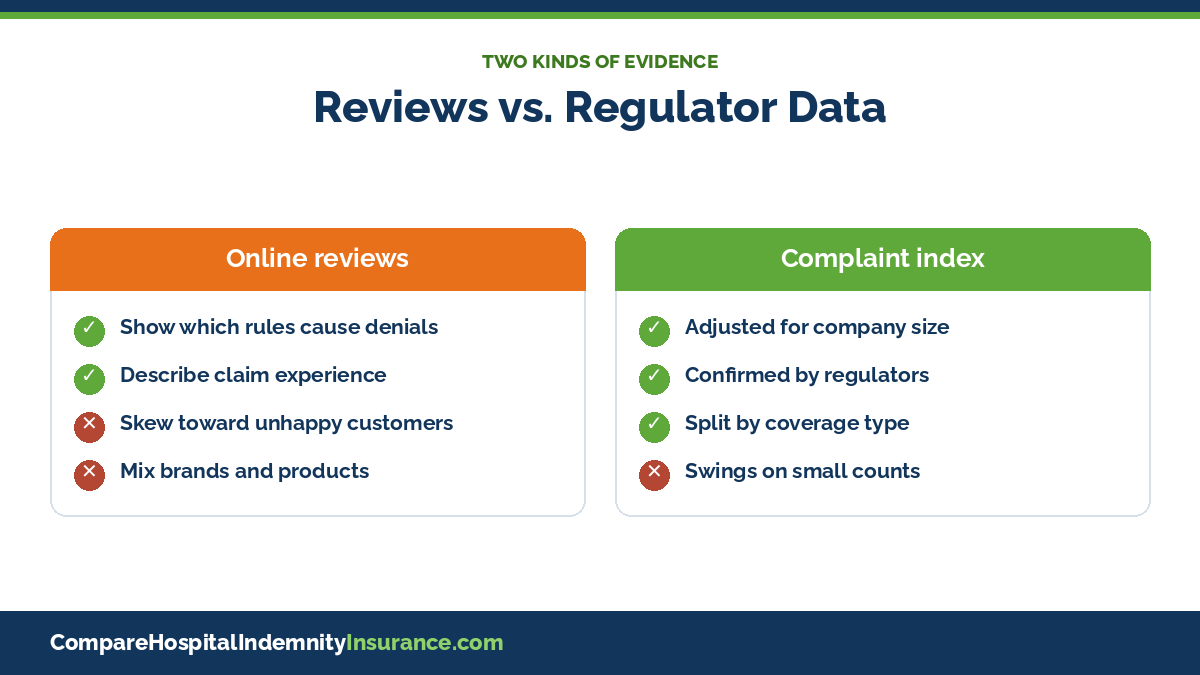
Online reviews come mostly from people with a strong feeling to share. A smooth claim rarely gets a post, while a denial often does. That tilt makes averages hard to compare.

  • Brand names hide several companies. One brand can sell through multiple legal insurers, and a review rarely says which one issued the policy.
  • Product lines blur together. A review page for a large insurer may mix life, dental, disability and hospital indemnity complaints.
  • Workplace and individual plans differ. An employer picks the plan design, so a group member’s bad experience may reflect the employer’s choice of benefits.
  • Size changes the count. A carrier with millions of policies will collect more reviews, good and bad, than a small regional insurer.

That last point is the reason regulators measure complaints against market share rather than counting them raw.

Comparison of what hospital indemnity insurance reviews show versus what regulator complaint data shows

How the NAIC Complaint Index Works

The National Association of Insurance Commissioners collects closed, confirmed complaints that state insurance departments report and publishes them through its free Consumer Insurance Search tool. You can look up a company by name, state and type of insurance, and the results cover the past three years.

1
Find the share of complaints. Divide the company’s complaints for a coverage type by all complaints for that type.
2
Find the share of business. Divide the company’s premium for that coverage type by all premium for that type.
3
Divide the first by the second. The result is the complaint index.
4
Read it against 1.00. At 1.00, complaints match the company’s size. Above 1.00 means more complaints than its size predicts, below means fewer.

Example only:

If a made-up insurer writes 2% of the accident and health premium in a state and draws 4% of the complaints, its index is 2.00, or twice the expected level. If it draws 1% of the complaints, its index is 0.50. These numbers illustrate the math and do not describe any real company.

The NAIC itself notes that an index can move because of shifts across the whole market for that coverage type, not only because of the company. Small insurers can swing far from 1.00 on a handful of complaints.

Russell Noga, licensed insurance agent

Complaint-data tip

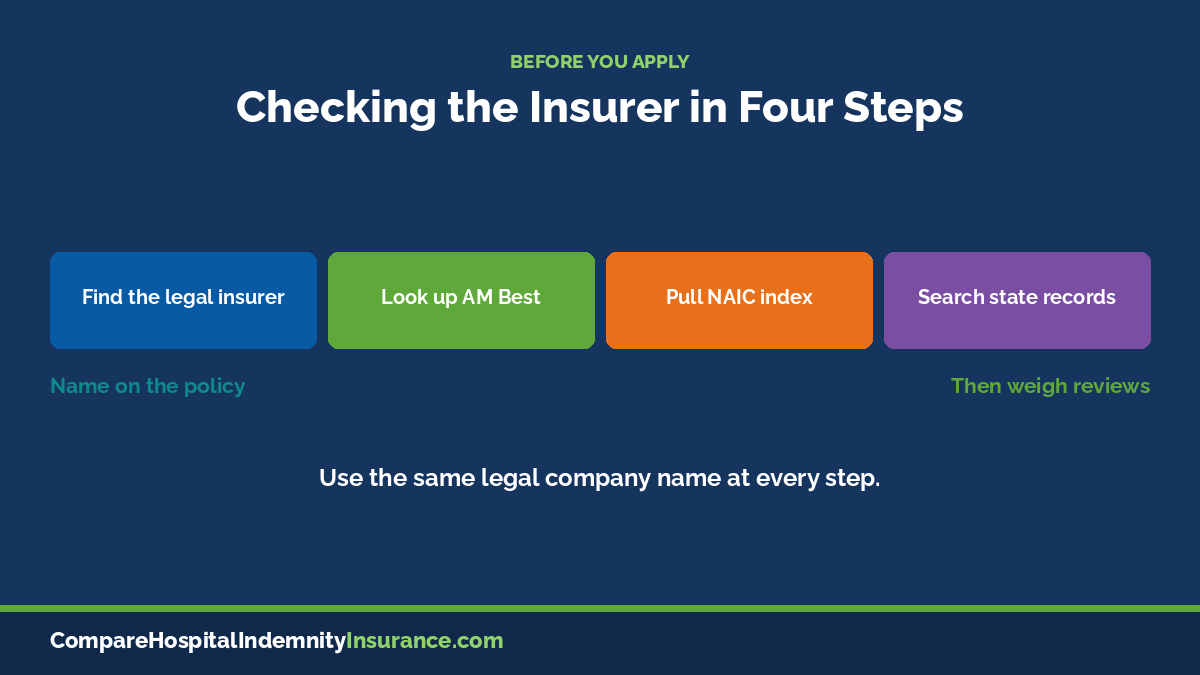
The NAIC Consumer Insurance Search lists complaints under each insurer’s legal name and NAIC company code, not the brand name. The legal name and code appear on the policy, the certificate or the outline of coverage, and searching that exact entity avoids mixing in a sister company that sells other products.

Russell Noga, Licensed Insurance Agent

Our Table: Ratings and Complaint Data for Six Carriers

Review sites rarely list the regulator data next to the ratings, so we pulled both for six insurers that sell hospital indemnity plans. Complaint figures come from Indiana’s 2025 Health Complaint Index, one of the few state reports that names each insurer with its premium, complaint count and index in one place.

Carrier Insurer we checked AM Best financial strength Indiana 2025 health complaint index
Aflac American Family Life Assurance Co. of Columbus A+ (Superior), stable, affirmed Oct. 2026 2.56 (4 complaints)
MetLife Metropolitan Life Insurance Co. A+ (Superior), stable, affirmed April 2026 1.37 (4 complaints)
Mutual of Omaha Mutual of Omaha and United of Omaha A+ (Superior), affirmed April 2026 Not listed
Wellabe Medico and affiliated insurers A (Excellent), stable, affirmed June 2026 Not listed
Guarantee Trust Life Guarantee Trust Life Insurance Co. A (Excellent), raised from A- in Oct. 2024 Not listed
ManhattanLife Manhattan Insurance Group members B++ (Good), raised from B+ in Nov. 2022 Not listed

Our analysis of AM Best rating releases and the Indiana Department of Insurance 2025 Health Complaint Index (complaints per premium dollar, Medicare and Medicaid premium excluded). The Indiana figures cover each insurer’s whole health line in that state, not hospital indemnity alone. Not listed means the insurer did not appear in the table, which leaves out companies with zero complaints. Checked Nov. 2026; confirm current ratings on AM Best before buying.

How to read it

Both indexes above 1.00 rest on four complaints each. That is enough to push the number well past the baseline, which is why one state’s single year should be treated as a prompt to dig deeper, not a verdict.

Aflac is the biggest name in workplace supplemental coverage, so its review volume is high. Our Aflac hospital indemnity page covers how its plans pay, and our Mutual of Omaha hospital indemnity page does the same for an individual-market option.

State Insurance Department Lookups

Your state’s insurance department licenses the insurer, takes complaints and can confirm whether a company may sell in your state. Each state publishes its data a little differently.

How three states report complaints
Indiana
index by premium; insurers under $1 million in premium are not calculated
Kansas
lists top 20 premium writers per line plus any insurer with 10 or more closed complaints
Texas
open data with confirmed complaints and policies in force by line of coverage

Texas measures complaints against policies in force rather than premium, so a Texas figure and an Indiana figure for the same company are not directly comparable. Search your department’s site for complaint index, complaint ratio or company lookup, and check whether a license is active before you apply.


Four steps to check an insurer behind hospital indemnity insurance reviews

Hospital Indemnity Quotes

Call a Licensed Agent Now

A licensed agent can show which insurer issues each plan and how its observation and pre-existing rules read.

☎ 1-888-891-0229

No obligation to enroll

AM Best, J.D. Power and the BBB: What Each Measures

Three other names come up in hospital indemnity insurance reviews. Each answers a different question, and none of them grades whether a specific claim should have paid.

What they can tell you
✔

AM Best: the insurer’s ability to meet ongoing policy and claim obligations
✔

J.D. Power: satisfaction scores in the product lines it studies
✔

BBB: how a company responds to complaints filed through the BBB
What they cannot tell you
✕

AM Best does not rate customer service or claim decisions
✕

We found no J.D. Power study that ranks hospital indemnity carriers
✕

The BBB is not a regulator, and its letter grade is not a claims record

Treat a BBB grade as a measure of responsiveness. A company can earn a strong grade by answering complaints even if the policy terms behind them stay the same.

Matching a Bad Review to Your Own Policy

One question our readers ask is which plan is best for lower premiums and strong claim satisfaction. No public source scores claim satisfaction for hospital indemnity alone, so the practical test is to check whether the rule behind a bad review is in the policy you are considering.

Questions to answer from the outline of coverage
  • ✔
    Does an observation stay count, and after how many hours?
  • ✔
    How many months does the pre-existing look-back reach, and how long does the exclusion last?
  • ✔
    Is there a waiting period for sickness claims that does not apply to accidents?
  • ✔
    What documents does a claim require, and can they be uploaded online?
  • ✔
    Is the issuing insurer the same legal company you checked on AM Best and the NAIC tool?

For a workplace plan, the same questions apply to the certificate your employer hands out. To understand how the benefits are triggered in the first place, see how hospital indemnity insurance works.

No-cost help

Talk Through Ratings and Plan Rules With a Licensed Agent

See benefit terms from more than one insurer before you choose.

Plan availability, eligibility, and benefits vary by state and policy.

Hospital Indemnity Insurance Reviews: Questions People Ask

➤ Are online hospital indemnity insurance reviews reliable?

They are reliable for spotting recurring problems, such as observation denials, but not for ranking companies, since they often mix several products and legal insurers.

➤ What is a good NAIC complaint index?

A figure at or below 1.00 means the insurer draws no more complaints than its share of the market predicts. Check several years and the coverage type, because a small insurer can jump above 1.00 on a few complaints.

➤ Why was a hospital indemnity claim denied for an overnight stay?

Many policies pay the admission benefit only for a formal inpatient admission. If the hospital kept the patient under observation, the stay may count as outpatient care unless the plan has an observation or short-stay benefit.

➤ Does AM Best rate claims service?

No. An AM Best financial strength rating reflects an insurer’s ability to pay its obligations. It does not grade customer service, claim speed or how fairly individual claims are decided.

➤ Is there a J.D. Power ranking for hospital indemnity insurance?

We could not find a J.D. Power study that ranks hospital indemnity carriers. J.D. Power studies cover other insurance lines, so a score from one of those studies does not describe a hospital indemnity product.

➤ Where do I file a complaint about a hospital indemnity insurer?

Start with the insurer’s own grievance process, then file with your state insurance department if the issue is not resolved. The department can review whether the claim was handled under the policy terms and state law.

➤ Do reviews of a workplace plan apply to an individual policy?

Not always. An employer chooses the benefit levels, riders and sometimes waiting periods, so a group member’s experience can reflect that employer’s plan design rather than the insurer’s individual policy.

➤ Does a strong rating mean the plan replaces health insurance?

No. Even a top-rated insurer’s hospital indemnity plan is a supplemental, limited-benefit policy that pays fixed amounts. It is not minimum essential coverage and is meant to sit alongside a medical plan.

Compare Before You Buy

Call a Licensed Agent Now

Line up plans from carriers with strong ratings and clear claim rules in your state.

☎ 1-888-891-0229

No obligation to enroll

Russell Noga, licensed insurance agent

About the Author: Russell Noga

Russell Noga is a licensed insurance agent and the founder of ZRN Health & Financial Services, LLC. He has helped people compare health and supplemental insurance for more than 16 years and reviews every page on Compare Hospital Indemnity Insurance before it is published. Learn more about us or read our Editorial Standards.

CompareHospitalIndemnityInsurance.com is operated by ZRN Health & Financial Services, LLC, a Texas limited liability company based in Austin, Texas. We are not connected with or endorsed by any government agency.