Speak with a licensed insurance agent

1-888-891-0229

Can You Have More Than One Hospital Indemnity Plan? How Stacking Policies Works

Reviewed by Russell Noga, Licensed Insurance Agent — Last updated November 8, 2026

Yes, you can have more than one hospital indemnity plan, and in most cases each policy pays its own fixed cash benefit for the same covered hospital stay, because these policies pay set dollar amounts regardless of other insurance you carry. A common setup is a voluntary plan through work plus an individual policy bought on your own, and both can send you a check after one admission.

Add-on coverage

Already Covered at Work? See What a Second Plan Adds

Enter your ZIP to compare individual hospital indemnity plans that pay on top of workplace coverage.

Plan availability, eligibility, and benefits vary by state and policy.

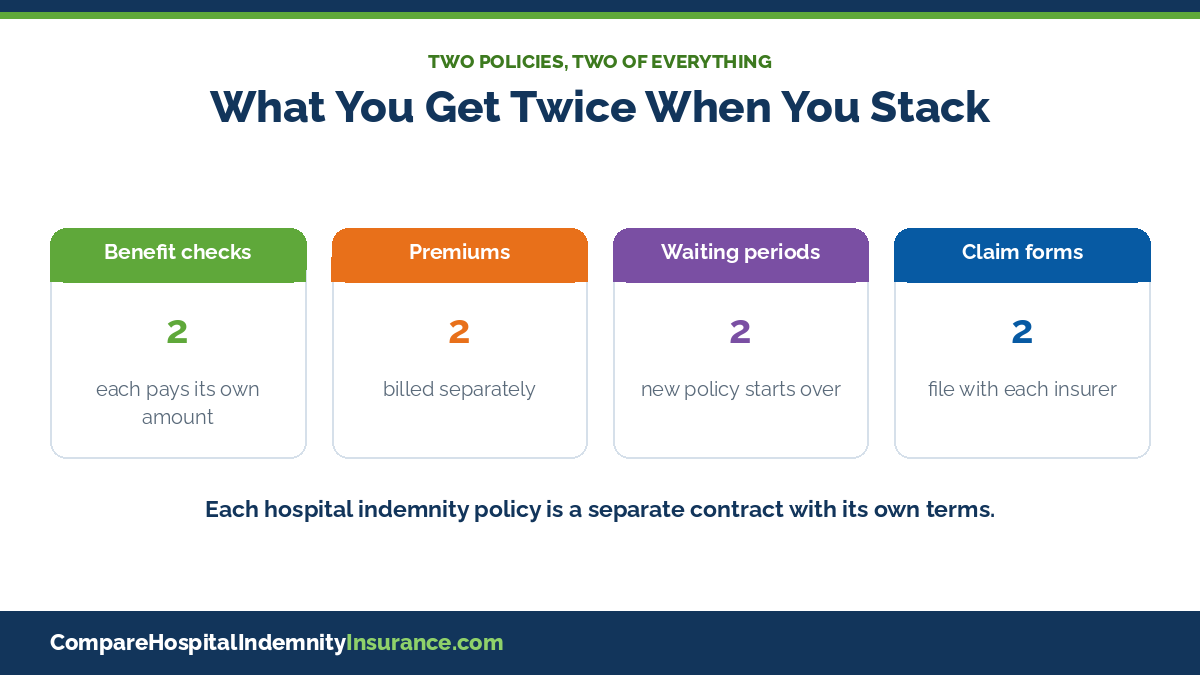
The catch is that each policy is a separate contract with its own premium, waiting periods, definition of a hospital stay and claim form, and some insurers limit how many like policies they will issue to one person. Below: why two policies can both pay, what filed documents and state rules say, and when a second policy is worth it. For plan types and benefit designs, see our guide to hospital indemnity insurance plans, or compare hospital indemnity insurance options sold in your area.

Quick answer

You can have more than one hospital indemnity plan. Fixed indemnity policies generally pay without coordinating with other coverage, so a work plan and an individual plan can each pay in full for the same stay, though one insurer may cap how many of its own policies you hold.

Why Two Hospital Policies Can Both Pay for One Stay

Major medical insurance pays a share of your actual bill, so when two medical plans cover one person, coordination of benefits rules decide which pays first and keep the total from exceeding the charges. Hospital indemnity pays a stated amount per admission or per day, no matter what the hospital charged. Since the payment is not tied to the bill, there is nothing to split between two policies.

The federal test for workplace plans:

Federal rules at 29 CFR 2590.732(c)(4) let an employer offer hospital indemnity as an excepted benefit only if it is a separate policy, does not coordinate with the employer’s group health plan, and pays for an event without regard to whether the group health plan also pays for it. A workplace hospital plan that cut its check because your medical plan paid would not meet that test.

The same logic holds when the second policy is an individual plan from another company. Neither insurer is paying your hospital bill, so each checks only whether your stay meets its own terms.

An Example: A Work Plan and an Individual Plan for the Same Stay

The amounts below are examples, not quotes from any real policy. They show how two separate benefit schedules add up for one three-day inpatient stay, assuming every day qualifies under both policies.

1
Work plan admission benefit. Example: the voluntary plan pays $1,000 when you are admitted.
2
Work plan daily benefit. Example: $100 a day for three days adds $300, so the work plan pays $1,300.
3
Individual plan admission benefit. Example: the policy you bought on your own pays $500 at admission.
4
Individual plan daily benefit. Example: $200 a day for three days adds $600, so the individual plan pays $1,100.
5
Add the two checks. Together the example policies pay $2,400 for one stay, sent separately by each insurer after you file each claim.

Real results depend on details such as whether daily pay starts on the first day or the second, how many days each policy covers per stay, and whether a stay counts as inpatient at all. Our breakdown of how much hospital indemnity pays covers those payout rules for a single policy.


Can you have more than one hospital indemnity plan: what doubles when you hold two policies

What Carriers’ Own Documents Say About Other Coverage

Marketing claims are easy to find, so we went to the brochures, outlines of coverage and plan FAQs carriers and plan sponsors have posted. The table lists only what each document states. A blank in the fine print is shown as not stated, which does not mean the policy has no such rule.

Document reviewed Statement on other coverage Requires other health coverage? Limit on number of policies
ManhattanLife hospital indemnity brochure, policy form M-8019 (posted on an employer benefits site) Cash benefit paid regardless of any other insurance you have; benefits pay in addition to other coverage Not stated Not stated
MetLife group hospital indemnity FAQ, Kansas State Employee Health Plan Paid regardless of any other insurance payment from other plans; no need to coordinate with other insurance Not stated Not stated
MetLife hospital indemnity product page (individual and group overview) Pays regardless of what your medical insurance covers Some states require the insured to have medical coverage Not stated
Aflac Choice HSA-Compatible Hospital Confinement Indemnity, Option H outline of coverage (Georgia), form series B4010H Supplemental coverage, a supplement to health insurance and not a substitute for major medical coverage Issued only to supplement insurance already in force Not stated

Sources: the carrier and plan sponsor documents named in the first column, checked November 2026. Terms vary by state and policy form; the certificate or policy you receive controls.

What the documents agree on

None of these documents reduces its payment because another plan paid. The differences sit elsewhere: some forms are sold only to people who already have health insurance, and none of the four publishes a cap on how many hospital policies you can own.

State Rules That Protect Payment When You Hold Other Coverage

Hospital indemnity is regulated state by state, and several state rulebooks write the no-coordination idea into their minimum standards for these policies. A few examples, taken from the regulations themselves:

Examples from state insurance rules
  • ✔
    Idaho (IDAPA 18.04.08.035): the minimum standards for hospital confinement indemnity coverage state that benefits will be paid regardless of other coverage.
  • ✔
    Utah (Utah Admin. Code R590-126-7): the standards for hospital fixed indemnity insurance state that benefits shall be paid regardless of other insurance.
  • ✔
    Oregon: the state’s coordination of benefits rule (OAR 836-020-0775) leaves hospital indemnity and other fixed indemnity coverage out of its definition of a plan, and the state’s filing guidelines say coordination language is not allowed in indemnity plans.

Other states use their own wording, and some sell certain forms only to people who already carry health insurance. Outside these three states, the outline of coverage for the specific policy shows how your state handles it.

Russell Noga, licensed insurance agent

Before you buy

Two policies only pay twice when the stay meets both sets of terms. One certificate may count a night under observation as a hospital stay while another requires a formal inpatient admission, and day limits per stay can differ, so compare the definition of hospital confinement in each document before counting on a second check.

Russell Noga, Licensed Insurance Agent

Where Limits Do Show Up: Same-Insurer Rules and Application Questions

Owning policies from two different companies is the simplest case. Holding two similar policies from the same insurer is where a written limit is most likely to appear.

  • Other insurance with this insurer. State policy provision laws, including Texas Insurance Code Section 1201.221 and California Insurance Code Section 10369.4, allow an individual policy to include a clause that limits you to one like policy with that company, or voids coverage above a stated total. Under either version, the insurer returns the premiums paid for the excess coverage.
  • Questions about coverage in force. Individual applications may ask whether you have other hospital or supplemental coverage, or whether the new policy replaces one. Answers can affect approval, and an inaccurate answer can cause problems at claim time, so list every policy you hold.
  • Underwriting judgment. An insurer reviewing an application can decline coverage or offer a lower amount when the total daily benefits a person holds look large. Whether and how an insurer does this is not usually spelled out in consumer brochures.

Watch for:

A second policy restarts the clock. Each policy has its own pre-existing condition limitation and any waiting periods, so a condition that the work plan now covers could be excluded under a new individual policy for its first months.

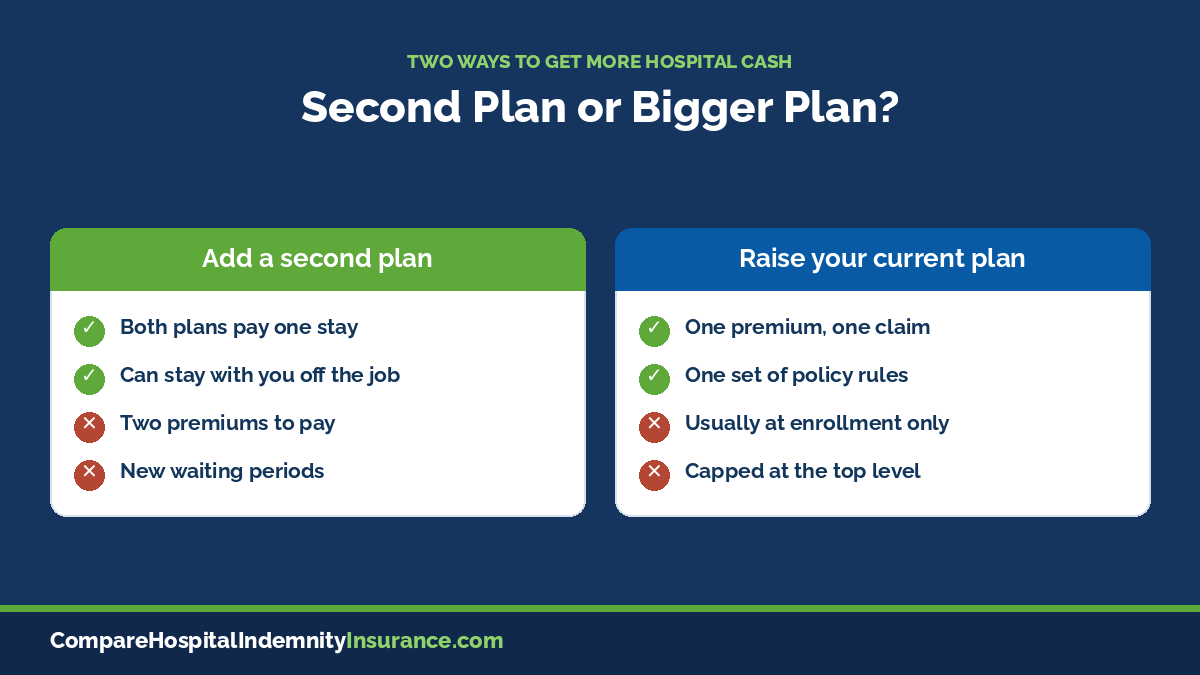
Can you have more than one hospital indemnity plan compared with raising the benefit level on one plan

Hospital Indemnity Quotes

Call a Licensed Agent Now

Licensed agents can show how a second policy would sit next to the plan you already have.

☎ 1-888-891-0229

No obligation to enroll

When Stacking Makes Sense and When It Usually Does Not

A second policy can fit if
✔

Your work plan pays a small amount and its top level still leaves a large gap against your deductible
✔

You want coverage you own if you change jobs
✔

Several days in the hospital would mean lost pay your household cannot absorb
✔

You qualify now and want benefits in place before a likely stay
It is usually a poor fit if
✕

Your medical plan has a low deductible, so one policy already covers most of what you would owe
✕

Raising your current level at enrollment would cost less than a second premium
✕

The new policy has a long waiting period for the condition you are worried about
✕

Two premiums would crowd out an emergency fund

A quick test: estimate what one likely stay would cost under your medical plan, then compare that with what your current hospital plan pays. If the current plan covers most of the gap, a second premium buys mostly overlap. Workplace options are covered in our guide to voluntary hospital indemnity insurance.

Alternatives to a Second Hospital Policy, and What No Policy Replaces

A second hospital plan only pays when you are in the hospital again. If the gap you are trying to fill is broader, a different kind of supplemental coverage may pair better with the plan you have.

Raise your current level
Many workplace menus offer a higher option at annual enrollment. It keeps one premium, one claim and one set of rules.
Add critical illness coverage
Pays a lump sum when a covered diagnosis such as a heart attack or cancer is made, whether or not you are admitted. See our critical illness insurance guide.
Add accident coverage
Pays set amounts for injuries such as fractures, ER visits and follow-up care, which a hospital-only plan may skip. See accident insurance.

Stacking does not change the basics:

Two hospital indemnity policies are still two limited-benefit supplements. Neither is minimum essential coverage under the Affordable Care Act or a substitute for major medical insurance. A 2024 federal rule would have required a new consumer notice on workplace fixed indemnity plans, but a federal court in Texas vacated that notice in December 2024 and the government dropped its appeal in June 2025. The older federal notice for individual policies still applies.

Free comparison

Find the Right Way to Add Hospital Cash Coverage

Compare a second policy, a higher benefit level or a different supplemental plan by ZIP code.

Plan availability, eligibility, and benefits vary by state and policy.

Holding Two Hospital Indemnity Plans: Questions People Ask

➤ Will my workplace hospital plan pay less if I also have an individual policy?

It should not. Federal rules require an employer’s hospital indemnity plan to pay without regard to the employer’s medical plan, and carriers’ group documents state that benefits are paid regardless of other insurance. Each policy pays its own scheduled amount.

➤ Can I buy two hospital indemnity policies from the same company?

Sometimes, but this is where limits most often appear. State laws let individual policies include an other insurance with this insurer clause that limits you to one like policy or caps the total, with premiums for the excess returned.

➤ Do I have to tell a new insurer about the hospital policy I already have?

If the application asks about other coverage in force or replacement, answer fully and accurately. Leaving a policy off can lead to a declined claim or a rescinded policy if the insurer finds the answer was wrong.

➤ Do I file one claim or two after a hospital stay?

Two. Each insurer has its own claim form and proof requirements, so request enough copies of your admission and discharge records to send to both companies.

➤ Does having two hospital indemnity plans satisfy the health insurance requirement under the ACA?

No. Fixed indemnity coverage is not minimum essential coverage, no matter how many policies you hold. You still need a major medical plan, Medicare, Medicaid or other qualifying coverage.

➤ Is it better to stack hospital plans or add critical illness coverage?

It depends on the risk you want covered. A second hospital plan adds cash only for admissions, while critical illness insurance pays a lump sum for a covered diagnosis even without a hospital stay.

Free Plan Comparison

Call a Licensed Agent Now

Compare an added policy with a higher benefit level before you pay two premiums.

☎ 1-888-891-0229

No obligation to enroll

Russell Noga, licensed insurance agent

About the Author: Russell Noga

Russell Noga is a licensed insurance agent and the founder of ZRN Health & Financial Services, LLC. He has helped people compare health and supplemental insurance for more than 16 years and reviews every page on Compare Hospital Indemnity Insurance before it is published. Learn more about us or read our Editorial Standards.

CompareHospitalIndemnityInsurance.com is operated by ZRN Health & Financial Services, LLC, a Texas limited liability company based in Austin, Texas. We are not connected with or endorsed by any government agency.