How Policies Define a Covered Condition
Insurers do not pay on a label alone. Each covered illness carries a definition tied to tests, imaging or a minimum length of time. The examples below come straight from filed group documents.
| Condition |
What the filed wording requires (example) |
Source document |
| Heart attack |
New and serial ECG findings consistent with a heart attack plus cardiac enzymes above normal lab levels |
Aflac group CI brochure (CAIC series C21000) |
| Stroke |
Neurological deficits confirmed by neuroimaging; transient ischemic attacks and head injuries excluded |
Aflac group CI brochure |
| Stroke |
Migraine symptoms and brain injury from trauma or lack of oxygen excluded |
MetLife group CI disclosure (GCERT14-CI) |
| Coma |
Continuous unconsciousness for 14 days or longer |
Voya group CI certificate (ReliaStar Life) |
| Paralysis |
Loss of use of two or more limbs for at least 60 days |
Voya group CI certificate |
| Multiple sclerosis |
Symptoms that persist for 6 months |
Voya group CI certificate |
Wording paraphrased from employer-group certificates and brochures filed by each insurer, checked November 2026. Definitions vary by state, plan and policy form.
Why this matters:
A short-lived stroke-like episode that resolves without lasting damage on imaging may be called a transient ischemic attack, and the definitions above exclude it. The diagnosis on your chart and the definition in your certificate have to line up.
Policy-reading tip
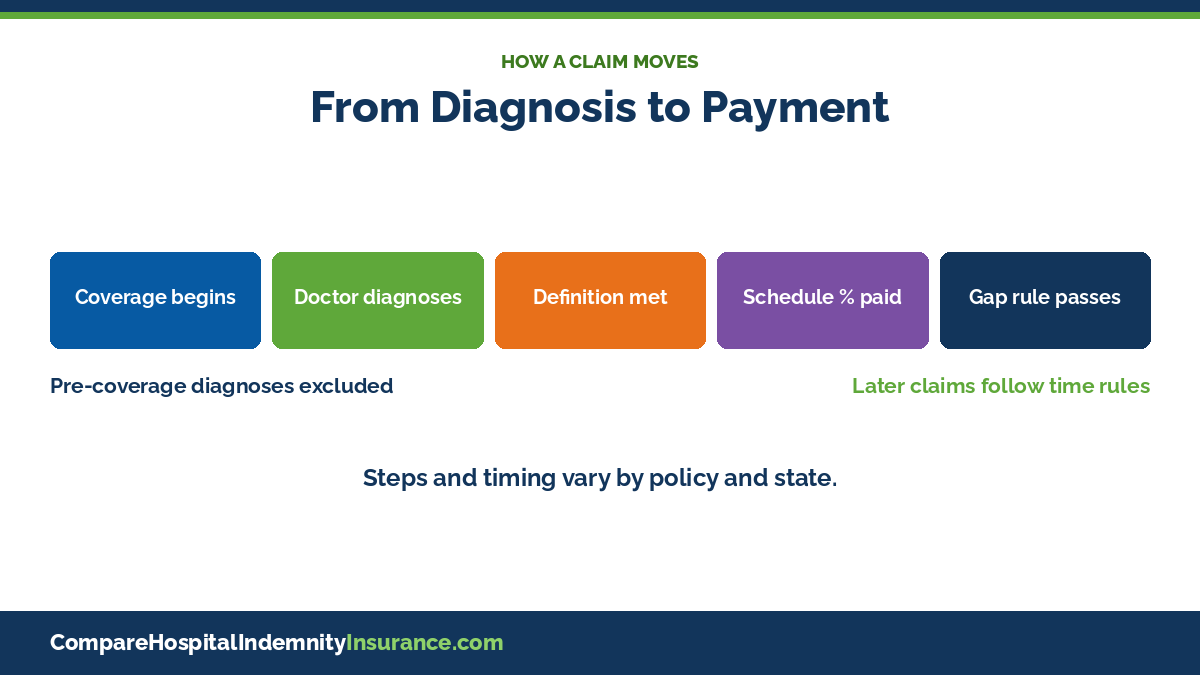
The schedule of benefits page shows a percentage next to each condition. Any condition listed below 100%, such as carcinoma in situ or bypass surgery, pays only that share of the chosen amount, so multiply before counting on the full lump sum.
Russell Noga, Licensed Insurance Agent
Full Benefit, Partial Benefit and the Percentage Schedule
The schedule assigns each condition a share of your benefit amount. Invasive cancer, heart attack and stroke usually pay 100%. Earlier or less severe diagnoses, such as carcinoma in situ (cancer cells that have not spread into nearby tissue) or coronary bypass surgery, often pay a smaller share.
Example only: a $20,000 benefit amount
$20,000
invasive cancer at 100%
$10,000
carcinoma in situ on a plan that pays 50%
$5,000
non-invasive cancer on a plan that pays 25%
$5,000
bypass surgery on a plan that pays 25%
The percentage is a plan design choice, not an industry rule. Two Voya employer certificates reviewed for this page show the same insurer paying carcinoma in situ at 50% on one plan and 100% on another. The Aflac group brochure lists 25% for non-invasive cancer, and one MetLife summary lists 25% for its partial benefit cancer category.
Four Insurers’ Filed Terms Side by Side
No single public source lines up these contract terms across insurers, so we built the comparison from each company’s own employer brochures, certificates and product pages. Blank spots mean the term was not stated in the documents reviewed.
| Insurer and plan |
Benefit amounts |
Early-stage cancer |
Repeat or second diagnosis |
Screening benefit |
Continuation and age rules |
| Aflac group CI (Continental American Insurance Co., C21000) |
Set by the employer plan |
25% for non-invasive cancer |
Pays again when diagnoses are at least 6 months apart |
$50 a year, employee and spouse |
Can be kept after leaving the job, with conditions |
| MetLife group CI (GCERT14-CI) |
$15,000 or $30,000 on one plan; lifetime cap of 7 times the amount |
25% first payment, 100% if it recurs, on one plan |
Suspension periods of 30 to 365 days, by plan |
Once a year; amount set by plan |
Benefit cut at ages 65 and 70 on one disclosure |
| Voya group CI (ReliaStar Life) |
Varies |
50% on one plan, 100% on another |
New cancer diagnosis counts after 1 or 3 months, by plan; most other conditions pay once |
Varies |
Elect within 31 days; must be under 70 to continue |
| Guardian group CI |
$1,000 to $50,000 |
Varies |
$500 to $25,000 for a new occurrence of the same illness |
Optional, picked by the employer |
Varies |
Source: insurer-filed employer brochures, certificates and disclosure statements, plus Guardian’s own product page, checked November 2026. Terms differ by state, employer and plan version; the certificate you receive controls.
Pattern to notice
The biggest differences are not in the headline benefit amount. They sit in the early-stage cancer percentage and in the waiting gap before a second claim, which can decide whether a cancer that comes back pays anything.
Age Reductions, Prior Diagnoses and Survival Rules
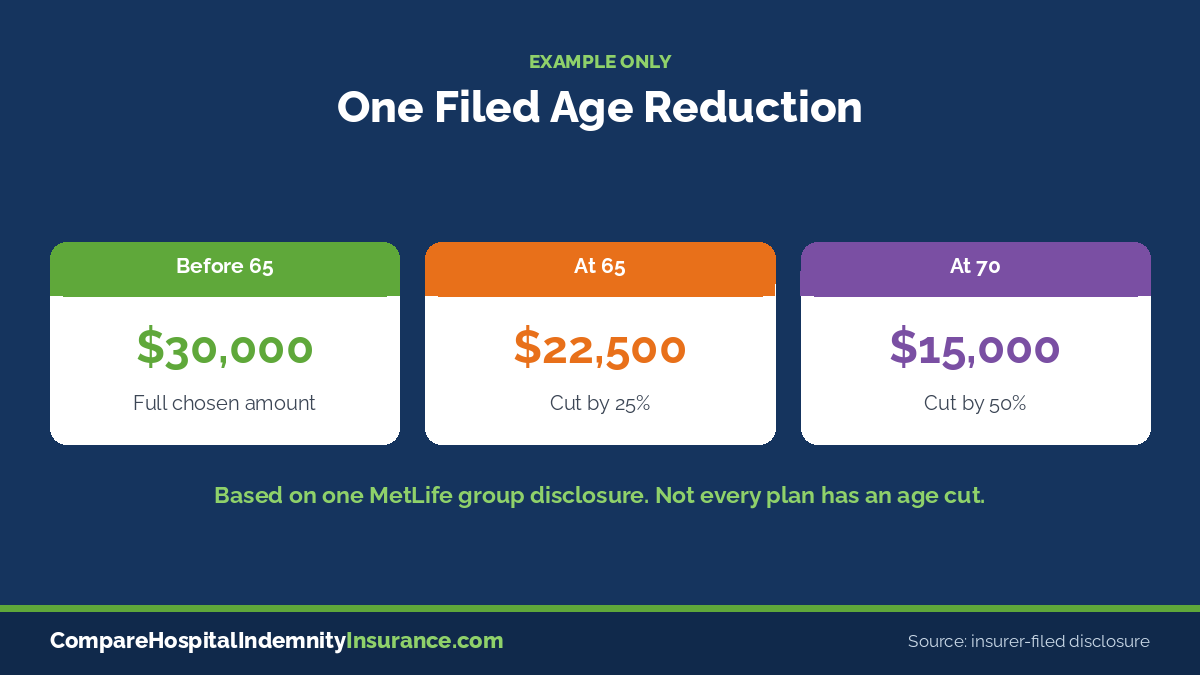
Some contracts shrink the benefit as you get older even though the premium keeps coming out of your paycheck. One MetLife group disclosure reduces both the benefit amount and the lifetime total by 25% at age 65 and by 50% at age 70. It adds that if the reduced lifetime total is at or below what has already been paid, coverage ends on the date of the reduction.
Other limits to look for
- ✔
Diagnosis before the start date. One MetLife summary pays nothing for a covered condition diagnosed before the coverage effective date. Some individual policies use a look-back period instead, so read that section closely.
- ✔
Eligibility waiting periods. One Voya certificate lists its waiting period as none. Others delay coverage for a set number of days after the start date, which varies by plan and state.
- ✔
Survival periods. Policies in Canada and some other countries can require you to live 14 to 30 days after diagnosis. The US group certificates reviewed here did not include a general survival period, though a few conditions carry their own time tests, such as 14 days for coma.