Speak with a licensed insurance agent

1-888-891-0229

Cigna Hospital Indemnity Low vs High: Plan 1 vs Plan 2 Benefits, Costs and Break-Even Math

Reviewed by Russell Noga, Licensed Insurance Agent — Last updated November 14, 2026

Cigna hospital indemnity low vs high is a choice between Plan 1 and Plan 2 of Cigna’s workplace Hospital Care policy: Plan 2 pays twice as much on almost every benefit line and costs about 1.9 to 2 times as much, so it suits people who expect a hospital stay or carry a high deductible, while Plan 1 suits people who mainly want cheap protection. Employer guides may say Low and High, but the Cigna summary underneath prints Plan 1 and Plan 2.

Top up your coverage

Want More Than Cigna's Plan 2 Pays? Check Plans by ZIP

See hospital indemnity options you can add on your own in your state.

Plan availability, eligibility, and benefits vary by state and policy.

Both levels are limited-benefit fixed indemnity coverage. The summaries reviewed here state that the policy is not health insurance and does not satisfy the minimum essential coverage requirement. For who insures Cigna’s products after its 2025 supplemental sale, see our Cigna hospital indemnity guide, or see how Cigna ranks among hospital indemnity insurance companies. Without a Cigna plan at work, you can compare hospital indemnity insurance sold to individuals.

The deciding factor

Pick Cigna’s higher level, usually printed as Plan 2, when a hospital stay next year is likely or your deductible is large, since it doubles the admission, daily and ICU checks for close to double the premium; pick the lower level, Plan 1, when a stay is unlikely and the smaller payroll deduction matters more.

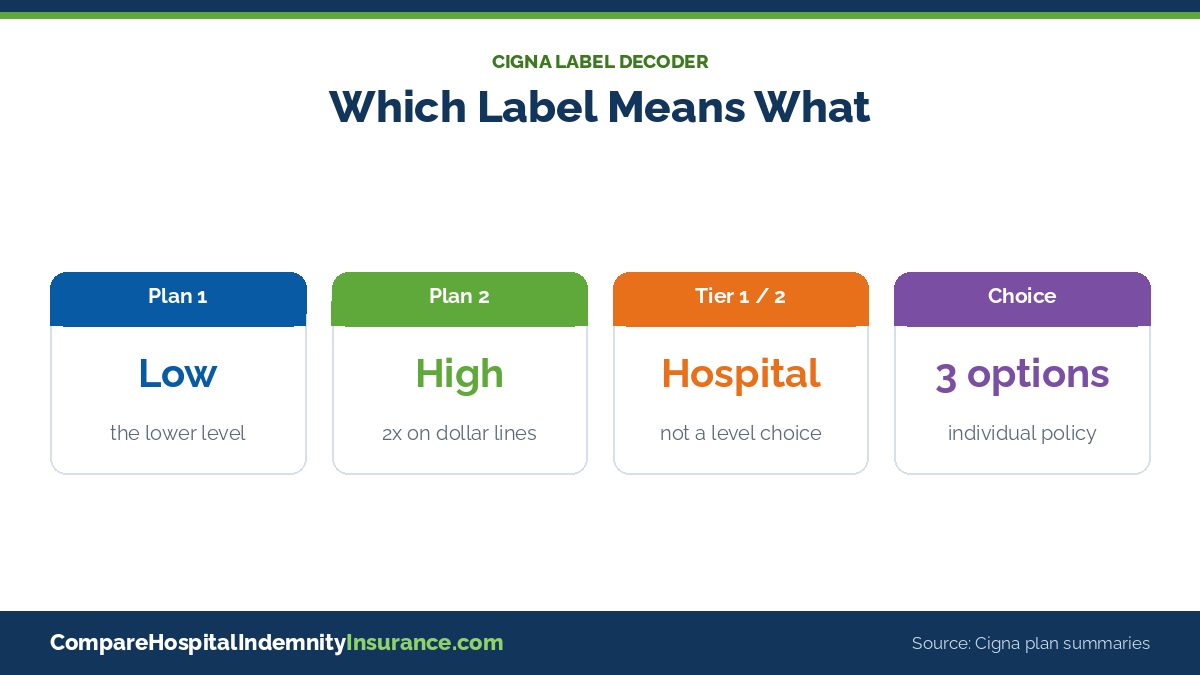
Plan 1, Plan 2, Tier 1, Choice Core: Reading Cigna’s Labels

Searchers looking for a Cigna Low and High chart often land on a summary that never uses those words. The Hospital Care summaries posted by Dartmouth College and World Wide Technology, LLC show columns headed Plan 1 and Plan 2. Those are the low and high options.

Not a level choice:

Some Cigna summaries show Tier 1 and Tier 2 columns instead. Those describe where you are treated, not how much coverage you bought. Baylor Scott & White Health’s single plan (HC962377) pays $625 to admit at a client facility and $500 elsewhere.

Bucknell University pays for the low option for employees in one cost-share bracket of its high-deductible medical plan, who can buy up to the high option by paying the difference. The individual policy on Cigna’s website, insured by Loyal American Life Insurance Company for ages 18 to 89, uses a different three-option setup covered in the FAQ below.

Cigna hospital indemnity low vs high label guide: Plan 1 is the lower level, Plan 2 the higher level, Tier 1 and Tier 2 mean hospital location, Choice options are the individual policy

Two Posted Cigna Menus, Plan 1 Against Plan 2

Cigna does not publish one national Hospital Care schedule; each employer picks its amounts. In each cell below, the first figure is Plan 1 and the second is Plan 2.

Benefit line Dartmouth College (HC110988) World Wide Technology (HC110724)
Hospital admission, regular or ICU $1,000 / $2,000, 1 day $1,000 / $2,000, 1 day
Daily hospital stay $100 / $200, up to 31 days $100 / $200, up to 30 days
ICU $200 / $400 a day, up to 31 days Extra $1,200 / $2,400 on ICU day 1, then $200 / $400 a day through day 30
Observation, per 24 hours $100 / $200 after a 12-hour observation period, 72-hour cap $100 / $200 after a 24-hour elimination period, 72-hour cap
Chronic condition admission $50 / $100 $50 / $100
Newborn nursery Not listed $250 / $500 admission, then $100 / $200 a day up to 30 days
Wellness incentive Not listed $50 / $50, once a year
Employee only $11.23 / $22.27 monthly $4.27 / $8.11 semi-monthly
Employee and spouse $22.87 / $45.56 monthly $10.98 / $20.91 semi-monthly
Employee and children $18.92 / $37.64 monthly $8.54 / $15.92 semi-monthly
Employee and family $25.98 / $51.80 monthly $15.26 / $28.80 semi-monthly

Sources: Cigna Hospital Care benefit summaries posted by Dartmouth College (group policy HC110988, 2026 Cigna summary, monthly rates) and World Wide Technology, LLC (group policy HC110724, 2023 Cigna form, semi-monthly rates). Neither summary states a plan year. Examples only; both say costs are subject to change, and the group certificate controls. Checked Nov. 2026.

The pattern in both menus

Plan 2 doubles Plan 1 on every dollar line except the $50 wellness incentive. Day limits, frequency rules and exclusions stay the same, so the choice is only about the size of the check.

Plan 2 Costs Twice as Much, or a Little Less

Since Plan 2 pays exactly double, the fair test is whether it costs exactly double. The table converts each rate to a yearly figure and divides Plan 2 by Plan 1. A ratio under 2.00 means the higher level is priced slightly better per benefit dollar.

Coverage tier Dartmouth per year, Plan 1 / Plan 2 Ratio WWT per year, Plan 1 / Plan 2 Ratio
Employee only $134.76 / $267.24 1.98 $102.48 / $194.64 1.90
Employee and spouse $274.44 / $546.72 1.99 $263.52 / $501.84 1.90
Employee and children $227.04 / $451.68 1.99 $204.96 / $382.08 1.86
Employee and family $311.76 / $621.60 1.99 $366.24 / $691.20 1.89

Our math from the two posted summaries: monthly rates x 12, semi-monthly rates x 24. Rounded to the cent; your employer’s rates will differ.

What the ratio tells you:

At World Wide Technology’s rates, Plan 2 is about 5% to 7% cheaper per benefit dollar than Plan 1. At Dartmouth’s, the two are priced almost identically. Plan 1 is not the better value; it is simply less coverage for less money.

What the Extra Premium Buys in Four Example Stays

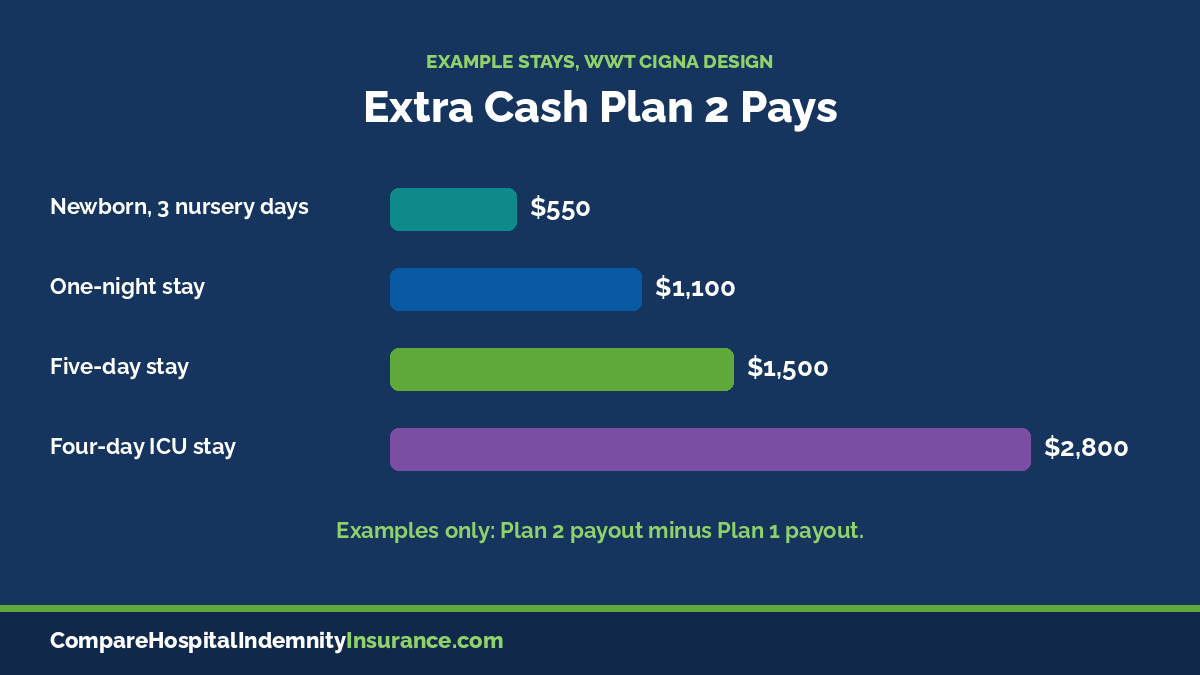
These examples use the World Wide Technology design, which has the most benefit lines.

1
A one-night stay. Plan 1: $1,000 admission plus $100 for the day, or $1,100. Plan 2: $2,200. Plan 2 adds $1,100.
2
A five-day stay. The federal Healthcare Cost and Utilization Project put the average U.S. inpatient stay at 4.6 days in 2016 (Statistical Brief 246). Rounded up to five days: Plan 1 pays $1,500 and Plan 2 pays $3,000, a $1,500 difference.
3
A four-day ICU stay. Plan 1: $1,000 admission, the $1,200 ICU day-one amount and three more ICU days at $200, or $2,800. Plan 2: $5,600, a $2,800 difference. Dartmouth’s design has no ICU day-one line.
4
A newborn’s three-day nursery stay. Plan 1: $250 nursery admission plus three days at $100, or $550. Plan 2: $1,100. This is separate from the parent’s own delivery admission.

All four are examples and assume the daily benefit pays for each day confined, including the admission day; a certificate may count days differently. When a day qualifies for both a regular stay and ICU, only the larger amount is paid.


Cigna hospital indemnity low vs high example: extra cash Plan 2 pays over Plan 1 for a nursery stay, one-night stay, five-day stay and four-day ICU stay

Break-Even Odds for Each Coverage Tier

Divide the extra yearly premium by the extra payout for a likely stay. The result is the yearly chance of a stay at which both levels cost the same on average. These use the five-day example, worth $1,500 more on Plan 2.

Break-even chance of a stay, five-day example
6.1%
WWT, employee only: $92.16 more a year
8.8%
Dartmouth, employee only: $132.48 more a year
20.7%
Dartmouth, family: $309.84 more a year
21.7%
WWT, family: $324.96 more a year

For context, the National Center for Health Statistics reported that 7.9% of people age 1 and older had at least one hospital stay in 2019, including 10.1% of those ages 55 to 64 and 2.6% of children ages 1 to 17. An ICU stay, worth $2,800 more, would drop the WWT employee-only break-even to about 3.3%. Family figures are the chance that anyone on the plan is admitted.

Known events change the math:

A planned delivery, scheduled surgery or ongoing treatment makes a stay close to certain for that year, and one admission then usually returns more than the upgrade’s yearly cost.

Russell Noga, licensed insurance agent

Enrollment-timing fact

Cigna Hospital Care summaries state that late applicants may have to provide medical evidence of insurability. The first enrollment window after becoming eligible is the point when either level is open without health questions, so a move to Plan 2 is simplest at that time.

Russell Noga, Licensed Insurance Agent

When Plan 2 Earns Its Cost and When Plan 1 Is Enough

Signs the higher Cigna level fits
  • ✔
    A baby is due, or a procedure is already on the calendar for the coming plan year.
  • ✔
    Your medical plan’s deductible and out-of-pocket maximum would be hard to pay in one month.
  • ✔
    Several people are on your Hospital Care coverage, so more than one admission a year is possible.
  • ✔
    Your summary prices Plan 2 at less than twice Plan 1, as the WWT rates do.

Plan 1 is usually enough when you cover only yourself, have no planned care and hold savings that would cover your deductible. It also makes sense when your employer pays the Plan 1 premium, as Bucknell does for some employees. Our hospital indemnity low vs high plans guide covers Aflac and Aetna menus too.

Coverage limits apply to both:

Neither level pays for an ER visit without an admission, or for hospice, custodial or rehab facility days. See what Cigna hospital indemnity covers for the full exclusion list.

Hospital Indemnity Quotes

Call a Licensed Agent Now

Unsure whether Plan 2 is worth it for your household? A licensed agent can run the numbers with you.

☎ 1-888-891-0229

No obligation to enroll

Locking In Your Level at Open Enrollment

1
Find the two columns. Look for Plan 1 and Plan 2 in the Cigna summary. Tier 1 and Tier 2 mean one plan with amounts that vary by hospital.
2
Turn rates into a yearly figure. Multiply by the deductions taken in a year: semi-monthly times 24, biweekly times 26.
3
Ask whether deductions are pre-tax. Benefits from fixed indemnity coverage paid with pre-tax dollars can count as taxable income, and Plan 2 doubles that amount.
4
Decide before the window closes. Most employers allow level changes only at open enrollment or after a qualifying life event, and Cigna summaries warn that late applicants may need medical evidence of insurability.
5
Remember the level travels with you. Both summaries let you continue 100% of your coverage when your job ends, at rates that may change, until age 100.

To see how these payroll prices compare with individual policies, read our breakdown of hospital indemnity insurance cost.

No-cost quotes

Price an Individual Hospital Plan Next to Cigna Plan 1

Compare admission and daily amounts from other insurers before enrollment ends.

Plan availability, eligibility, and benefits vary by state and policy.

Cigna Plan 1 vs Plan 2: Questions Before You Enroll

➤ Is Cigna’s Plan 2 the same as the High option in my benefits guide?

In the Cigna Hospital Care summaries reviewed here, yes. The higher-paying column is Plan 2 and the lower one Plan 1, even when an enrollment site says High and Low.

➤ Does moving up to Plan 2 add any new benefits?

Not in the two menus reviewed. Plan 2 pays twice as much on the same lines and adds no new ones, and the wellness incentive stays at $50 on both levels in the WWT summary.

➤ Will my spouse and children get the same level I choose?

Cigna summaries set spouse and dependent amounts at 100% of the employee amount, so family members follow the level you elect.

➤ Are Plan 2 payouts taxable?

It depends on how premiums are paid. IRS chief counsel guidance has treated fixed indemnity benefits as taxable income when the employer pays or premiums are pre-tax, and generally not taxable when paid after tax. Ask HR which applies.

➤ Does Plan 2 pay more for an observation stay?

The per-24-hour amount doubles from $100 to $200 in both menus; the waiting period and 72-hour cap stay the same.

➤ Does the individual Cigna-branded policy have low and high levels?

It has three options, Choice Core, Choice Preferred and Choice Premier, insured by Loyal American Life Insurance Company. Dollar amounts per option are not on the product page, so a quote is the way to compare them.

➤ Can I drop from Plan 2 to Plan 1 later?

Usually at the next open enrollment or after a qualifying life event, under your employer’s rules. Once the change takes effect, the lower Plan 1 amounts apply to any stay that begins after it.

Free Plan Check

Call a Licensed Agent Now

Compare your Cigna Plan 1 or Plan 2 benefits with individual hospital plans before you enroll.

☎ 1-888-891-0229

No obligation to enroll

Russell Noga, licensed insurance agent

About the Author: Russell Noga

Russell Noga is a licensed insurance agent and the founder of ZRN Health & Financial Services, LLC. He has helped people compare health and supplemental insurance for more than 16 years and reviews every page on Compare Hospital Indemnity Insurance before it is published. Learn more about us or read our Editorial Standards.

CompareHospitalIndemnityInsurance.com is operated by ZRN Health & Financial Services, LLC, a Texas limited liability company based in Austin, Texas. We are not connected with or endorsed by any government agency.