Speak with a licensed insurance agent

1-888-891-0229

How Does Hospital Indemnity Work for Pregnancy? A Stage-by-Stage Walkthrough

Reviewed by Russell Noga, Licensed Insurance Agent — Last updated November 12, 2026

Hospital indemnity works for pregnancy by paying you a fixed cash amount each time a pregnancy-related event matches a benefit on your schedule, most often an inpatient hospital admission and each day you stay, once any pregnancy waiting period has passed. Whether anything pays before delivery depends on whether the plan also carries outpatient or diagnostic benefits.

Expecting or planning

Map Your Pregnancy Benefits Before You Need Them

Compare plans that pay for complication stays, delivery and more.

Plan availability, eligibility, and benefits vary by state and policy.

Most guides stop at the delivery room. This one follows a pregnancy from the day coverage starts to the day your baby joins the policy, showing which benefit can fire at each step and how the money reaches you. For the overview, see our guide to hospital indemnity insurance for pregnancy, or compare hospital indemnity insurance from several companies.

Keep one fact in view: these are supplemental, limited-benefit policies. They are not health insurance and not minimum essential coverage, so they sit on top of a health plan rather than replacing it.

The mechanics in brief

A hospital indemnity policy treats pregnancy events like any other covered claim: when your situation matches a scheduled benefit, such as an admission, a hospital day or, on some plans, an office visit or test, the insurer pays you a set dollar amount, no matter what the hospital charges or your health plan pays.

Stage One: The Clock Starts on Your Effective Date

Nothing pays until the policy is in force, and for pregnancy two clocks often run from that effective date, not from the day you applied.

Pregnancy waiting period
Some contracts pay nothing for normal pregnancy or childbirth for a set stretch. The Sun Life group certificate reviewed here sets it at 10 months.
Pre-existing look-back
A pregnancy that already exists on the effective date can be treated as pre-existing and left out for that birth.
Complications carve-out
The same Sun Life certificate exempts complications of pregnancy from that wait, so an early serious problem can still pay.

Already expecting? Enrollment rules differ enough to need their own page: see hospital indemnity if you are already pregnant.

Stage Two: Prenatal Months and Which Plans Pay Before Admission

Routine prenatal care happens in an office, a lab or an imaging center. On a confinement-only plan, those months produce no claims; an Aflac HSA-compatible outline states it provides no benefits other than the fixed indemnity for a hospital stay.

  • Inpatient-only plans: office visits, ultrasounds and blood work pay nothing until an admission.
  • Plans with outpatient add-ons: some employer plans offer physician visit, lab, x-ray or diagnostic benefits that pay a flat amount per visit or test, often with a yearly cap.
  • Wellness benefits: a few plans attach a small yearly screening benefit by rider, while many daily benefits still exclude routine exams.

The HSA trade-off

Principal’s employer brochure offers physician visit, lab, x-ray and diagnostic benefits only on its non-HSA designs. Prenatal-stage cash and HSA contributions may not come in the same package.

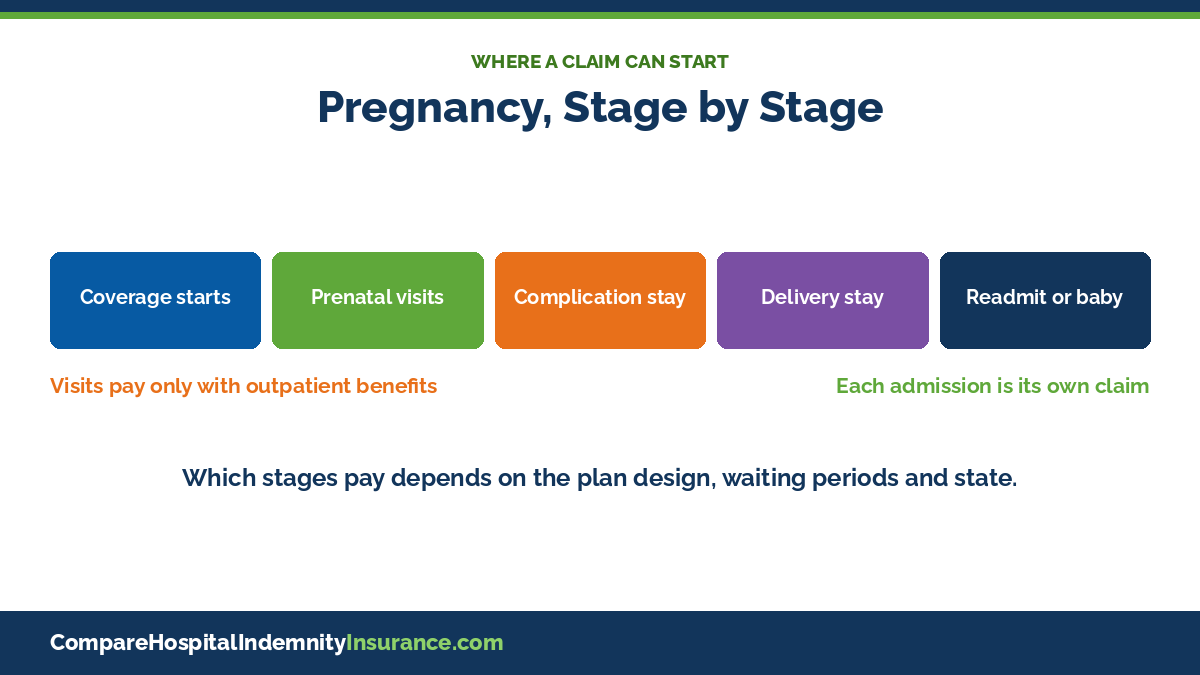
Timeline showing how hospital indemnity works for pregnancy from coverage start to prenatal care, complication stays, delivery and baby

Stage Three: Complication Stays Before the Due Date

Hospital stays before delivery are where many pregnancy claims begin. Preterm labor, severe vomiting known as hyperemesis gravidarum, and preeclampsia are common reasons a doctor keeps an expecting mother for monitoring or treatment. Each can count as its own covered confinement if the stay meets the policy’s definition.

Observation vs. inpatient: the status that decides the claim

Hospitals often place a pregnant patient in observation status first, which is billed as outpatient care even though you sleep in a hospital bed. Contracts treat that status very differently, and top search results on this topic rarely mention it.

How three filed documents treat an observation stay
  • ✔
    Sun Life group certificate: confinement means at least 20 continuous hours as a resident inpatient, and an observation stay of 19 hours or less does not pay hospital benefits.
  • ✔
    Voya (ReliaStar) certificate with an observation endorsement: confinement includes admission to a hospital observation unit for 0 hours or more.
  • ✔
    Transamerica employer plan brochure: the daily benefit excludes a stay in an observation unit or recovery room.

Check the definition of complications of pregnancy as well. The Aflac outline says premature delivery, false labor and prescribed rest during pregnancy are not complications, which matters where only complications escape the waiting period.

Pregnancy Terms in Four Insurers’ Own Documents

We lined up four carriers’ certificates and employer brochures on the points that shape a pregnancy claim. Each insurer sells several designs and employers often pick the options, so treat this as a sample of the range.

Document reviewed How pregnancy is treated Observation stays Outpatient-type benefits Baby after birth
Sun Life group certificate, form 20-HI-C-01 A sickness, including normal pregnancy and childbirth; 10-month pregnancy wait, complications exempt Not paid at 19 hours or less None; all benefits are confinement-based Automatic 31 days; enroll within 31 days to continue
Voya (ReliaStar Life) certificate RL-HI2-CERT-20-IN with endorsement RL-HI2-END-22 Sickness includes pregnancy; no pregnancy wait found in the certificate Counts as confinement from 0 hours None in the certificate; some employers add diagnostic or wellness riders Children’s rider pays a one-time newborn amount if no child coverage exists
Principal employer brochure GP63060-05 Employer picks full maternity, complications only, or full maternity after 10 months Optional, non-HSA plans only Physician visit, lab, x-ray and diagnostic options, non-HSA plans only Sample HSA plan shows one day of newborn nursery
Transamerica school district brochure, policy forms TMHI10TX and TCHI10TX No pre-existing limits; a dependent child’s pregnancy excluded except complications Excluded from the daily benefit Routine exams excluded; wellness rider form listed Routine newborn stay excluded unless the baby is sick or injured

Source: each carrier’s own certificate or employer brochure, reviewed November 2026. Terms vary by employer, state and policy form, and your certificate controls.

Russell Noga, licensed insurance agent

Paperwork pointer

Hospital records for a pregnancy stay often list the status as observation, inpatient or a change between the two. Before discharge, ask for the date and time the status changed to inpatient, since contracts that count confinement in continuous hours measure from that point.

Russell Noga, Licensed Insurance Agent

Stage Four: Delivery, Readmission and Your Baby’s Coverage

The delivery is the claim most people picture: an admission benefit plus a daily benefit for each covered day. Length of stay, C-section rules and birth claim paperwork are covered in our guide on whether hospital indemnity covers childbirth, so this stage looks at what surrounds it.

1
A transfer is one stay. Moving from an antepartum unit to labor and delivery without going home is usually one continuous confinement, so a once-per-confinement benefit pays once.
2
A readmission is a new stay. An infection, bleeding or blood pressure problem that brings you back after discharge starts a new confinement, subject to any yearly admission limit.
3
The baby is a separate person. A newborn’s own claims depend on child coverage and the automatic newborn window.
4
Add the baby in writing. Missing the deadline can leave a later NICU readmission unpaid.

Watch the benefit-year language. The Sun Life certificate pays its first-day benefit once per continuous confinement and counts benefits per calendar year, so a March complication stay and a June delivery share one year’s limits.


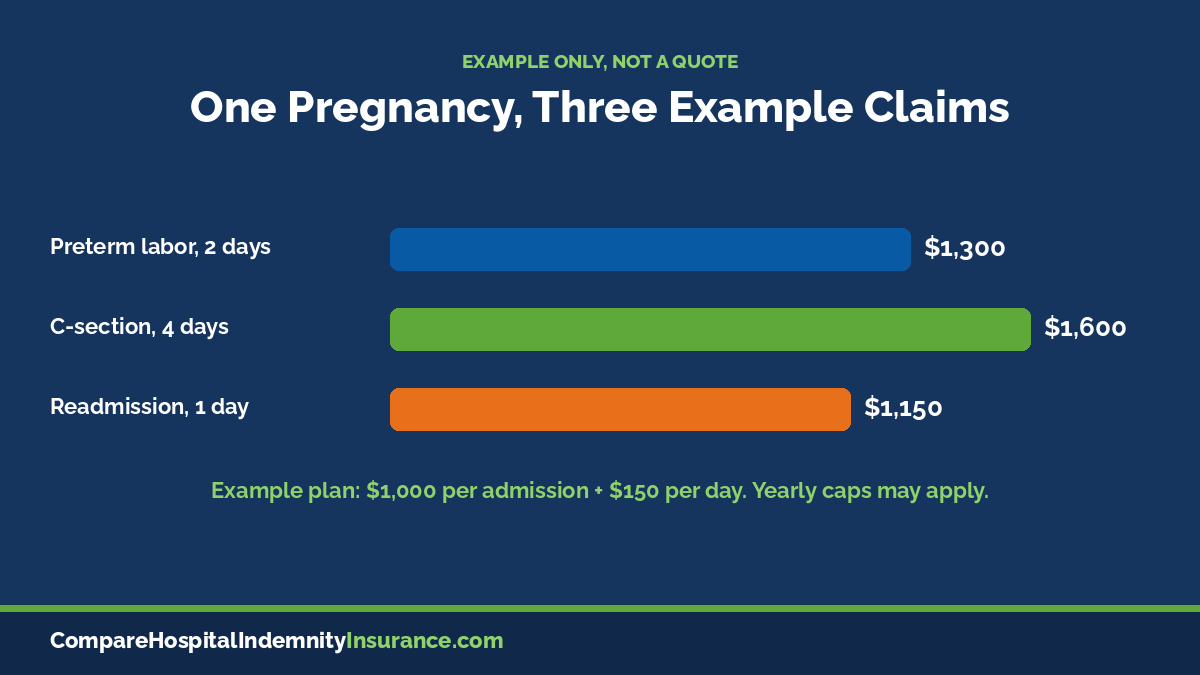
Example bar chart of how hospital indemnity works for pregnancy across three separate hospital stays in one year

Hospital Indemnity Quotes

Call a Licensed Agent Now

A licensed agent can compare pregnancy waiting periods, observation rules and newborn terms for you.

☎ 1-888-891-0229

No obligation to enroll

Per Admission, Per Day, Per Occurrence in Pregnancy Terms

Benefit schedules use a few counting words. Read against a pregnancy timeline, they show where a payout grows and where it stops.

Schedule wording What it counts How it plays out in a pregnancy
Per admission Each separate inpatient admission, often capped per year A preeclampsia admission and a later delivery can each pay if the yearly cap allows
Per day Each day confined, up to a stated maximum A longer C-section recovery or antepartum monitoring adds days
Per occurrence or per visit Each qualifying event, such as an office visit or test Only on plans with outpatient benefits; routine prenatal visits may be excluded
Per confinement One continuous stay, however many units it spans A move from triage to delivery inside one stay counts once

Where the Money Goes: You, the Hospital and Your HSA

Hospital indemnity pays the policyholder, not the hospital. The Voya certificate says benefits are payable to you unless otherwise specified, and the Voya and Sun Life certificates both bar assignment. Where assignment to a provider is allowed, it is your choice. The cash can go toward a deductible, rent or child care.

Peterson-KFF, large employer plans
$18,865
average added health spending for people who give birth
$2,854
average added out-of-pocket cost

Those Peterson-KFF figures come from 2018 to 2020 claims in large employer health plans and cover pregnancy, childbirth and postpartum care. The indemnity check and your health plan pay separately, and neither reduces the other. You still owe your deductible and coinsurance up to the out-of-pocket maximum; the cash helps pay them. For the general claim flow, see how hospital indemnity insurance works.

The HSA rule in the tax code

Federal tax law, 26 U.S.C. 223(c)(3), lists insurance paying a fixed amount per day or other period of hospitalization as permitted insurance, so a plan that pays only for hospital days can sit next to a health savings account. Office visit or test benefits are where HSA problems tend to arise.

Disclosure update

A 2024 federal rule would have added a new not-health-insurance notice to workplace fixed indemnity plans from 2025. A federal court in Texas vacated it in December 2024 and the appeal was dismissed in June 2025, so group plans currently carry no such federal notice. Individual policies still carry the older one.

No-cost comparison

See Which Plans Pay Beyond the Delivery Room

Look at outpatient options, observation rules and newborn terms side by side.

Plan availability, eligibility, and benefits vary by state and policy.

Pregnancy and Hospital Indemnity: Questions Readers Ask

➤ Can you use hospital indemnity for childbirth?

Yes, on most plans that include maternity, a hospital delivery is a covered admission once any pregnancy waiting period has passed and the pregnancy began after the effective date. Some individual policies pay only for complications.

➤ Can hospital indemnity be used for childbirth and prenatal visits on the same plan?

Only if the plan has outpatient benefits. A confinement-only plan pays for the delivery stay but nothing for routine checkups, and visit benefits often come only on non-HSA designs.

➤ Should I get hospital indemnity insurance for pregnancy?

It tends to make sense when you can enroll well before conception, the plan pays for normal childbirth, and your health plan leaves a large deductible. If you are already pregnant or routine birth is excluded, it may pay little for this baby.

➤ Does a hospital stay for preterm labor use up my delivery benefit?

Not by itself. A stay that ends with you going home is one confinement and the delivery is another, though yearly admission caps apply to both.

➤ Will my health insurance pay less because I have hospital indemnity?

No. Your health plan applies its own deductible and coinsurance, and the indemnity policy pays its fixed amounts to you.

➤ Can I keep contributing to my HSA if I buy hospital indemnity?

Generally yes, if the plan pays a fixed amount per day of hospitalization, which the tax code treats as permitted insurance. Ask whether the design is labeled HSA-compatible.

➤ Does a readmission after delivery pay a new admission benefit?

Often yes, because going home and returning starts a new confinement. Check how many admissions the policy pays per year.

Pregnancy Plan Review

Call a Licensed Agent Now

Find out which benefits on a plan could pay at each stage of a pregnancy.

☎ 1-888-891-0229

No obligation to enroll

Russell Noga, licensed insurance agent

About the Author: Russell Noga

Russell Noga is a licensed insurance agent and the founder of ZRN Health & Financial Services, LLC. He has helped people compare health and supplemental insurance for more than 16 years and reviews every page on Compare Hospital Indemnity Insurance before it is published. Learn more about us or read our Editorial Standards.

CompareHospitalIndemnityInsurance.com is operated by ZRN Health & Financial Services, LLC, a Texas limited liability company based in Austin, Texas. We are not connected with or endorsed by any government agency.