Both are supplemental, limited-benefit policies. Neither pays your doctor or hospital, neither replaces a major medical plan, and neither counts as minimum essential coverage under federal law. Because different events trigger them, the cash arrives at different times and in very different amounts.
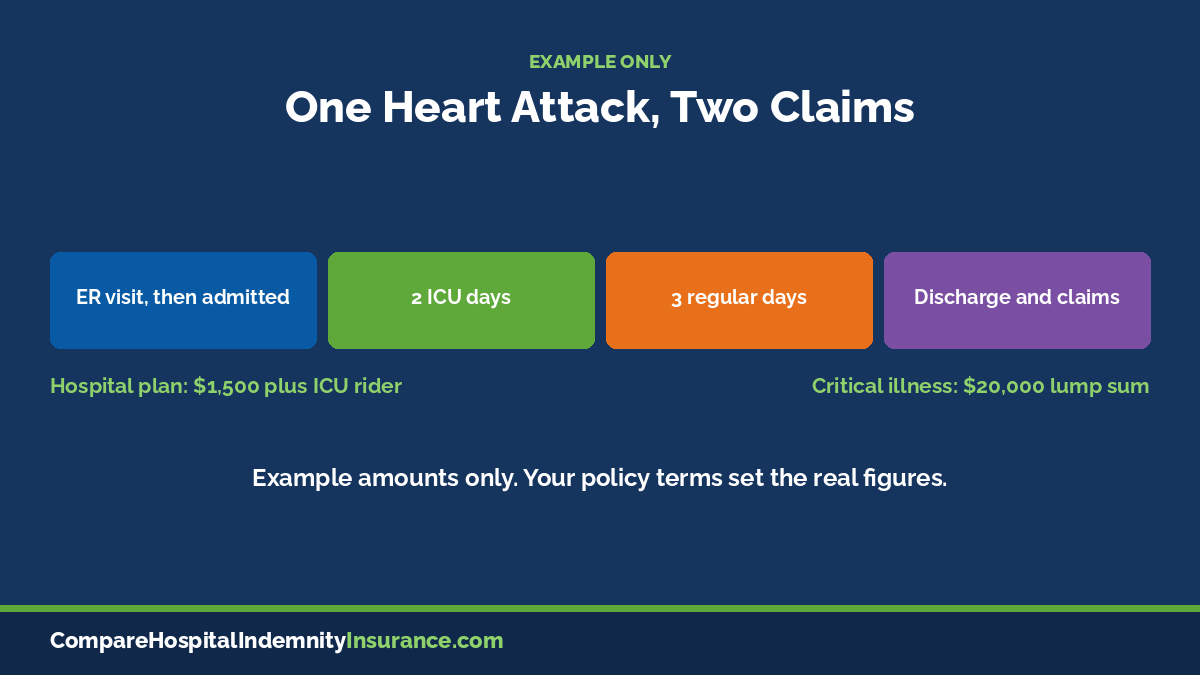
Below, the contract terms from four carrier documents sit side by side, and one hospitalized heart attack runs through both policies. If you are still asking is hospital indemnity insurance worth it, start there, and when you want prices you can compare hospital indemnity insurance plans sold in your state.
Bottom line first
Hospital indemnity pays for being in the hospital, from almost any covered illness or injury. Critical illness pays for being diagnosed with one of a short list of serious conditions, in a single larger check.
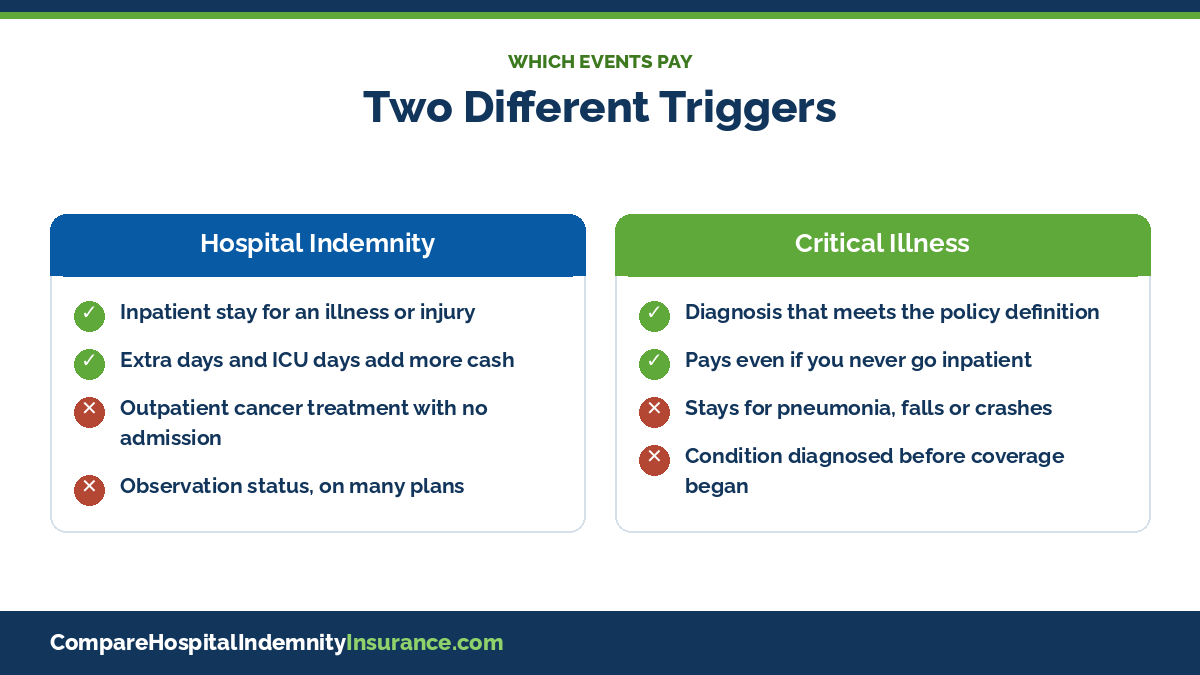
Admission Versus Diagnosis: What Sets Off Each Payment
These two products do not even look at the same thing. A hospital indemnity insurer asks whether you were formally admitted as an inpatient. A critical illness insurer asks whether your diagnosis matches the medical definition written in the policy.
What starts the claim
Hospital indemnity: an inpatient admission. Critical illness: a qualifying diagnosis, even if you are treated as an outpatient.
Shape of the payment
Hospital indemnity: a set amount per admission plus a set amount per day. Critical illness: one lump sum, sometimes a partial percentage.
What changes the amount
Hospital indemnity: how long you stay and whether you land in intensive care. Critical illness: which condition you have and the benefit amount you chose.
So a long stay for pneumonia can produce a sizable hospital claim and nothing from critical illness coverage, while an early cancer treated with outpatient surgery and infusions can do the reverse.
Our Side-by-Side Read of Four Carrier Documents
Carrier explainers describe each product in general terms. This table pulls the working rules from two individual outlines of coverage and two employer plan summaries.
| Contract term |
Aflac individual CI (GA outline) |
MetLife group CI (one employer) |
Aflac individual HI (TX outline) |
MetLife group HI (one employer) |
| Trigger |
Diagnosis of a listed event, such as heart attack, stroke or internal cancer |
Diagnosis of a listed condition across several categories |
Hospital confinement of 23 hours or more; ER time does not count |
Inpatient admission and each day confined |
| Main benefit |
Face amount on the policy schedule; spouse and child at 50% |
Employee picks $10,000 to $50,000 |
$500 to $5,000 confinement benefit once per calendar year; rider adds $100 a day |
$1,000 admission plus $100 a day, up to 365 days a year |
| Intensive care |
Not a feature |
Not a feature |
Rider pays $500 a day, up to 30 days |
Extra $1,000 at ICU admission plus $100 a day, up to 90 days |
| Paying again |
Later event pays 50% of face; cancer recurrence needs 12 months in a row free of treatment |
Recurrence pays 100% for listed conditions; cancer needs 365 days free of treatment or symptoms |
Confinement benefit limited to once per calendar year |
No new admission benefit for a readmission for the same or related cause within 90 days |
| Prior conditions |
Not covered if treated in the 12 months before coverage, unless the loss starts more than 12 months after |
No benefit for a condition diagnosed before the effective date |
Same 12-month lookback and 12-month limit; 6 months if issued at 65 or older |
A limitation may apply; details not in the summary |
| Early waiting rule |
Internal cancer diagnosed in the first 30 days never pays |
Waiting periods may apply |
30-day waiting period for sickness |
Not stated in the summary |
Source: Aflac outlines of coverage for form series B71100 (Georgia) and B40100 (Texas), a MetLife critical illness page for one employer group, and a MetLife hospital indemnity summary for one university employer, checked November 2026. Amounts and rules vary by state, employer and plan version.
Pattern to notice
Critical illness documents spend their fine print on repeat diagnoses and treatment-free gaps. Hospital indemnity documents spend it on how often an admission can pay and what counts as a stay.