Speak with a licensed insurance agent

1-888-891-0229

Hospital Indemnity Insurance Plans: Types, Benefits and Costs

Reviewed by Russell Noga, Licensed Insurance Agent — Last updated October 30, 2026

Every hospital indemnity plan does the same basic job: it pays you a fixed cash benefit when you are admitted to the hospital. Beyond that, plans differ a lot. Some are sold through employers and some directly to you. Some pay $100 a day and some pay $500. Some cover only inpatient stays, while others add emergency room visits, outpatient surgery and ambulance rides.

Compare Hospital Indemnity Plans in Your Area

Enter your ZIP code to see plan options and monthly rates.

Plan availability, eligibility, and benefits vary by state and policy.

This guide breaks down the main types of hospital indemnity insurance plans, how benefits are structured, what drives the price and how to pick a benefit level that actually fits your health coverage. You can also compare hospital indemnity insurance plans side by side with our licensed agents.

The Four Types of Hospital Indemnity Plans

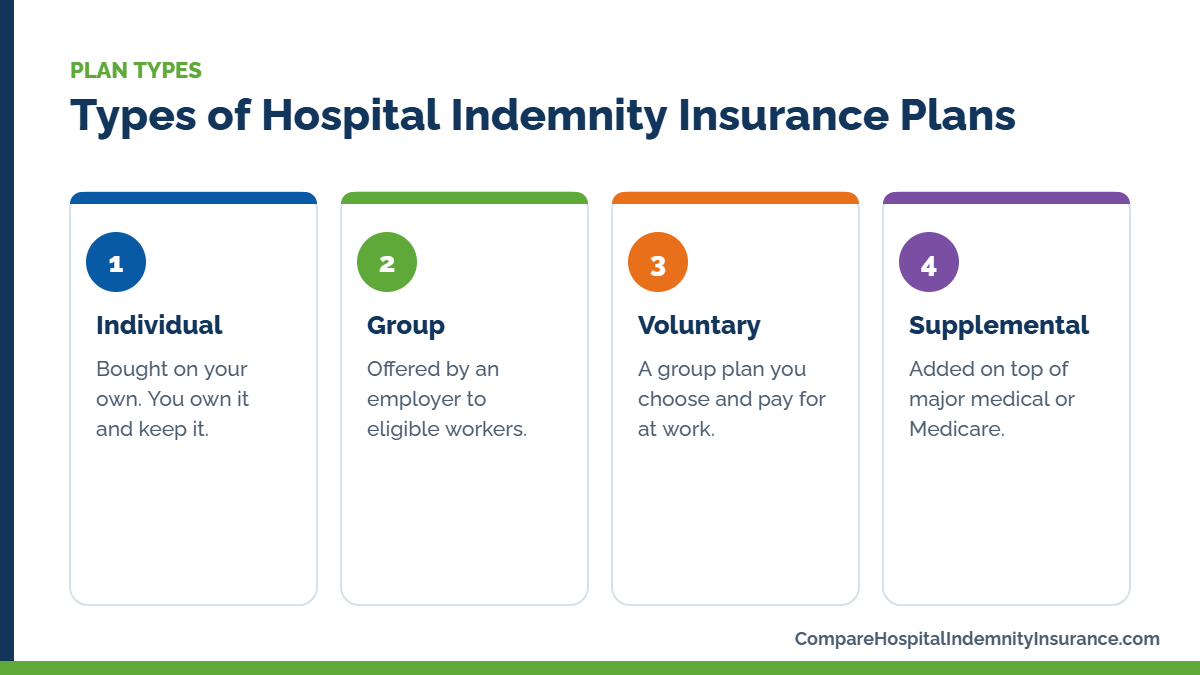
Four types of hospital indemnity insurance plans: individual, group, voluntary and supplemental

Individual hospital indemnity insurance

Individual plans are sold to adults of all ages through licensed agents. You usually answer a short set of health questions, the premium is drafted from your bank account or card, and the policy is yours no matter where you work. Individual plans are popular with self-employed people, early retirees, ACA Marketplace members and people on Medicare Advantage.

Group hospital indemnity insurance

Employers offer group plans as part of a benefits package. Because the insurance company is covering a whole group, these plans are often guaranteed issue during open enrollment, meaning no health questions. Some employers pay part of the premium.

Voluntary hospital indemnity insurance

Voluntary coverage is a group plan the employee chooses and pays for through payroll deduction. It is the most common way people get hospital indemnity insurance today. Some voluntary plans are portable, so you can keep them, sometimes at a different rate, if you leave the job.

Supplemental hospital insurance

“Supplemental hospital insurance” is less a separate product than a description. It is hospital indemnity coverage bought to supplement major medical insurance or Medicare, and you will see it used on both individual and group plans.

How Plan Benefits Are Built

Benefit What it pays Why it matters
Admission benefit A lump sum when you are admitted Covers a large share of your deductible right away
Daily confinement benefit A set amount per inpatient day Helps with daily copays and longer stays
ICU benefit A higher or extra daily amount in intensive care Serious stays cost more
Maximum days Days covered per stay or per year Short limits can leave long stays uncovered
Riders Outpatient surgery, ER, ambulance or skilled nursing Extends coverage beyond inpatient stays
Russell Noga, licensed insurance agent

Sizing the benefit

A practical starting point is the health plan’s own deductible and coinsurance. Pick an admission and daily benefit that would roughly cover those costs for a typical three- to four-day stay. A daily benefit far larger than the out-of-pocket exposure adds premium without adding much protection.

Russell Noga, Licensed Insurance Agent

Low vs. High Hospital Indemnity Plans

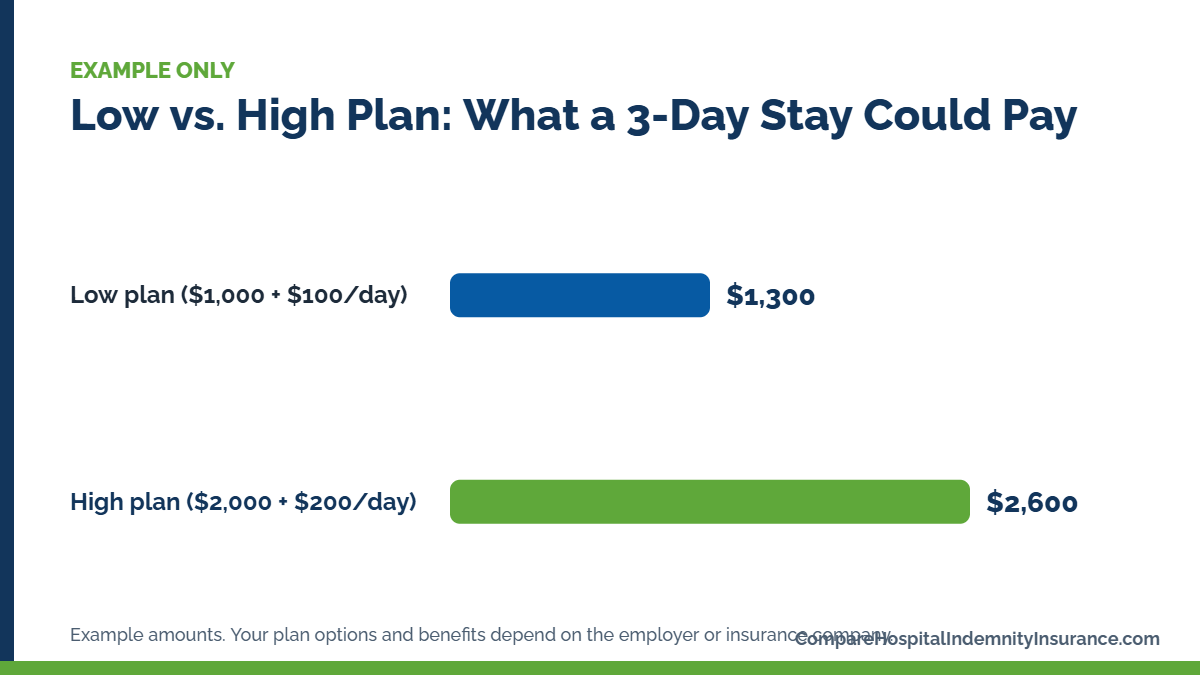
Many employer plans offer two options, usually called Low and High. Both cover the same events. The High plan simply pays larger benefits for a higher premium.


Example comparison of a low and high hospital indemnity plan payout for a 3-day hospital stay
Low plan example High plan example
Admission benefit $1,000 $2,000
Daily benefit $100 $200
3-day stay pays $1,300 $2,600
Monthly premium Lower Higher
Best for Lower deductibles or tight budgets High deductibles or more financial risk

Pick the option whose payout for a typical stay comes closest to your health plan’s out-of-pocket cost without going far over it.

Hospital Indemnity Plan Quotes
Call a Licensed Agent Now
We will match a benefit level to your deductible and budget.
No obligation to enroll

How Much Do Hospital Indemnity Plans Cost?

Premiums depend on the plan and on you. Group plans are often priced the same for everyone in an age band, while individual plans are priced on your own details. The biggest drivers are the benefit amounts you choose and your age.

What affects the premium
  • ✔
    Your age and state
  • ✔
    The admission and daily benefit amounts
  • ✔
    How many days per stay the plan covers
  • ✔
    Riders such as outpatient surgery, ER or ambulance
  • ✔
    Whether you add a spouse or children
  • ✔
    Tobacco use on individual plans

To weigh the premium against what the plan pays, read is hospital indemnity insurance worth it.

Matching a Plan to Your Health Coverage

Your main coverage How a hospital indemnity plan helps
High-deductible employer plan Cash to cover the deductible after an admission
ACA Marketplace plan Helps with high out-of-pocket limits on Bronze and Silver plans
Medicare Advantage A daily benefit can be matched to daily hospital copays
Original Medicare Helps with the Part A deductible and other costs
Medicare Supplement Extra cash for non-medical costs during recovery

Riders Worth Considering

  • Outpatient surgery rider: pays a set amount per covered procedure, useful if your plan has high outpatient coinsurance.
  • Emergency room rider: pays for a covered ER visit even if you go home the same day.
  • Ambulance rider: pays for covered ground or air ambulance transport.
  • Skilled nursing rider: pays a daily amount for a stay in a skilled nursing facility after a hospital stay.

Add a rider only if it fills a real gap in your health plan. Each one adds to the premium.

How to Choose the Right Plan

1
Find your out-of-pocket gap. Look up your deductible, coinsurance, daily hospital copay and out-of-pocket maximum.
2
Match the benefit to the gap. Choose admission and daily amounts that cover most of a typical stay.
3
Compare waiting periods. Check illness, pre-existing condition and pregnancy waiting periods.
4
Decide on riders. Add only the riders that cover real gaps.
5
Compare companies. Get quotes from several of the best hospital indemnity insurance companies.

Planning a baby? Waiting periods matter more than price; see hospital indemnity insurance for pregnancy. Compare providers in our list of the best hospital indemnity insurance companies, see exactly what plans pay in hospital indemnity insurance coverage, or start with what is hospital indemnity insurance.

Related guide: supplemental hospital insurance Plan designs, four filed policies side by side, and who this extra cash coverage helps most.

Related guide: voluntary hospital indemnity insurance How workplace plans work: low vs high options, payroll deduction, taxes and portability.

Related guide: hospital indemnity low vs high plans How to choose between a Low and a High workplace option, with three real employer menus side by side and upgrade math.

Related guide: hospital indemnity insurance New York rules and carriers New York DFS rules for hospital indemnity, the New York company each carrier uses and how plans fit next to NY State of Health.

Related guide: can you have more than one hospital indemnity plan How a work plan and an individual policy can both pay for one stay, the limits that exist, and when stacking is worth it.

Related guide: hospital indemnity insurance Washington rules, plans and rates Washington’s required disclosure form, the WAC 31-day standard, filed WA plans side by side and published premiums.

Compare options

Find the Right Plan for Your Budget

See low and high benefit options from several companies near you.

Plan availability, eligibility, and benefits vary by state and policy.

Hospital Indemnity Plan FAQs

➤ What are the different types of hospital indemnity insurance plans?

The main types are individual plans you buy on your own and group or voluntary plans offered through an employer. Both pay a fixed cash benefit for covered hospital stays.

➤ What is the difference between a low and high hospital indemnity plan?

A high plan pays larger admission and daily benefits than a low plan and costs more each month. Both cover the same types of hospital stays.

➤ Can I buy a hospital indemnity plan on my own?

Yes. Individual plans are sold through licensed agents in most states, usually with a short set of health questions.

➤ What is voluntary hospital indemnity insurance?

It is a group hospital indemnity plan offered by an employer that the employee chooses and pays for, usually through payroll deduction.

➤ Can I have more than one hospital indemnity plan?

In many cases, yes. Hospital indemnity plans pay regardless of other coverage, though some policies limit total benefits, so check the terms.

➤ How do I choose a daily benefit amount?

Look at what your health plan would leave you to pay for a typical hospital stay and choose an amount that covers most of that cost within your budget.

➤ Do hospital indemnity plans cover spouses and children?

Most plans let you add a spouse and dependent children for an additional premium.

Hospital Indemnity Plan Quotes
Call a Licensed Agent Now
Tell us about your health plan and we will match you with the right benefit level.
No obligation to enroll
Russell Noga, licensed insurance agent
About the Author: Russell Noga
Russell Noga is a licensed insurance agent and the founder of ZRN Health & Financial Services, LLC. He has helped people compare health and supplemental insurance for more than 16 years and reviews every page on Compare Hospital Indemnity Insurance before it is published. Learn more about us or read our Editorial Standards.
CompareHospitalIndemnityInsurance.com is operated by ZRN Health & Financial Services, LLC, a Texas limited liability company based in Austin, Texas. We are not connected with or endorsed by any government agency.